Gear & Tone Talk: Jazz
TrueFire's Jazz Artists Share Priceless Gear & Tone Insight
Get this course and 1,000+ more with All Access
Try 7 days free. Cancel any time.

TrueFire
Educator
Genres
About this course
Learning how to dial in the elusive “perfect tone” is a journey that never ends for we guitarists. Understanding how our instruments and settings impact sound is requisite for dialing in the optimal tone for the genres you dig and expressing your own artistic identity.
Each edition of TrueFire’s Gear & Tone Talk series is a genre-specific compilation of gear and tone video segments from top TrueFire artists’s courses. They’ll rundown their rig and talk about how they “dial in” their own tone for the performances in their courses.
In this Jazz edition, you’ll absorb solid gear and tone insights from 6 TrueFire artists: Frank Vignola, Adam Levy, Tom Dempsey, Mark Whitfield, Tim Lerch and Sean McGowan
You’ll have all of TrueFire’s learning tools at your finger tips to personalize your workspace and reference the videos at your own pace. You can loop, slow down, or speed up any section of a lesson.
Plug in and let’s dial in our jazz tone!
Each edition of TrueFire’s Gear & Tone Talk series is a genre-specific compilation of gear and tone video segments from top TrueFire artists’s courses. They’ll rundown their rig and talk about how they “dial in” their own tone for the performances in their courses.
In this Jazz edition, you’ll absorb solid gear and tone insights from 6 TrueFire artists: Frank Vignola, Adam Levy, Tom Dempsey, Mark Whitfield, Tim Lerch and Sean McGowan
You’ll have all of TrueFire’s learning tools at your finger tips to personalize your workspace and reference the videos at your own pace. You can loop, slow down, or speed up any section of a lesson.
Plug in and let’s dial in our jazz tone!
Release date: 04/01/2023 • 1h 05m runtime
Sample lessons
Gear & Tone Talk with Tim Lerch
From Solo Jazz Pathways: Chordal Improv
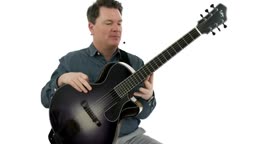
Gear & Tone Talk with Sean McGowan
From Modern Jazz Palettes: Improv Edition
What's included
11 lessons
Gear & Tone is a video guitar lesson presented by Jason Loughlin and is sourced from 30 Country Jazz Licks You MUST Know
Country jazz started in the early toddler years of the electric guitar. Everything from big archtops to telecasters are used in the genre, with no one guitar that defines the style. There are some very cool guitars associated with this style however: Players like Billy Byrd and Grady Martin were among the first to play Paul Bigsby’s solid body electric guitar, of which there were 23 made and 23 accounted for. Really beautiful instruments. There's also the Bigsby inspired Jim Harvey guitars like the double neck that Paul Buskirk played. Modern guitar builders like TK Smith are reviving these designs with the same level of artistry.
The sound is all about a clean guitar tone. Players like Jimmy Bryant were rumored to go directly into the board at times. Most reverbs were added after the amp signal. Plate reverb or spring would be added to the whole band. Sometimes players would use the amp's built-in spring tank. Remember, early amplifiers did not have built-in spring reverb. The first effect added to amps was tremolo, which you'll hear occasionally. The most common effect at the time was slapback echo, with one quick repeat at or around the same volume as the initial attack used by players such as Les Paul and Chet Atkins. Both were always experimenting with new sounds. Les also utilized the double-speed guitar trick by recording at half speed and then playing back at the correct speed, and Chet was arguably the first to use a wah wah pedal by putting a passive tone knob into a pedal. You can hear one of the first examples of this on Chet’s “Boo Boo Stick Beat” from the Teensville record.
Country jazz started in the early toddler years of the electric guitar. Everything from big archtops to telecasters are used in the genre, with no one guitar that defines the style. There are some very cool guitars associated with this style however: Players like Billy Byrd and Grady Martin were among the first to play Paul Bigsby’s solid body electric guitar, of which there were 23 made and 23 accounted for. Really beautiful instruments. There's also the Bigsby inspired Jim Harvey guitars like the double neck that Paul Buskirk played. Modern guitar builders like TK Smith are reviving these designs with the same level of artistry.
The sound is all about a clean guitar tone. Players like Jimmy Bryant were rumored to go directly into the board at times. Most reverbs were added after the amp signal. Plate reverb or spring would be added to the whole band. Sometimes players would use the amp's built-in spring tank. Remember, early amplifiers did not have built-in spring reverb. The first effect added to amps was tremolo, which you'll hear occasionally. The most common effect at the time was slapback echo, with one quick repeat at or around the same volume as the initial attack used by players such as Les Paul and Chet Atkins. Both were always experimenting with new sounds. Les also utilized the double-speed guitar trick by recording at half speed and then playing back at the correct speed, and Chet was arguably the first to use a wah wah pedal by putting a passive tone knob into a pedal. You can hear one of the first examples of this on Chet’s “Boo Boo Stick Beat” from the Teensville record.
Getting the Sound is a video guitar lesson presented by Frank Vignola and is sourced from Take 5: Jazz Chord Tone Soloing
In this segment, I discuss tone and gear as well as some important tips.
In this segment, I discuss tone and gear as well as some important tips.
Getting the Sound is a video guitar lesson presented by Frank Vignola and is sourced from Take 5: Jazz Chord Colors
In this segment, I talk about the gear I'm using for this course, the gear I use on stage and how I approach getting my sound.
In this segment, I talk about the gear I'm using for this course, the gear I use on stage and how I approach getting my sound.
Folk Jazz Sonic Approaches is a video guitar lesson presented by Adam Levy and is sourced from Trading Solos: Folk Jazz
For playing folk jazz, the signal chain can be kept pretty simple. Generally, the more organic the tone, the better. I've got just six stomp boxes (plus a power supply) on my board. In sequential order: tuner, compressor, booster/EQ, overdrive, tremolo, and delay.
For playing folk jazz, the signal chain can be kept pretty simple. Generally, the more organic the tone, the better. I've got just six stomp boxes (plus a power supply) on my board. In sequential order: tuner, compressor, booster/EQ, overdrive, tremolo, and delay.
Gear & Tone Tips is a video guitar lesson presented by Tom Dempsey and is sourced from 30 Jazz Progressions You MUST Know
So let me talk to you about some of the things that I use to get the sound that I have. This guitar I have been playing for about four or five years. This is an Eastman Jazz 16. It's my understanding that this is not one that they make commercially produced. This is one that was built for a guitar shop in New Jersey. It's basically become my travel hollowbody guitar. As we all know, airplanes are not always so kind to musicians. So I need to find something that I can travel with that would work on the gig and I wouldn't have to worry so much about. It's very similar to my main guitar which is a Gibson L5 in the sense that it is the same scale. The difference is that the body is a little thinner. And the width of it is a bit more narrow. It's a little more compact which for traveling makes it easier.
I modified some things to this guitar. Originally it came with a Lollar pickup. I changed it to a Seth Lover pickup which is closer to the pickup in my L5. I also replaced all the frets in it because I discovered something about frets that depending on where the metal for the frets is produced, that can affect your sound. The metal in the original frets was from Asia. That has a different sound than the metal that is made in the United States. I replaced it with all new frets and got it working the way I like it.
I've been playing Thomastik-Infeld Swing Series strings for a long time. These are .012s that are on here. Medium gauge jazz guitar strings. I'm an endorsee for Thomastik and I really love their strings. One of the things I like the most is that while I have the thickness I want, they don't have as much tension as some other strings which makes them easy to play.
This pick that I'm using is a Blue Chip pick. I've recently been using Blue Chip picks over the last eight months or so. This specific one is a Blue Chip Jazz 35. It's very small. The way that I pick is a lot different than the conventional way of picking. Most people will pick flat on. I pick on the side of the pick. It gives me a much more focused and rounder sound.
Let's talk about the pedals that I'm using. For most of my career I haven't been much of a pedal person but recently I've been experimenting with some pedals. The ones that I'm using right now are the Flint Tremolo/Reverb. I'm just using the reverb portion of the pedal. It gets a really nice reverb sound. One of the best that I have heard out of a pedal. I've also been recently experimenting with this Giggity pedal. I believe they call it an analog mastering pedal. Basically it helps to give a bit more air to the quality of the sound. It really kind of enhances the sound and I do notice a difference. It's almost like an EQ pedal but it makes the sound more present.
The amp that I'm playing through for this session is this Fender Super Reverb amp. I've always been a fan of Fender Tube Amps. I play a Deluxe Reverb a lot on gigs. I often ask for Fender amps when I'm on the road. But I'm also a fan of a couple of solid state amps. I really like the Quilter amps. I use them a lot on gigs. For many years my solid state set up had been an Acoustic Image 1R head with Raezer's Edge cabinets. One of the things I've discovered about speaker cabinets is that when I got ready to change to the Raezer's Edge I approached A-B ing the amps the same way I looked at buying my first good quality stereo system. I really started to listen to the speakers. And I tried to get an understanding of what speaker sound I really liked. Then I added the amp. It's a really good way to hone in on what you like about your sound. Your sound can be impacted more by the speaker than the actual amp. That's essentially what I'm using. Some gigs I use more. Some I use less. But for this session and my general traveling rig, this is what it is.
So let me talk to you about some of the things that I use to get the sound that I have. This guitar I have been playing for about four or five years. This is an Eastman Jazz 16. It's my understanding that this is not one that they make commercially produced. This is one that was built for a guitar shop in New Jersey. It's basically become my travel hollowbody guitar. As we all know, airplanes are not always so kind to musicians. So I need to find something that I can travel with that would work on the gig and I wouldn't have to worry so much about. It's very similar to my main guitar which is a Gibson L5 in the sense that it is the same scale. The difference is that the body is a little thinner. And the width of it is a bit more narrow. It's a little more compact which for traveling makes it easier.
I modified some things to this guitar. Originally it came with a Lollar pickup. I changed it to a Seth Lover pickup which is closer to the pickup in my L5. I also replaced all the frets in it because I discovered something about frets that depending on where the metal for the frets is produced, that can affect your sound. The metal in the original frets was from Asia. That has a different sound than the metal that is made in the United States. I replaced it with all new frets and got it working the way I like it.
I've been playing Thomastik-Infeld Swing Series strings for a long time. These are .012s that are on here. Medium gauge jazz guitar strings. I'm an endorsee for Thomastik and I really love their strings. One of the things I like the most is that while I have the thickness I want, they don't have as much tension as some other strings which makes them easy to play.
This pick that I'm using is a Blue Chip pick. I've recently been using Blue Chip picks over the last eight months or so. This specific one is a Blue Chip Jazz 35. It's very small. The way that I pick is a lot different than the conventional way of picking. Most people will pick flat on. I pick on the side of the pick. It gives me a much more focused and rounder sound.
Let's talk about the pedals that I'm using. For most of my career I haven't been much of a pedal person but recently I've been experimenting with some pedals. The ones that I'm using right now are the Flint Tremolo/Reverb. I'm just using the reverb portion of the pedal. It gets a really nice reverb sound. One of the best that I have heard out of a pedal. I've also been recently experimenting with this Giggity pedal. I believe they call it an analog mastering pedal. Basically it helps to give a bit more air to the quality of the sound. It really kind of enhances the sound and I do notice a difference. It's almost like an EQ pedal but it makes the sound more present.
The amp that I'm playing through for this session is this Fender Super Reverb amp. I've always been a fan of Fender Tube Amps. I play a Deluxe Reverb a lot on gigs. I often ask for Fender amps when I'm on the road. But I'm also a fan of a couple of solid state amps. I really like the Quilter amps. I use them a lot on gigs. For many years my solid state set up had been an Acoustic Image 1R head with Raezer's Edge cabinets. One of the things I've discovered about speaker cabinets is that when I got ready to change to the Raezer's Edge I approached A-B ing the amps the same way I looked at buying my first good quality stereo system. I really started to listen to the speakers. And I tried to get an understanding of what speaker sound I really liked. Then I added the amp. It's a really good way to hone in on what you like about your sound. Your sound can be impacted more by the speaker than the actual amp. That's essentially what I'm using. Some gigs I use more. Some I use less. But for this session and my general traveling rig, this is what it is.
Sonic Considerations is a video guitar lesson presented by Mark Whitfield and is sourced from The Soul of Jazz
Here I talk about the challenges we all face in achieving a tone we can be proud of, and the way I conquered this particular struggle both with my right and left hand technique. I'll also run down the gear I've grown to love and used on this course!
Here I talk about the challenges we all face in achieving a tone we can be proud of, and the way I conquered this particular struggle both with my right and left hand technique. I'll also run down the gear I've grown to love and used on this course!
Gear & Tone Tips is a video guitar lesson presented by Tom Dempsey and is sourced from Jazz Guitar Comping Playbook
So let me talk to you about some of the things that I use to get the sound that I have. This guitar I have been playing for about four or five years. This is an Eastman Jazz 16. It's my understanding that this is not one that they make commercially produced. This is one that was built for a guitar shop in New Jersey. It's basically become my travel hollowbody guitar. As we all know, airplanes are not always so kind to musicians. So I need to find something that I can travel with that would work on the gig and I wouldn't have to worry so much about. It's very similar to my main guitar which is a Gibson L5 in the sense that it is the same scale. The difference is that the body is a little thinner. And the width of it is a bit more narrow. It's a little more compact which for traveling makes it easier.
I modified some things to this guitar. Originally it came with a Lollar pickup. I changed it to a Seth Lover pickup which is closer to the pickup in my L5. I also replaced all the frets in it because I discovered something about frets that depending on where the metal for the frets is produced, that can affect your sound. The metal in the original frets was from Asia. That has a different sound than the metal that is made in the United States. I replaced it with all new frets and got it working the way I like it. I've been playing Thomastik-Infeld Swing Series strings for a long time. These are .012s that are on here. Medium gauge jazz guitar strings. I'm an endorsee for Thomastik and I really love their strings. One of the things I like the most is that while I have the thickness I want, they don't have as much tension as some other strings which makes them easy to play. This pick that I'm using is a Blue Chip pick. I've recently been using Blue Chip picks over the last eight months or so. This specific one is a Blue Chip Jazz 35. It's very small. The way that I pick is a lot different than the conventional way of picking. Most people will pick flat on. I pick on the side of the pick. It gives me a much more focused and rounder sound. The amp that I'm playing through for this session is this Fender Super Reverb amp. I've always been a fan of Fender Tube Amps. I play a Deluxe Reverb a lot on gigs. I often ask for Fender amps when I'm on the road. But I'm also a fan of a couple of solid state amps. I really like the Quilter amps. I use them a lot on gigs. For many years my solid state set up had been an Acoustic Image 1R head with Raezer's Edge cabinets. One of the things I've discovered about speaker cabinets is that when I got ready to change to the Raezer's Edge I approached A-B ing the amps the same way I looked at buying my first good quality stereo system. I really started to listen to the speakers. And I tried to get an understanding of what speaker sound I really liked. Then I added the amp. It's a really good way to hone in on what you like about your sound. Your sound can be impacted more by the speaker than the actual amp.
Let's talk about the pedals that I'm using. For most of my career I haven't been much of a pedal person but recently I've been experimenting with some pedals.The ones that I'm using right now are the Flint Tremolo/Reverb. I'm just using the reverb portion of the pedal. It gets a really nice reverb sound. One of the best that I have heard out of a pedal. I've also been recently experimenting with this Giggity pedal. I believe they call it an analog mastering pedal. Basically it helps to give a bit more air to the quality of the sound. It really kind of enhances the sound and I do notice a difference. It's almost like an EQ pedal but it makes the sound more present. That's essentially what I'm using. Some gigs I use more. Some I use less. But for this session and my general traveling rig, this is what it is.
So let me talk to you about some of the things that I use to get the sound that I have. This guitar I have been playing for about four or five years. This is an Eastman Jazz 16. It's my understanding that this is not one that they make commercially produced. This is one that was built for a guitar shop in New Jersey. It's basically become my travel hollowbody guitar. As we all know, airplanes are not always so kind to musicians. So I need to find something that I can travel with that would work on the gig and I wouldn't have to worry so much about. It's very similar to my main guitar which is a Gibson L5 in the sense that it is the same scale. The difference is that the body is a little thinner. And the width of it is a bit more narrow. It's a little more compact which for traveling makes it easier.
I modified some things to this guitar. Originally it came with a Lollar pickup. I changed it to a Seth Lover pickup which is closer to the pickup in my L5. I also replaced all the frets in it because I discovered something about frets that depending on where the metal for the frets is produced, that can affect your sound. The metal in the original frets was from Asia. That has a different sound than the metal that is made in the United States. I replaced it with all new frets and got it working the way I like it. I've been playing Thomastik-Infeld Swing Series strings for a long time. These are .012s that are on here. Medium gauge jazz guitar strings. I'm an endorsee for Thomastik and I really love their strings. One of the things I like the most is that while I have the thickness I want, they don't have as much tension as some other strings which makes them easy to play. This pick that I'm using is a Blue Chip pick. I've recently been using Blue Chip picks over the last eight months or so. This specific one is a Blue Chip Jazz 35. It's very small. The way that I pick is a lot different than the conventional way of picking. Most people will pick flat on. I pick on the side of the pick. It gives me a much more focused and rounder sound. The amp that I'm playing through for this session is this Fender Super Reverb amp. I've always been a fan of Fender Tube Amps. I play a Deluxe Reverb a lot on gigs. I often ask for Fender amps when I'm on the road. But I'm also a fan of a couple of solid state amps. I really like the Quilter amps. I use them a lot on gigs. For many years my solid state set up had been an Acoustic Image 1R head with Raezer's Edge cabinets. One of the things I've discovered about speaker cabinets is that when I got ready to change to the Raezer's Edge I approached A-B ing the amps the same way I looked at buying my first good quality stereo system. I really started to listen to the speakers. And I tried to get an understanding of what speaker sound I really liked. Then I added the amp. It's a really good way to hone in on what you like about your sound. Your sound can be impacted more by the speaker than the actual amp.
Let's talk about the pedals that I'm using. For most of my career I haven't been much of a pedal person but recently I've been experimenting with some pedals.The ones that I'm using right now are the Flint Tremolo/Reverb. I'm just using the reverb portion of the pedal. It gets a really nice reverb sound. One of the best that I have heard out of a pedal. I've also been recently experimenting with this Giggity pedal. I believe they call it an analog mastering pedal. Basically it helps to give a bit more air to the quality of the sound. It really kind of enhances the sound and I do notice a difference. It's almost like an EQ pedal but it makes the sound more present. That's essentially what I'm using. Some gigs I use more. Some I use less. But for this session and my general traveling rig, this is what it is.
+ 4 more lessons
Reviews
No reviews yet
Complete this course and be the first to share your experience.
Stop searching. Start improving with All Access.
Try 14 days free. Cancel any time.