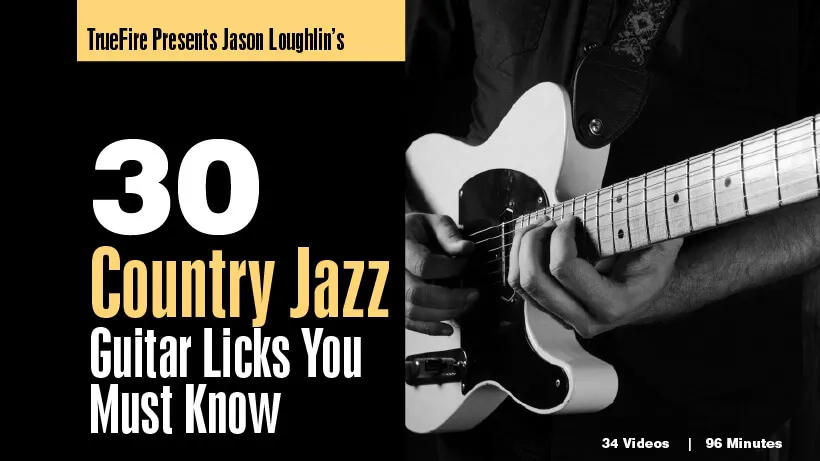
30 Country Jazz Licks You MUST Know

Learn how to play country jazz guitar with 30 must-know licks

Marty FriedmanTommy EmmanuelSteve VaiEric GalesEric Johnson

Get this course and 1,000+ more with All Access

Try 14 days free. Cancel any time.

Purchase Individual Course for $9.99
30 Country Jazz Licks You MUST Know

About this course

The fusion of country and jazz started in the 1930s when western swing players like Jimmy Wyble, Junior Barnard and Eldon Shamblin began using jazz improvisation concepts over country progressions and feels. Early electric guitar heroes like Les Paul, Jimmy Bryant, Grady Martin and Hank Garland continued the evolution of the style through the 50s. Jason Loughlin’s 30 Country Jazz Licks You Must Know is a rewarding exploration of this exciting chapter of American music.

”I've hand-picked this collection of country jazz licks from the brilliant work of players like Les Paul, Billy Byrd, Grady Martin, Jimmy Capps, Junior Barnard, Chet Atkins, Eldon Shamblin, Roy Lanham, Jimmy Wyble, Speedy Harworth and so many more giants of the country jazz genre. These guys are the early heroes of electric guitar!

Learning these 30 licks will not only expand your country jazz vocabulary, they’ll also reveal how to incorporate jazz improvisation concepts over classic and contemporary country progressions, two-beat feels and country shuffles.”


As you work and play your way through the course, you’ll pick up on a Les Paul lick that shows you a flashy way to ornament a major arpeggio. You’ll learn how to combine a fiddle pattern and a swing line with a Roy Lanham lick. The Texas Troubadours are one of the pioneers of the country jazz genre and you’ll study a few of the licks played by none other than the legendary Leon Rhodes. Jimmy Wyble’s licks will reveal how to approach playing over changes.

You’ll learn some jazzy chord voicings ala Jimmy Capps, impose harmonic movement onto chord via a George Barnes lick, and learn how to play through a solo break in the style of Jimmy Bryant. That’s just a few examples of the essential approaches and concepts that you’ll be introduced to.

Jason demonstrates all of the licks over rhythm tracks and then breaks them down, note-by-note emphasizing the key concepts and techniques employed in the performance of the lick.

All of the licks are tabbed and notated for your practice, reference and study purposes. You’ll also get Guitar Pro files so that you can loop and/or slow any section down as you work through the lessons. Plus, Jason generously includes all of the rhythm tracks for you to work with on your own.

Grab your guitar and let’s jazz up our country licks with Jason Loughlin!

What you'll learn

  • Create melodic lines using only chord tones
  • Use approach notes in soloing
  • Create melodic lines over jazz blues changes
  • Use syncopated rhythmic patterns
  • Develop rhythmic jazz phrasing
Release date: 03/07/2016 • 1h 36m runtime
Start Course
Sample lessons
Kalamazoo
Kalamazoo
Lick 1
Mr. Slewfoot
Mr. Slewfoot
Lick 2
Sweet Licks
Sweet Licks
Lick 9
Secret Weapon
Secret Weapon
Lick 13

What's included

34 lessons • 30 charts • 30 Jam Tracks

30 Country Jazz Licks
Hi, I’m Jason Loughlin and welcome to 30 Country Jazz Licks You Must Know. A lot of you are probably fans of western swing, jazz, and country, and have even heard country jazz before but were not sure how to categorize it. In this course, I've picked a great collection of licks from the masters to help expose you to this style. These guys are the early heroes of the electric guitar. Through learning the licks, you'll see how to use jazz improvisation concepts over country progressions, two beat feels, and country shuffles. This course should start you on a journey of discovering an exciting chapter in American music.

I've included notation, tab, and all the backing tracks (as well as a YouTube playlist, a list of iconic players, and a list of reference books and websites for find recordings of all this great music). For each lick, I'll perform it over a backing track and then break it down and analyze the lick. So grab your guitar and let’s swing!
History and Resouces
For many of you, this is a new genre you're discovering for the first time. The question I get the most is how is this music different from western swing or jazz. There's a lot of gray area and crossover for sure, as these records we're drawing from here are either western swing, music that grew out of western swing, or jazz records inspired by music of the south. What we're looking for are the first guitarists to improvise with jazz sensibilities over country music.

The combination of the styles is mostly the result of the rise of the record industry. Before the age of 78's, songs were passed by live radio broadcasts, traveling minstrel shows and sheet music. There were two "booms" happening in the record business - swing and hillbilly music. These were big selling words. Hillbilly music was an advertising label given to Appalachian music, a label reluctantly accepted by people in more rural areas. Records allowed music to spread quicker and allowed disc jockeys to play the same song as much as they wanted and the artist's popularity to spread. It was only a matter of time before someone married these two genres to form a new kind of music.

Western swing may be America's first fusion of styles, and nobody did this more definitively than Bob Wills and The Texas Playboys. He was the first to use trumpet, sax, piano, fiddle, guitar, and lap steel all together to create a big band of the south (Tulsa, Oklahoma to be specific). His band became a breeding ground for great guitarists. These guitar heroes would go on to inspire the next wave of electric guitarists who would define rockabilly.

Country jazz is not a widely known term, mostly because this music was not hugely popular at the time and got folded into the country or the jazz genre. It describes the music that exists outside of western swing - music that comes from players who are deeply rooted in Appalachian music and country, but have a more sophisticated sense of harmony when it comes to composing or improvisation.

Books

Country Music USA by Bill C. Malone
Southwest Shuffle by Rich Kienzie
The Jazz of The Southwest: An Oral History of Western Swing by Jean A. Boyd

Websites

Bear Family Records - dedicated to preserving and rereleasing great American music.
Discogs - Great place to find vinyl records.
YouTube Playlist - I've complied playlist of videos of all the artist covered here and more!
www.jasonloughlin.com for full transcriptions and downloadable lessons.

List of Players

Jimmy Bryant
Les Paul
Grady Martin
Hank Garland
Chet Atkins
Roy Lanham
Leon Rhodes
Jimmy Wyble
Benny Garcia
Phil Baugh
Sheldon Bennett
Jimmie Rivers
George Barnes
Thumbs Carllile
Jimmy Capps
Billy Byrd
Speedy Haworth
Buddy Merrill
Zeb Turner
Zeke Turner
Junior Barnard
Roy Clark
Neil LaVang
Merle Travis
Paul Buskirk
Eldon Shamblin
Jethro Burns
Butterball Paige
Bob Wills
Speedy West
Joaquin Murphey
Curly Chalker
Buddy Emmons
Buddy Charleton
Leon McAuliffe
Gear & Tone
Country jazz started in the early toddler years of the electric guitar. Everything from big archtops to telecasters are used in the genre, with no one guitar that defines the style. There are some very cool guitars associated with this style however: Players like Billy Byrd and Grady Martin were among the first to play Paul Bigsby’s solid body electric guitar, of which there were 23 made and 23 accounted for. Really beautiful instruments. There's also the Bigsby inspired Jim Harvey guitars like the double neck that Paul Buskirk played. Modern guitar builders like TK Smith are reviving these designs with the same level of artistry.

The sound is all about a clean guitar tone. Players like Jimmy Bryant were rumored to go directly into the board at times. Most reverbs were added after the amp signal. Plate reverb or spring would be added to the whole band. Sometimes players would use the amp's built-in spring tank. Remember, early amplifiers did not have built-in spring reverb. The first effect added to amps was tremolo, which you'll hear occasionally. The most common effect at the time was slapback echo, with one quick repeat at or around the same volume as the initial attack used by players such as Les Paul and Chet Atkins. Both were always experimenting with new sounds. Les also utilized the double-speed guitar trick by recording at half speed and then playing back at the correct speed, and Chet was arguably the first to use a wah wah pedal by putting a passive tone knob into a pedal. You can hear one of the first examples of this on Chet’s “Boo Boo Stick Beat” from the Teensville record.
Kalamazoo
Billy Byrd was most known for his guitar work with Ernest Tubb’s Texas Troubadours. His straightforward solos in that band reminded all of us that melody is king. Billy’s solos would usually quote the vocal melody while adding simple ornamentation and harmonization by using the interval of a 6th for good measure. He was one of the first electric guitarists to really make a name for himself. This was largely helped by Ernest Tubb calling his name before every solo, which definitely added to the excitement and anticipation of a Billy Bird solo. He went on to play sessions with many other artist including Little Jimmy Dickens, Eddy Arnold, and Webb Pierce. Billy Byrd and Hank Garland worked closely with Gibson to develop the iconic Byrdland archtop guitar.

Billy has a couple instrumental records available, all worth hearing, especially his record I Love a Guitar.

This lick comes from a great compilation record called Tennessee Guitar, from Billy’s contribution called "Gibson Girl". Here we're looking at a lick he uses over the V chord, or a D7 chord. Notice how Bill outlines the E minor triad and the A minor triad to bring attention to the extensions of the D7 chord.
Mr. Slewfoot
This lick is from Grady Martin, one of true chameleons on the electric guitar. It’s always a little difficult to figure who played on what recording from this time period, but it’s exceptionally difficult when it comes to Grady Martin. I mean this as a compliment - he was one of the most in demand session players from the 50's through to the 70’s and a true master of many styles. He becomes a totally different player from artist to artist and song to song; you rarely hear Grady repeat himself. He can be a smoking rockabilly player with Johnny Burnette, a beautiful country guitarist with Marty Robbins, or swinging demon with his own band The Slewfoot Five. He was one of the anointed few to play the Bigsby double neck guitar. There are only 23 of these guitars in existence, most of which were played by the first wave of guitar gods. Grady can be heard on recordings with Loretta Lynn, Marty Robbins, Elvis, Buddy Holly, Patsy Cline, Johnny Burnette, Johnny Cash, and Bing Crosby to name a few.

We're gonna look a lick in Ab over a V chord leading back to the I from "The Slew Foot Rag", an instrumental from The Slewfoot Five. What separates Grady from the other players who were playing jazz similar to Charlie Christian (outlining and embellishing chord shapes) is his being influenced by fiddle players. He uses more scales than arpeggios and uses ornamentation associated with fiddle players.
Sugarfooter
A true genius of the electric guitar, Hank made a name for himself at a very young age. He was only 18 when "Sugarfoot Rag" became a million selling hit record. Hank quickly became an in demand session player in Nashville. It’s harder to find records that him and Grady Martin didn’t play on then to find ones they did. They even teamed up in The Slewfoot Five for a time. Check out "Pork Chop Stomp" to hear their twin leads on the intro. Really out there for the time. Hank was also a great producer and songwriter, running sessions for Patsy Cline, Roy Orbison, and he even wrote "Jingle Bell Rock". Back then the music business was such that you couldn't get credit for multiple jobs, so he never received credit for a lot of his production and co-writes. He can also be heard on a lot of Elvis' music from 1958 to 1961. That’s Hank playing the lead on “Little Sister”, on a Stratocaster no less.

In the late 50’s, he was doing quite a few rockabilly sessions at the height of rockabilly’s popularity, playing guitar on one of my favorite Jimmy Lloyd recordings “I've got a Rocket in Pocket”. He also did sessions with The Everly Brothers, Brenda Lee, Conway Twitty, and Marty Robbins.

As Hank grew as a musician, he moved further away from country and closer to jazz, playing with George Shearing and the legendary Charlie Parker. His record Jazz Winds from a New Direction was a crazy collection of talent. It featured Gary Burton on vibes, Joe Benjamin on bass, and Joe Morello on drums. George Benson sites this record as a huge influence on his playing.

The Bear Family has released a compilation of all the Hank Garland and His Sugarfooters 78's on CD. Highly recommended! Velvet Guitar and Jazz Winds from a New Direction are both gems, too.

This lick comes from a Hank Garland and His Sugar Footers tune called "Sugarfoot Boogie". It's a descending legato idea over an E chord ending with a sweep through an E major triad.
Blues Be Gone
What can you say about Les that hasn't been said before? Brilliant inventor, guitarist, arranger, engineer, champion of new talent...giant influence in my life. I started seeing him play back when I was twelve. Him and Tommy Doyle (Les' guitar tech and luthier) turned me onto a lot of great music. He’s credited as inventing the first solid body electric guitar, but that's not completely true. Rickenbacker created a lap steel looking guitar that was meant to be played by fretting notes, a very rare guitar to find these days. Paul Bigsby is really the guy to make this first solid body electrics that resemble that guitars we use today. Les' greatest contribution was the invention of multi-tracking - the layering of musical performances to create a sound of a full ensemble. His arrangements with his wife Mary Ford are brilliant. The tones, the effects, the parts, the vocal harmonies…. nothing is out of place. Perfection.

There are a lot of Les Paul records, most of which are great (some are great in a goofy way), and some are only available on vinyl. Any Les Paul and Mary Ford compilation is a good place to start. New Sounds, Bye Bye Blues and The Hawaiian Paradise records are some of my favorites.

Let's look at one of Les Paul's licks from the "Bye Bye Blues" solo. This lick is very much inspired by Django Reinhardt's embellishment of chord tones.

+ 27 more lessons

Start Course

Reviews

11 results

Quigle

Verified buyer

02/28/26

Great course for adding Jazz "Sparkle"

the teachers are concise and instruction is succinct, the play alongs are great because they give you valuable video band experience, really enjoyed it.

matco

Verified buyer

01/15/21

30 country jazz licks you must know

Jason is a great teacher , his course brings you to next country guitar level.

tremelo68

Verified buyer

12/30/20

Excellent content and great teacher!

Gromeul

Verified buyer

12/18/20

A lot to learn 👍!

I learned many may tricks & licks with this course, every level 👍!

lrussel

Verified buyer

11/30/20

The Very Best

Excellent instructor. No dull moments. Material is a challenge to me and this instructor knows how to make it doable!

Stop searching. Start improving with All Access.

Try 14 days free. Cancel any time.