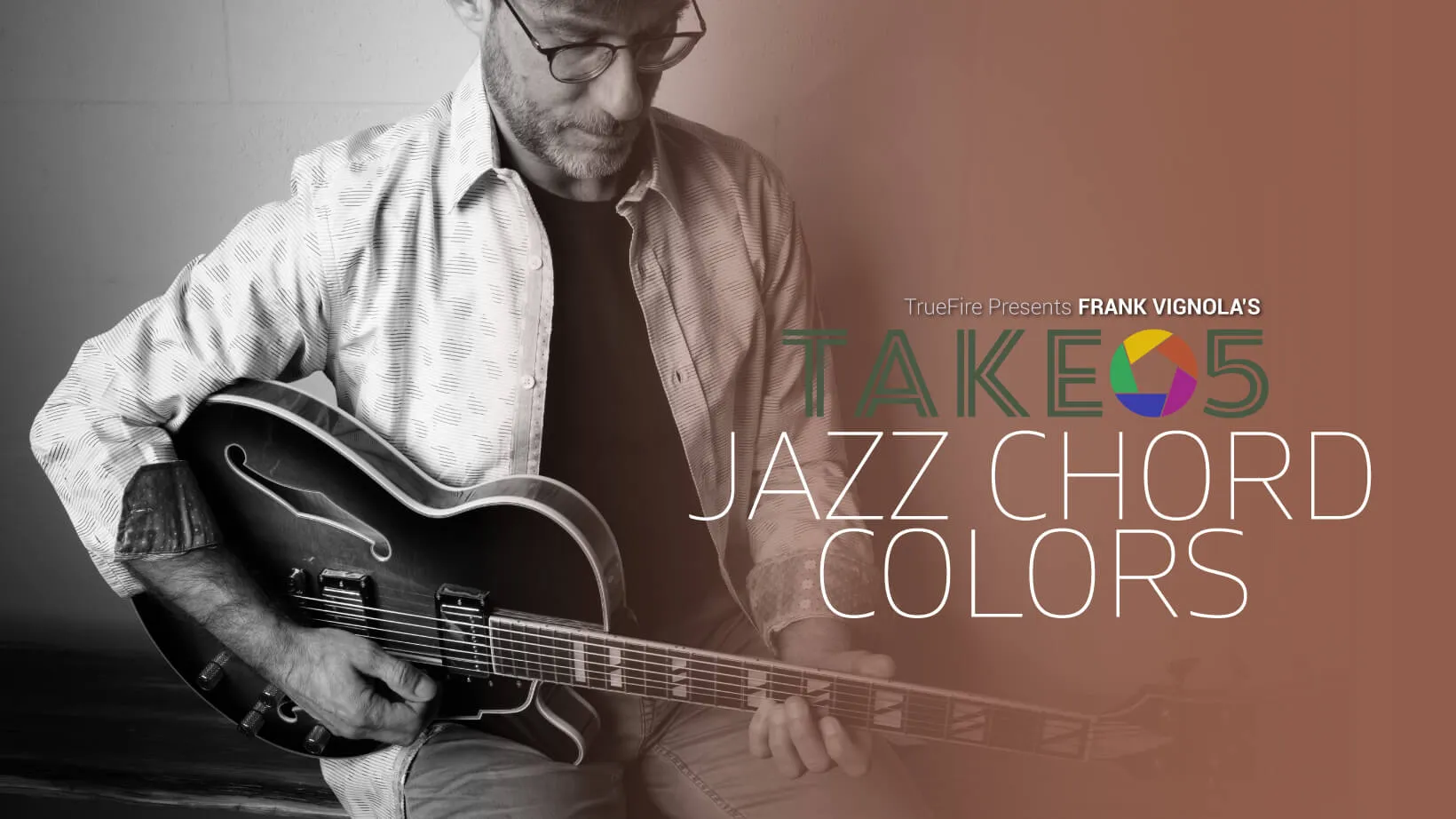

Take 5: Jazz Chord Colors

Jazz Chord Essentials for Guitarists

Marty FriedmanTommy EmmanuelSteve VaiEric GalesEric Johnson

Get this course and 1,000+ more with All Access

Try 14 days free. Cancel any time.

Purchase Individual Course for $14.99
Take 5: Jazz Chord Colors

About this course

Knowing how to ‘color’ your chords when comping behind a vocalist or soloist is an essential skill for any jazz guitarist. In fact, your job in the rhythm section -- when you’re responsible for the harmony -- is coloring the chords to feed the soloist harmonic ideas that they can improvise over.

This Jazz Chord Colors edition of Take 5 from Frank Vignola will focus on the chord extensions that you can use in any jazz setting to spice up your comping and accompaniment skills.

”We’ll start with a chord coloring primer where I’ll pass on a vocabulary of the most useful jazz chord extensions, voicings, and fingerings. I’ll show you several ways to play any Major, Minor or Dominant chord that you might encounter in the jazz songbook. We’ll work with 7ths, 9ths, 6ths, flat 9s, 13ths, flat 13ths, and 6/9s. I’ll show you the exact chords that I use 90% of the time when performing or recording in any setting.”

Frank will then guide you through 5 Jazz Chord Colors performance studies, from basic to more sophisticated and challenging chord coloring and comping approaches. Frank performs each study over a backing track and then breaks it down emphasizing the key concepts in play.

All of the performance studies are tabbed and notated and you’ll have the jam tracks to work with on your own.  You can loop and slow down the videos so you can work with the lessons at your own pace.

Grab your guitar and let’s color our chords with Frank Vignola!

What you'll learn

  • Master multiple voicings for major, minor, and dominant chords
  • Apply smooth voice leading between chord changes
  • Comp with a modern smooth jazz rhythm pattern
  • Understand how to color chords to support vocalists and soloists
  • Learn essential jazz chord extensions and voicings for comping
Release date: 05/13/2019 • 1h 11m runtime
Start Course
Sample lessons
Level 5: Jazz Chord Colors
Overview
Level 5: Jazz Chord Colors
Performance
Level 5: Jazz Chord Colors
Breakdown

What's included

19 lessons • 6 charts • 5 Jam Tracks

Take 5: Jazz Chord Colors
Hi, I'm Frank Vignola. Welcome to this Jazz Chord Colors edition of Take 5!

Knowing how to color your chords behind a vocalist or soloist is an essential skill for any jazz guitarist. In fact, your job in the rhythm section is to be responsible for the harmony and to color your chords, feeding the soloist with juicy sounding chords and harmonic ideas that they can improvise over.

We start the course with a chord coloring primer where I will pass on a vocabulary of the most useful jazz chord extensions, voicings, and fingerings. I'll show you several ways to play any major, minor, or dominant chord that you will encounter in the jazz songbook, working with 7ths, 9ths, 6ths, flat 9's, 13ths, flat 13's, and 6/9's. In fact, these are the very chords that I use 90% of the time when performing or recording in any setting.

I'll then guide you through five jazz chord colors performance studies from basic to more sophisticated and challenging approaches. All of the studies are tabbed and notated and you'll have the jam tracks to work with on your own. You can loop and slow down the videos so you can work with the lessons at your own pace.

Ready? Grab your guitar and let's get started!
Jazz Chord Color Approaches
Before we dig into the five studies, I'll discuss and demonstrate what chord colors are. You have three basic chord types: major, minor and dominant. Major and minor are made up of triads or three notes - the 1st, 3rd and 5th steps of the scale make up the major chord. The 1st, flat 3rd, 5th make up the minor chord. Chord colors are the tones on top of the chord that are added to give the chord some color. Sometimes, they're referred to as chord extensions. These are what we'll be working with, adding these chord colors to the triads to give some spice to your chord accompaniment.
Level 1: Jazz Chord Colors
In this Level 1 study, we'll use a ii-V7-I (2-5-1) chord progression in the key of C major and C minor: Dm - G7 - C for major and Dm - G7 - Cm for minor. These are the three basic chord types being used. I chose the 2-5-1 progression because it's in just about every jazz standard that you'll play. This ii-V7-I progression is used in songs written in the "teens" and 20's, swing era tunes, bop and post bop classics. Even pop tunes of the 70's, 80's and beyond use this progression.

First, I'll demonstrate the progression with the basic chords both in C major and C minor. Then, I'll use the most common chord colors. The minor 7th, dominant 9, and major 7th making the progression Dmin7 - G9 - Cmaj7 and then Dmin7 - G9 - Cmin7. I'll show you this in 2 positions on the fingerboard.
Level 1: Jazz Chord Colors
In this Level 1 study, we'll use a ii-V7-I (2-5-1) chord progression in the key of C major and C minor: Dm - G7 - C for major and Dm - G7 - Cm for minor. These are the three basic chord types being used. I chose the 2-5-1 progression because it's in just about every jazz standard that you'll play. This ii-V7-I progression is used in songs written in the "teens" and 20's, swing era tunes, bop and post bop classics. Even pop tunes of the 70's, 80's and beyond use this progression.

First, I'll demonstrate the progression with the basic chords both in C major and C minor. Then, I'll use the most common chord colors. The minor 7th, dominant 9, and major 7th making the progression Dmin7 - G9 - Cmaj7 and then Dmin7 - G9 - Cmin7. I'll show you this in 2 positions on the fingerboard.
Level 1: Jazz Chord Colors
In this Level 1 study, we'll use a ii-V7-I (2-5-1) chord progression in the key of C major and C minor: Dm - G7 - C for major and Dm - G7 - Cm for minor. These are the three basic chord types being used. I chose the 2-5-1 progression because it's in just about every jazz standard that you'll play. This ii-V7-I progression is used in songs written in the "teens" and 20's, swing era tunes, bop and post bop classics. Even pop tunes of the 70's, 80's and beyond use this progression.

First, I'll demonstrate the progression with the basic chords both in C major and C minor. Then, I'll use the most common chord colors. The minor 7th, dominant 9, and major 7th making the progression Dmin7 - G9 - Cmaj7 and then Dmin7 - G9 - Cmin7. I'll show you this in 2 positions on the fingerboard.
Level 2: Jazz Chord Colors
In this Level 2 jazz chord color study, we'll use the same ii-V7-I (2-5-1) chord progression in the key of C major and C minor: Dm - G7 - C and Dm - G7 - Cm. I introduce 6 new chord colors in this study - the minor 9, dominant 13, major 9, dominant 7(b9), major 6th and minor 6th.
Level 2: Jazz Chord Colors
In this Level 2 jazz chord color study, we'll use the same ii-V7-I (2-5-1) chord progression in the key of C major and C minor: Dm - G7 - C and Dm - G7 - Cm. I introduce 6 new chord colors in this study - the minor 9, dominant 13, major 9, dominant 7(b9), major 6th and minor 6th.

+ 12 more lessons

Start Course

Reviews

15 results

fenachrone

Verified buyer

10/13/22

Useful for seeing new chord interpretations and for developing dexterity in moving between chords.


Robert R.

01/02/22

Take your time with this one

I am half way through this course and already my chordal knowledge and appreciation and increased substantially. This is one of those very efficient courses where the time spent pays off immediately.

cazalisx

Verified buyer

09/06/21

Chord Colors

Another great course from Frank Vignola. Clearly explains how and when to use 6ths, 7ths, 13ths etc. Breaking them down into 5 levels. I have not yet finished the entire course (currently doing level 3), I like to digest, practice and master the levels first before moving to the next. So far another excellent course from Frank. Many thanks.

Baritonepaul

Verified buyer

08/28/21

Anything Frank does is worth listening to. I needed to course to develop chord voicing that are usable and interesting, this course achieves that. Baritonepaul.

Charlie30252

Verified buyer

07/08/21

Great as always!

Stop searching. Start improving with All Access.

Try 14 days free. Cancel any time.