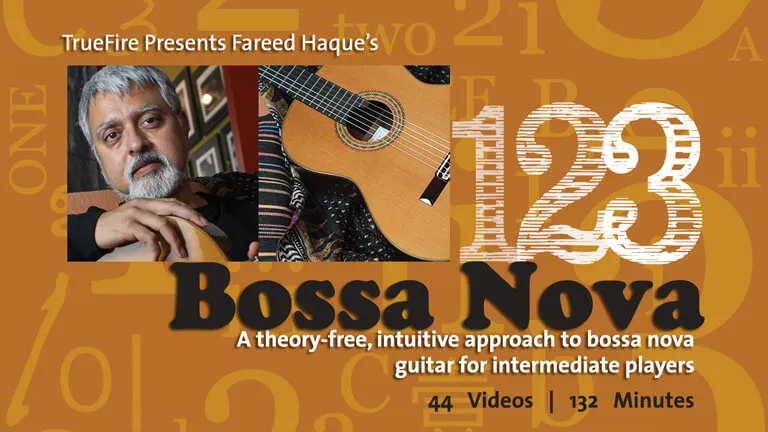
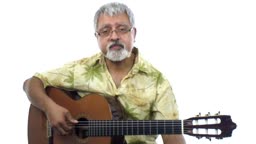
1-2-3 Bossa Nova

A theory-free, intuitive approach to bossa nova guitar for intermediate players

Marty FriedmanTommy EmmanuelSteve VaiEric GalesEric Johnson

Get this course and 1,000+ more with All Access

Try 14 days free. Cancel any time.

Purchase Individual Course for $24.99
1-2-3 Bossa Nova

About this course

Muddle some cachaca with lime and sugar, add crushed ice and take your Caipirinha to your favorite spot on Rio de Janeiro's famous Copacabana beach for the sunset. Bare feet wiggling in the sand, you watch the pretty people stroll aimlessly to the sounds of live bossa nova, itself a muddled blend of samba and jazz. The long tanned legs and bikinis are captivating but you play guitar and would much rather find the band and cop the guitarist's rhythm patterns and chord voicings. Stay right where you are mi amigo - Fareed Haque has you covered with 1-2-3 Bossa Nova.

In this accelerated introduction to bossa nova rhythm guitar for intermediate players and beyond, Fareed shows you the authentic bossa nova rhythms and chord voicings used by the Brazilian greats including Antonio Carlos Jobim, Joao Gilberto, Luis Bonfa, Baden Powell and many others. Fareed breaks the style down into one versatile rhythm pattern that underlies almost every bossa nova tune and then shows you the classic chord voicings used by most bossa nova guitarists. You'll put that all to work as you learn and play along to six etudes, each of which follows an essential chord progression found in many famous bossa nova tunes.

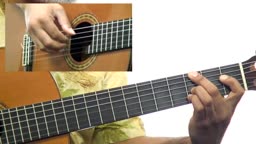
In the first section, Fareed drills down on the right-hand technique by dissecting and teaching it in three parts. All of the essential principles are covered including fingerings, hand and arm positions and use of the nails. Once you get a grip on the right-hand technique, Fareed reveals the key to the bossa nova rhythm pattern and steps you through several play-alongs until you nail it.

The second section is all about the essential chord voicings and moveable forms that you'll need to take on the bossa nova songbook. You'll learn the 6/9, minor 6th, minor 9th, dominant 13th, dominant 9th, half-diminished and diminished forms. Fareed also shows you embellishments for these forms - critical for bossa nova accompaniment.

You're now equipped to dig in to the third section and start building a repertoire of bossa nova progressions and tunes. Fareed prepared six etudes to kickstart your progress; Gilberto's Jam, Orphiana, No Note Samba, Mountain Bossa, Tall & Tan and Surf Samba all feature progressions commonly found in hundreds of bossa nova tunes.

So back to your Caipirinha and people watching for now. When you're done for the night, head to the shed with 1-2-3 Bossa Nova and prepare yourself for that gig on the beach.

What you'll learn

  • Create authentic bossa nova chord voicings
  • Create complex minor 9th chord voicings
  • Perform Bossa Nova Rhythm Patterns
  • Learn chord variation techniques
  • Understand thumb-bass rhythmic foundation
Release date: 02/14/2013 • 2h 12m runtime
Start Course
Sample lessons
Rhythm Pattern #3
Rhythm Pattern #3
Demonstration
6/9 Chord
6/9 Chord
6th String Root
Chords & Embellishments
Summary
Gilberto's Jam
Gilberto's Jam
Performance

What's included

44 lessons • 24 charts • 12 Jam Tracks

1-2-3 Bossa Nova
Welcome to 1-2-3 Bossa Nova. Don’t be a square! Get hip with the real bossa nova. In this course I will show you the authentic bossa nova rhythms and chord voicings used by Brazilian greats including Joao Gilberto, Luis Bonfa, Baden Powell and many, many others. We will break this style down into one basic rhythm pattern that underlies almost every bossa nova rhythm. Then we will follow with the classic chord voicings used by most bossa nova guitarists. Last we will jam along to 6 etudes I've created specifically for this course. Each etude follows an essential chord progression found in a famous bossa nova tune:
Gilberto's Jam, Orphiana, No Note Samba, Mountain Bossa, Tall & Tan and Surf Samba - I'll let you figure out which tunes these etudes draw from - and in very short order you will be playing authentic bossa guitar!
Bossa Rhythm Patterns
In this section we will take the basic bossa right hand pattern and break it down into 3 simple parts. But first! A few words about right hand technique. Classical guitar technique is basically the same as Brazilian guitar technique - which would explain why so many great classical guitarists come from Brazil! Here are some general principles: 1) To articulate or "pluck" strings we use thumb, index, middle and ring finger. Usually these are identified by the letters p for thumb (Actually Spanish for thumb - PULGAR), i for index finger, m for middle finger, a for ring (Spanish for ring finger - ANULAR). "Pinky" or "e" is rarely used. 2) Flesh and Nail: The basic contact with string is with flesh. Later on we will add nail to give brightness and possibilities for different tone colors. 3) Hand position: Right arm touches guitar roughly at top of guitar where bridge points to upper bout. Wrist remains relatively straight with a slight arch away from top. Touch strings with left side of fingertip. Fingers move in towards palm, and thumb moves away from fingers and away from top of guitar. Fingers and thumb make a little cross as they move away from each other. That's the basics. Check out Vladimir Bobri's "The Segovia Technique" as well as Christopher Parkening's method as they are both excellent and clear. But by far the best book is Pepe Romero's “La Guitarra: A Comprehensive Study of Classical Guitar Technique and Guide to Performing”. It has been rereleased by Guitar Salon International and is amazing!
Rhythm Pattern #1
This rhythm is used commonly in slow, mellow bossa novas. Just keep the bass notes coming straight on the beat. The most common error made by beginners is to try and syncopate the bass notes. The key to the bossa nova is that like jazz it is felt in 4/4 time. It's really a slow, sexy march, but a march nonetheless, just like jazz. And the walking bass in jazz is that steady pulsing quarter note bass in bossa nova. Keep da beat!
Rhythm Pattern #1
A slow play-along over G 6/9. Keep the bass note steady. Keep all notes sustaining and clear. Don't stop or cut bass notes short - let them ring!
Rhythm Pattern #1
Fast play-along. Don't tense up, keep the fingers moving to the palm, and the thumb moving away from the guitar. Bring the thumb up, around and back in a small circle.
Rhythm Pattern #2
This is the most typical basic bossa pattern. Note that pattern #1 is the first 1/2 of pattern #2 so all you have to do is add the second 1/2. Notice that when all four parts of Rhythm # 2 are put together you have 4 steady quarter notes in bass. On top you have the rhythm (in eighth notes) 2-3, 2-2-3, 2-2.
Rhythm Pattern #2
Slow play-along Rhythm #2: Make sure to keep the bass notes even. Don't push the third bass note. It comes after the fingers not with 'em! This is by far the most common error, so pay attention to getting it right!

+ 37 more lessons

Start Course

Reviews

23 results

StratBob

Verified buyer

06/03/26

Excellent introduction to Bossa Nova guitar

It's exactly what it claims to be; a simple and effective, step-by-step start to learning the fundamentals of Bossa Nova guitar. If this is a style you want to explore, this is a great point of entry.

bcanaday1

Verified buyer

05/01/26

Play bossa nova

Good course to learn Bossa nova

BassicLeh

Verified buyer

12/13/25

Maybe the Best True Fire Lesson

Maybe I am doing guitar wrong. I don't find enjoyment in overdriven pentatonic runs nor do I understand the approach to guitar that Joe Bonamassa and Samantha Fish take; to be the self appointed champion of the Blues, while hoarding gear like like Elon Musk hoards wealth made off exploiting workers. There is a seemingly endless stream of videos pushing John and Jane Q Guitarist to be the most stellar lead guitarist, and the art of rhythm playing, good rhythm playing, is neglected. I don't know. Is this what I am supposed to do? Again, I'm probably doing this guitar thing wrong. For those who would rather be wrong, I recommend this course. Fareed creates an incredible vibe, often times encouraging your mind to travel to a relaxed state as play your rhythms. There is a nice healthy mixture of easy Jazz chords like your minor 7ths, and some fancy chords like your half diminished chords. There is some theory, but not too much to where you are drowning. Everything is relaxed and nicely paced which is most welcome in this crazy modern world.

doogietrueman

Verified buyer

04/20/25

Es bueno

Great for those of us learning Latin guitar

brannyemi

Verified buyer

03/15/25

Get to learn a lots of new things

Stop searching. Start improving with All Access.

Try 14 days free. Cancel any time.