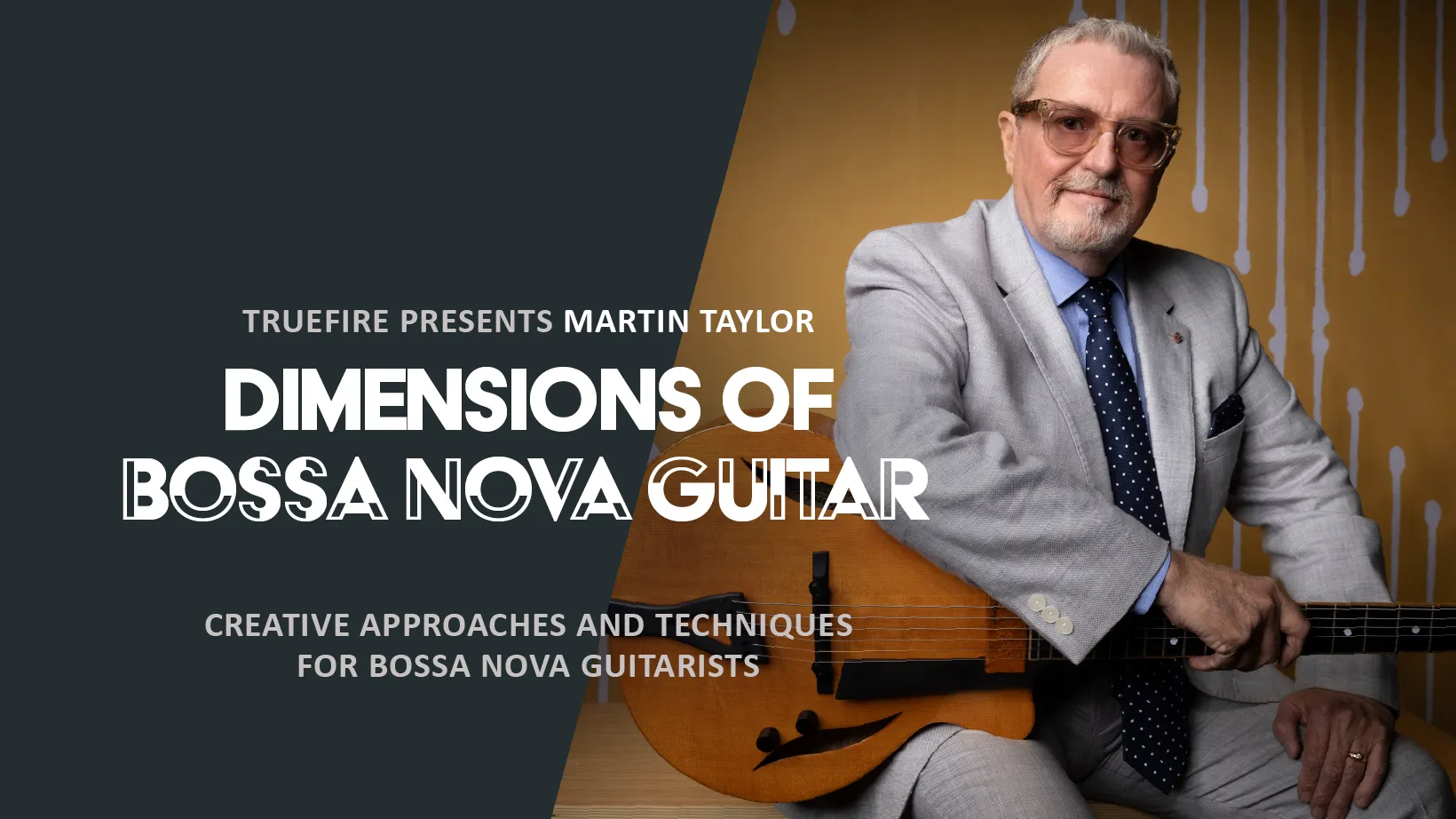
Dimensions of Bossa Nova Guitar

Hands-On Accelerated Course for Bossa Nova Guitar

Marty FriedmanTommy EmmanuelSteve VaiEric GalesEric Johnson

Get this course and 1,000+ more with All Access

Try 14 days free. Cancel any time.

Purchase Individual Course for $24.99
Dimensions of Bossa Nova Guitar

About this course

Bossa Nova and other Latin jazz styles are seamlessly woven into the fabric of the mainstream jazz standard songbook, becoming indispensable to worldwide jazz repertoire. As a result, Bossa Nova and Latin jazz tunes have not only become a staple in jazz performances but also essential study pieces for jazz students, symbolizing a perfect blend of rhythmic complexity and melodic beauty.

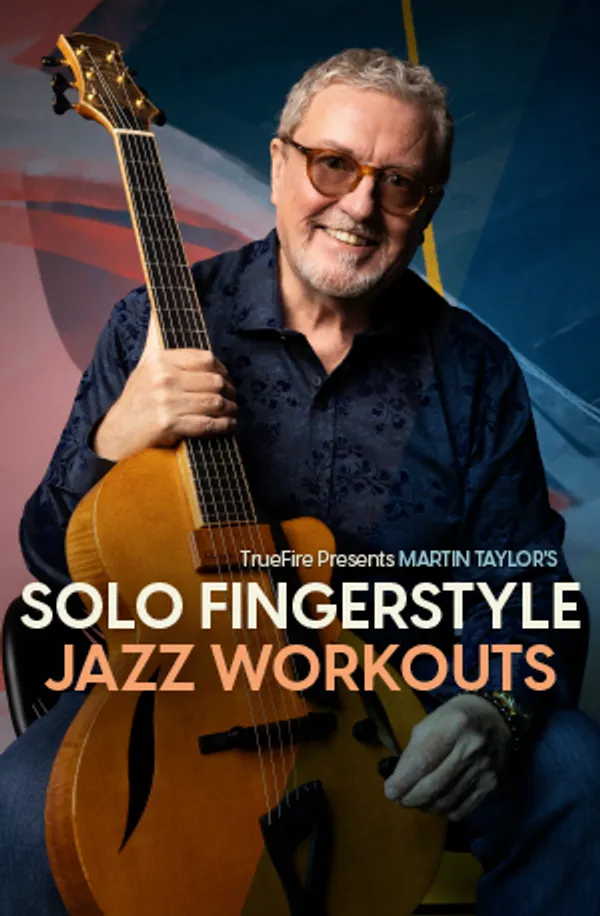
Martin Taylor’s immersive masterclass, Dimensions of Bossa Nova Guitar, accelerates students’ learning progress with a curriculum designed to play their way through rather than practice tedious exercises and force-feeding thick theoretical explanations.

“Bossa Nova sparked the Latin jazz movement in the late 50’s and continues to play a pivotal role in the Jazz songbook. Its melodic, rhythmic, and harmonic qualities provide jazz musicians, especially jazz guitarists, boundless expressive freedom for improvisation and creative exploration.

Using Bossa Nova tunes as our framework, I designed the course with a hands-on contextual approach. I’ll share essential approaches for rhythm and lead, and you’ll jam along with me throughout the course!

We’ll work on familiar chord sequences, rhythms, melodic phrasing, embellishments, chord melody, improvising, and many other vital elements that you’ll need to perform the Bossa Nova songbook confidently.”


You’ll have TrueFire’s interactive learning tools to customize your workspace and learn at your own pace. The demonstrations and performances are tabbed, notated, and synced to the video lessons with controls for looping, slow motion, fretboard animation, and other tools designed to accelerate your progress.

You’ll also get the tab and standard notation files to print out, downloadable Guitar Pro files, and backing tracks to practice with and use on home recording projects.

Grab your guitar, and let’s dig in with Martin Taylor!

What you'll learn

  • Play authentic bossa nova rhythm patterns with thumb technique
  • Embrace mistakes as creative opportunities in improvisation
  • Learn to spread voicings across the fretboard for fuller ensemble sound
  • Understand how to create effective two-guitar arrangements using octave voicing
  • Develop melodic improvisation skills that balance melody with spontaneity
Release date: 05/09/2024 • 2h 27m runtime
Start Course
Sample lessons
Rue De Dinan: Rhythm Guitar
Performance
Wave: Rhythm Guitar
Wave: Rhythm Guitar
Performance
Wave: Rhythm Guitar
Wave: Rhythm Guitar
Breakdown
Wave: Lead Guitar
Wave: Lead Guitar
Performance

What's included

34 lessons • 18 charts • 10 Jam Tracks

Dimensions of Bossa Nova Guitar
Hey there, I'm Martin Taylor. Welcome to Dimensions of Bossa Nova Guitar.

Bossa Nova sparked the Latin jazz movement in the late '50s and continues to play a pivotal role in the jazz songbook. Its melodic, rhythmic, and harmonic qualities provide jazz musicians, and especially jazz guitarists, boundless expressive freedom for improvisation and creative exploration.

Using bossa nova tunes as our framework, I designed the course with a hands-on, contextual approach. I'll share essential techniques for rhythm, lead, and even solo arrangements. We'll work on familiar chord sequences, rhythms, melodic phrasing, embellishments, chord melody, and many other vital elements you'll need to perform the bossa nova songbook.

Ready to get started? Grab your guitar, and let's dig in.
Essential Bossa Pattern & Soloing Approach
Before we dive into our lessons, I want to start with the basic bossa nova feel. If you were playing in a group with a bass player, you would typically leave the bass parts to them. It's important not to overlap with the bass player's role as it can create confusion.

Let's focus on establishing a basic bossa nova rhythm as our starting point. There are various ways to play bossa nova rhythms, and you'll find different styles even within different regions of Brazil.

Here’s what you need to know to get started: typically, if a bass player were involved, you’d hear a simple bass line emphasizing the first and the fifth of the chord. You might also smooth out the rhythm to make it more legato.

Even if there's a bass player, you can subtly play along with that bass line, but it’s crucial to keep it subdued. This approach will enhance the overall feel without making the music feel disjointed.

Remember, bossa nova is relaxed and laid-back music, so keep your playing style loose and easygoing.

As for playing lead lines, I don't focus much on scales. Instead, I concentrate on the chord sequence and maintaining a melodic flow. It's more about creating variations that are melodically driven rather than straying too far into scales or modes. My approach to soloing in bossa nova is all about staying close to the melody and enhancing its mood and essence.
Mirette
This is one of my original compositions, which I wrote for my group Spirit of Django years ago while living in France. I named it 'Mirette' after my house. It has a nice Bossa Nova feel, featuring those popular turnaround chord changes characteristic of Bossa Nova.

Let's walk through the chord changes together. We are in the key of E major. The sequence starts with an E major seventh for two bars, followed by D sharp minor seventh, G seventh, and C minor seventh. Then, B minor seventh, E seventh, A seventh, D nine, G sharp 13—a little move to F sharp 13, then an A with an A over B, back to E Major seven, D minor seven, G sharp seven, C sharp minor seven, and B minor seventh. This repeats similar patterns as before. The bridge features an F sharp minor 7 over B, with an A at the bottom, then G sharp minor 7th, C sharp minor 7th, F sharp minor 7th with a flat 9, and E major 7th followed by C sharp 7 with a flat 9, leading into a 2-5-1 progression back into E.

We play the A section again, which includes D sharp minor seven, G sharp seven, C sharp minor seven, B minor seven, E seven, A major seven, D nine, G sharp 13, and a rundown to C sharp seven, F sharp 13, A over B, and finishes on an E major 7th. When we reach the turnaround, it includes another A over B.

This lesson will cover the entire chord sequence, starting with laying down the sequence, then adding a lead line on top. I'll also demonstrate a combined chord and melody solo version of the tune. This integrated approach helps deepen your understanding of how the music comes together, enhancing your performance and knowledge, even if you don't perform the piece solo.

Mirette: Rhythm Guitar
In this lesson, we will delve into one of my original compositions, exploring its Bossa Nova-inspired chord progressions and various shapes such as major sevenths and minor sevenths. We'll break down the entire chord sequence, discuss how to integrate lead lines, and demonstrate a combined chord and melody solo version. This comprehensive approach aims to deepen your understanding of the music's structure and improve your overall performance skills.
Mirette: Rhythm Guitar
In this lesson, we will delve into one of my original compositions, exploring its Bossa Nova-inspired chord progressions and various shapes such as major sevenths and minor sevenths. We'll break down the entire chord sequence, discuss how to integrate lead lines, and demonstrate a combined chord and melody solo version. This comprehensive approach aims to deepen your understanding of the music's structure and improve your overall performance skills.
Mirette: Lead Guitar
In this lesson, we will delve into one of my original compositions, exploring its Bossa Nova-inspired chord progressions and various shapes such as major sevenths and minor sevenths. We'll break down the entire chord sequence, discuss how to integrate lead lines, and demonstrate a combined chord and melody solo version. This comprehensive approach aims to deepen your understanding of the music's structure and improve your overall performance skills.
Mirette: Lead Guitar
In this lesson, we will delve into one of my original compositions, exploring its Bossa Nova-inspired chord progressions and various shapes such as major sevenths and minor sevenths. We'll break down the entire chord sequence, discuss how to integrate lead lines, and demonstrate a combined chord and melody solo version. This comprehensive approach aims to deepen your understanding of the music's structure and improve your overall performance skills.

+ 27 more lessons

Start Course

Reviews

6 results

Mightygnat

Verified buyer

05/13/26

great

Magiera

Verified buyer

09/11/25

Martin Taylor ist a great Guitarist

Crowdofone

Verified buyer

01/31/25

Another winner

I have come to trust true fire products and this was is no exception. Both fun and informative.

Ecspon

Verified buyer

01/13/25

Great, but the level is high and you have a lot of work to do, to be confident on it.

bernhardbayi

Verified buyer

12/06/24

parfait

Stop searching. Start improving with All Access.

Try 14 days free. Cancel any time.