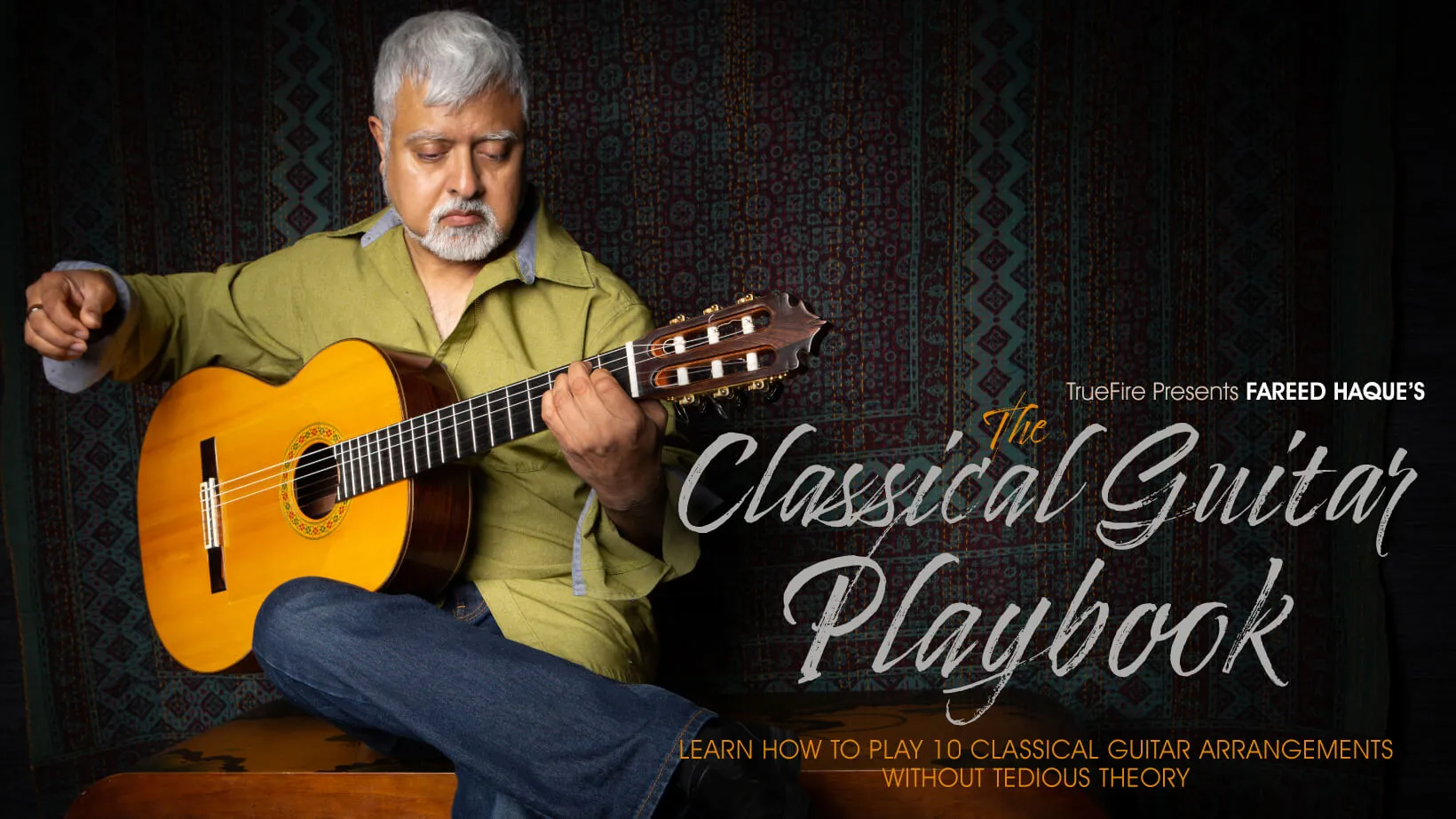
Classical Guitar Playbook

Learn How to Play 10 Classical Guitar Arrangements Without Tedious Theory

Marty FriedmanTommy EmmanuelSteve VaiEric GalesEric Johnson

Get this course and 1,000+ more with All Access

Try 14 days free. Cancel any time.

Purchase Individual Course for $19.99
Classical Guitar Playbook

About this course

Whatever style you play, having a set’s worth of solo guitar classical pieces in your repertoire is well worth the short amount of time that you’d invest in learning them. Performing these pieces for yourself or for family and friends is very gratifying and having them at your fingertips for gigs at weddings or parties is financially rewarding. But the biggest benefit of learning them, and their underlying techniques, is how dramatically your overall prowess on the guitar will be lifted.

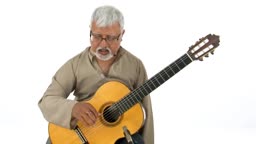
Fareed Haque’s Classical Guitar Playbook is not a formal classical guitar training course -- the objective here is getting you up and running quickly. You’ll play your way through the course without a lot of tedious exercises and intensive technique.

”This course is intended as a classical guitar primer for those of you who want to understand how to do it and for those of you who need to do it at weddings, bar mitzvahs, cafes and even the occasional funeral.

We'll cover the basic techniques used in classical guitar playing as well as a few techniques that are used in flamenco guitar playing, including rest stroke scales, free stroke scales, arpeggios, flamenco strums (called rasgueados), pizzicato, and that elusive beast - tremolo!

I’ll also make sure that you have all the information you need to play 10 solid pieces that you can take to the gig, play for your grandma, or serenade your loved one under the balcony window.”


With Fareed as your guide, you’ll learn how to play 10 beautiful classical arrangements, each with a variation. A key technique lesson accompanies each piece to help you perform the piece authentically. 

Fareed will explain and demonstrate all of the key concepts and approaches along the way. You’ll get standard notation and tabs for all of the key demonstrations and performance studies. Plus, you’ll be able to use TrueFire’s learning tool to sync the tab and notation to the video lesson. You can also loop or slow down the videos so that you can work with the lessons at your own pace. All the backing tracks are included to work with on your own as well.

Grab your guitar and let’s get classical with Fareed Haque!

What you'll learn

  • Apply pizzicato to scales and musical phrases
  • Execute classical pizzicato technique with proper palm placement
  • Learn essential flamenco strumming techniques
  • Recognize the relationship between flamenco forms and Spanish dance rhythms
  • Develop authentic flamenco sound through proper technique
Release date: 11/07/2019 • 2h 13m runtime
Start Course
Sample lessons
Classical Guitar Primer: 4
Secrets of the Classical Sound
Prelude Opus 28 No. 4
Overview
Prelude Opus 28 No. 4
Performance
Melody Over Block Chords
Technique: Demo

What's included

46 lessons • 11 charts

The Classical Guitar Playbook
Hi, I'm Fareed Haque. Welcome to the Classical Guitar Playbook.

This course is intended as a classical guitar primer for those of you who want to understand how to do it and for those of you who need to do it at weddings, bat mitzvahs, cafes and even the occasional funeral.

We'll cover the basic techniques used in classical guitar playing as well as a few techniques that are used in flamenco guitar playing, including rest stroke scales, free stroke scales, arpeggios, flamenco strums (called rasgueados), pizzicato, and that elusive beast - tremolo!

In addition, we will make sure that you have all the information you need to play 10 solid pieces that you can take to the gig, play for your grandma or serenade your loved one under the balcony window.

This course is goes along well with 1-2-3 Bossa Nova, so for a limited time TrueFire is offering a sweet discount so that you can get your nylon on!

Ready? Grab your guitar, and let's get started!
Classical Guitar Primer: 1
No revelations here. Good, relaxed posture is essential to good technique. Aligning your muscles and bones in an efficient manner is ideal for developing good playing habits and reliable performances. That being said, one size does not fit all! Different playing positions offer different advantages and disadvantages. Over the past 500+ years of guitar and lute history there have been MANY, MANY successful approaches to playing and holding plucked string instruments, so what we need is an understanding of the PRINCIPLES that underlie these different approaches. Generally speaking this is an aligned back, neck and torso, straight but relaxed body, arm and wrist joints not twisted or bent, shoulders relaxed, tummy relaxed so you can breathe normally.
Classical Guitar Primer: 2
Check out the Pepe Romero's Guitar Style and Technique for a more in depth explanation of right hand techniques. For a bird's eye view and explanation of these principles checkout Vladimir Bobri's "The Segovia Technique", with actual photos of Andres Segovia's hands, nails and playing position!

Practice scales!! Scales are an important part of developing technique, as well as developing ears and touch and tone. Speaking with everyone from Angel Romero to Pat Martino, playing scales was a hugely important part of their development on the guitar. Make sure to play scales with ALTERNATING fingers. for example: i-m-i-m-i-m-i-m or m-i-m-i-m-i-m-i. Avoid crossing strings using same finger twice (as in a descending scale playing [e string] m-i-m [b string] m-i-m, etc.) as that will slow you down. Once in a while, you'll have to use double m or double i fingerings in complex passages, but for now stick to straight alternation.

A bit about the care and feeding of the nails. The nails are a very important part of the sound, but even more important is using FLESH and NAIL to make the tone you want. Remember, we have nerves in our fingers! We can find the strings and control them easier with living flesh than dead nail cells! Extra hard tension strings and thick beauty salon nails can work, but flesh and nail gets a fatter, deeper and clearer sound with normal or even light tension strings and with thin nails. That's how the old masters did it, and it seems to work great. It makes playing easy and yields very musical results. If you have really thin nails, try vitamins and supplements. I have not found chemicals to work too well. For years, I used straight super glue on the tips of the nails, and this worked OK, though without the glue my nails have gotten stronger and healthier and don't dry out, split or crack.
Classical Guitar Primer: 3
The "Prepare, Play and Release" concept is key to avoiding injury. Over the years, I have had many students come to me for help with playing injuries and tendonitis. 100% of the time, those players who look really relaxed, and play really gently, softly are the ones with injury. Strange - you'd expect the tense and wild players to get hurt, right? The more I thought about this the more it made sense. The key to a healthy life is at least some exercise, right?? The body is designed to MOVE. If you're playing really lightly, with minimum motion, you are not FLEXING your muscles very much, if at all. Flexing, using your muscles is good. Squeezing your muscles tight pushes blood out of your hand and arm, getting rid of all the acids and toxins that build up after using a muscle. Relaxing your hand brings in fresh oxygenated blood and all the good stuff back into your hands.

SO HEAR ME NOW: THE "MINIMAL MOTION" IDEA in GUITAR TECHNIQUE is WRONG! Once you've mastered the big motions of arms hands and fingers, then eventually smaller motions will become part of the grand scheme of technique, but not at first! Check out the life experiences of David Leisner.

David is a wonderful guitarist and composer, who went thru 10 years of almost career ending injury and self-healing. His story is well worth reading, and his technique book well worth checking out. VERY LONG story, very short, by using big motions, and large muscle groups he was able to cure himself and resume a fantastic performing career. So once again...PREPARE BIG, PLAY BIG, and RELEASE even BIGGER!!
Classical Guitar Primer: 4
The slight arch in the wrist is an essential part of getting the classical sound. Too flat a wrist will create a plucky, bluegrassy sound. On the other hand, be careful, as too arched a wrist can over-bend the tendons and lead to injury.

The other essential element of the classical guitar sound is a fine instrument. So a few words here about getting a good ax: A fine classical guitar responds to your touch. When you're playing with good follow through and good right hand position, you can hear the classical sound blooming in response to your touch. You can vibrate a note or play with brighter or darker tone and the audience will hear all those subtleties, even in the back of the room. Conversely a bad ax will NOT respond to your touch and allow you to develop bad habits and unmusical choices, which will lead to being bored and eventually unsatisfied with your classical guitar playing.

All fine guitars have a top made of pine - cedar or spruce or redwood. Spruce is the pine of choice for most fine instruments and historically the greatest classical and flamenco guitars were made out of spruce with either cypress back for cheaper guitars, rosewood and maple for more expensive, prettier guitars. All are concert worthy. In general, old flamencos and classical were the same, just cheaper versions using local cypress wood back and sides for local flamenco journeymen, fancier versions with fancy backwood for classical players. Since the mid 60's, many guitar makers started to use cedar and redwood as they tend to be more mid-rangy, deeper, and have good sustain. Spruce tends to be brighter and projects well. I'd say many builders and players are reverting to spruce, but a good maker will make a fine instrument out of any wood.

Stay away from guitars that have too much finish. Stick to shellac, oil or urea based varnishes used by Ramirez, Contreras and many other Madrid guitar builders. At least in the beginning try to stick to a traditional fan braced guitar until you get going. Many working players favor flamenco negra guitars, or flamencos with rosewood back and sides. They tend to be traditionally built, easy to play and less expensive.

Don't shy away from 60's and 70's workshop guitars, guitars built on the workshop of famous Spanish builders. They tend to be well made, and supervised by the head of the shop, rather than farmed out to a chop shop overseas.

Other good affordable options are 60's and 70's handmade Japanese guitars, WAY WAY undervalued, and many many builders from Paracho, Mexico. They've been building for 500 years using the same time honored traditions from Spain, but without all the tariff and import duties tend also to be way way cheaper.

Last, but not least, classical guitars, especially spruce top guitars, often can take 1-2 years to truly open up. A fine instrument is built to last, and can take time to fully mature. So don't be afraid of used instruments, even those with some cracks on the back. They have gone thru their changes and you can feel like you are getting a known quantity. A new guitar can be a gamble, especially with finer more expensive instruments, as they are likely to go thru lots of changes as they mature. In general, look for a stiffer brighter new guitar as it will open up and mellow out.
Spagnoleta
The Renaissance is more or less 1300-1600's: Leonardo Da Vinci, Michelangelo, Columbus and his invasion of the Americas, etc.

Renaissance 1400-1650-ish [Think lutes and voices and ruffles and tights and leather]
Baroque 1650-1750-ish[Think makeup and wigs for MEN, fancy shoes and velvet, courtly craziness. The 1960's does not even compare - I'm blushing already]
Classical 1750 - 1820-ish [Think "Phew, I'm glad all that excess is over, time for some simple, elegant music and good fun]
Romantic/Nationalistic Music 1820 - 1900-ish [Think big sounds, huge orchestras, noisy trains, bombs and chords to match, Russian, Spanish, French, Polish, German, Bulgarian, Greek, English, etc. music celebrating folk traditions and national identity]
Modern/"20th Century" 1900-ish to Today [Think atonal, 12-tone, minimalists as well as all the great popular and world music all around us. It's a golden age of arts and music RIGHT NOW. Don't miss out.]
Spagnoleta
The modern classical guitar did not exist back in the Renaissance. At the time the vihuela was the popular plucked string instrument in Spain. This piece was originally included in a collection of Italian lute pieces, written in tablature. Yes, all you music reading fanatics, lute music and early guitar music was written in TAB!!!! Not exactly the same as our tab, but darn close....

The lute, popular in most of Europe for hundreds of years, is a bowl backed instrument with 6-14 courses (or groups of double strings; a typical 12 string acoustic guitar is a "6-course" instrument). The lute evolved from the middle eastern oud, al-oud a("the wood") which eventually became laud or luth in French, then lute in English. The Spanish didn't love the idea of a Moorish instrument, since they had just kicked the Moors after 500 years of occupation of southern Spain! So, they preferred the vihuela, a flat-backed, 6-course, plucked string instrument. NOw, vihuela is just the old Spanish version of the Italian word "viola". Back in the day, viola was the generic term for any stringed instrument. Viola da Gamba - "Viola of the Leg"...Viola de Arco - "Viola of the Bow"...Viola da Mano - "Viola of the Hand". (basically a guitar!) So, a vihuela da mano was just the Spanish version of the Italian name for the old guitar. Even today the word for a guitar in Portugal is still violaõ!!

+ 39 more lessons

Start Course

Reviews

11 results

Vinny228

Verified buyer

03/10/26

Great classical starter course

I was attracted by the learn as you play style of the course. I love the pieces chosen. They are not too difficult, but sound great.


MisterA2001

Verified buyer

03/10/25

Worth the money

great course

Dave K.

06/01/23

Great Course - but wit errors

As usual for Fareed Haque, a great course with superior instruction. However, I am soooo disappointed in the production quality. There are errors in the transcription that become apparent when one starts to work on a piece. Doesn't Truefire proofread anything?? Maybe you could get some volunteers to review a draft before publishing. It's just so sloppy.

watson49

Verified buyer

12/15/21

If you want to learn some classical tunes this is the course for you . without getting into theory you will learn these tunes using proper techniques.you will learn some very popular tunes that are not difficult to play. A follow up course would be great!

jc72

Verified buyer

12/25/20

Great course ! Wonderfull teacher !

Stop searching. Start improving with All Access.

Try 14 days free. Cancel any time.