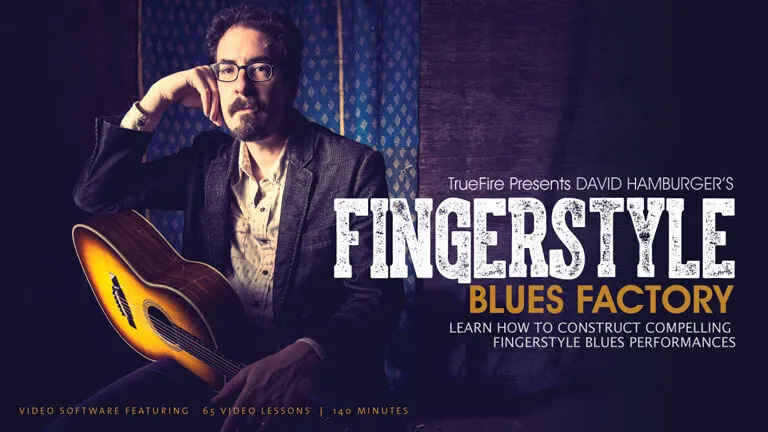
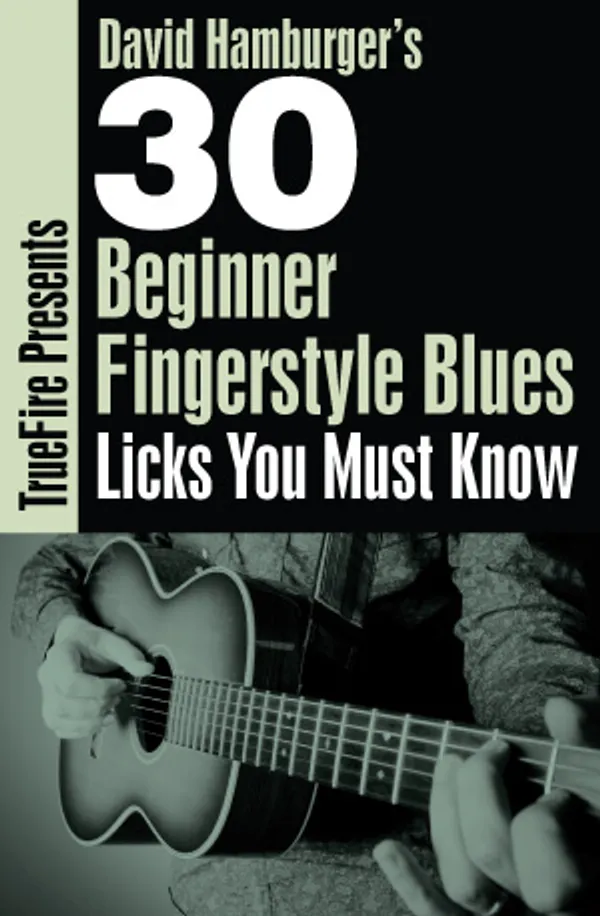
Nicolo Paganini and Robert Johnson sold their souls to the devil. That’s a pretty high price to pay to master one’s instrument. We can certainly sympathize with their urgency because who wants to spend twenty or more years shedding day and night? Who has that kind of time any more? So hey, to each his own.
Meanwhile, that option is no longer on the table. Beelzebub quit the music biz and is now doing quite well in politics and corporate affairs. So you’re left with two options; carve out the twenty years in the shed, or roll up your sleeves and go to work for a month or two with David Hamburger in his Fingerstyle Blues Factory.
OK, the twenty years in the shed is still the only path to real mastery, but David will indeed get you up and running more quickly than you could ever imagine. And once you’re up and running with the right and left-hand techniques, vocabulary and performance skills that you’ll acquire in the Factory, you’ll be adequately equipped and inspired to spend those twenty years pursuing that mastery.
“We're going to look at ways to play over both a steady-bass and alternating thumb bass, and focus on building our vocabulary in two of the most common keys for fingerstyle blues, E and A. Along the way we'll pick up moves in the styles of key players like Robert Johnson and Lightnin' Hopkins, learn essential chord voicings and turnarounds, explore syncopation, quarter-tone bends and other high-end concepts. By the time we're done, you'll have dozens of new licks under your fingers and eight whole choruses of fingerstyle blues to play.”
Hundreds, perhaps thousands, of fingerstyle blues tunes are performed in the keys of E and A and so, David set-up the Factory across six sections, all focused on those two keys. Each section builds on the key learnings acquired from the preceding sections to develop all of the fundamental skills and requisite vocabulary you’ll need to expand your repertoire exponentially.
In the first, second, third and fourth sections you’ll acquire a very tasty and very versatile vocabulary of licks, vamps, chord voicings and other essential moves to play over E, A, D and B chords (the 1, 4 and 5 chords for the keys of E and A). David will guide you through all of the techniques, rhythmic approaches and creative nuances needed to bring that vocabulary to life on your fretboard.
The fifth section delivers eight E and A turnarounds to distinguish your fingerstyle blues performances and then in the sixth and final section, you’ll put it all to work across four performance etudes: Rosedale Blues, South St Pete, Right Or Ronk and Ham’s Boogie. David performs the etude and then breaks it down for you move-by-move. Everything in the course is tabbed and notated.
You’ll play your way through the Fingerstyle Blues Factory. No tedious theory or boring exercises to struggle through. Hands down, there is no better, or quicker way to get squarely in the fingerstyle blues game.
If you’re still interested in doing a deal with Beelzebub, switch to politics. If you’re keen on becoming a fingerstyle blues player, grab your guitar and click now…
What you'll learn
Play E blues licks over an A bass note (IV chord approach)
Combine hammer-on/pull-off technique with steady bass notes
Execute smooth transitions between different fingerstyle patterns
Perform syncopated melodic phrases over steady bass
Combine multiple blues licks into a cohesive performance
Welcome to Fingerstyle Blues Factory! I've been fascinated with fingerpicking ever since I first started playing, and have loved the blues since I first heard it, so as far as I'm concerned, fingerstyle blues is the best of both worlds and an endlessly fascinating and flexible approach to explore. In this course, we're going to look at ways to play over both a steady-bass and alternating thumb bass, and focus on building our vocabulary in two of the most common keys for fingerstyle blues, E and A. Along the way we'll pick up moves in the styles of key players like Robert Johnson and Lightnin' Hopkins, learn essential chord voicings and turnarounds, and even talk about syncopation, quarter-tone bends and other high-end concepts. By the time we're done, you'll have dozens of new licks under your fingers and eight whole choruses of fingerstyle blues to play.
We're going to start with nearly a dozen licks to play on an E chord, some in the steady-bass style, some in the alternating-bass style. You can use these licks over the I chord on a blues in E, or, in some cases, as the V chord on a blues in A.
One thing to think about as you learn to play licks over a steady bass is that you’re either playing with the thumb, or you’re not. And by that piece of seemingly-smartass advice I mean: get the thumb in place, plunking out those quarter notes in the bass, and then notice where you’re pinching notes on the upper string with the bass, and when you’re playing a note (or notes) that land in between bass notes. It’s one or the other.
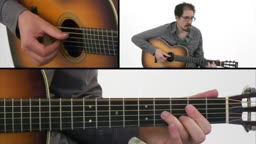
This lick is an adaptation of a move I first heard in the key of A on Stefan Grossman and John Renbourn’s recording of “Mississippi Blues #3” (originally recorded by William Brown in 1942 as “Missisippi Blues”). The E9 of this lick’s name comes at the top of the second bar, when you play a double stop with the b7 (3rd fret on the second string) and the 9th (2nd fret on the high string), then pass through an E6 double stop before resolving on just an E chord.
I sometimes picture the E7 shape used in this lick as an open D7 chord that’s been slid up two frets and then played without fretting the high string. Of course, if that just confuses you, don’t think of it that way. In fact, forget I ever said anything about it. [new paragraph] Playing three notes on top for every one bass note creates something called a “triplet feel,” also sometimes called a “12/8 feel.” Either way, you hear it all the time on slow blues tunes, whether electric (“Red House,” for example) or acoustic (“Kind Hearted Woman”).
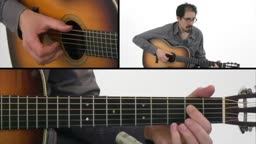
You gotta love the train whistle lick. If you’ve ever heard people going on about quarter-tone bends or, even more exotically, “microtonality,” this is all it is - bending to a note that’s somewhere in between two adjacent frets, and is therefore less than a half-step from its starting point. You know the sound, because you’ve heard it countless times in the blues: the bends we’re doing from the 8th fret of the second string are the sound of a note that’s reaching for, but not quite getting to, the full sweetness of a major third. There’s some great train whistle action on Roy Book Binder’s arrangement of “Friend Like Me,’ and Dave Van Ronk’s “Nobody Knows The Way I Feel This Morning” makes use of a similar kind of quarter-tone bend, without the double-stop.
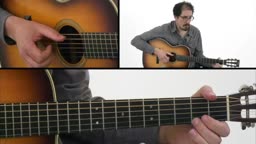
Sixths, while nearly impossible to pronounce, are the fingerstyle guitarist’s pal. They’re easier to finger than a full chord, yet provide more fullness over the bass than just a single note would. In the second measure of this lick, it’s the sixths on the offbeats that are our real destination: the double stop at the 7th fret helps to frame an E7 chord, as does the double stop at the 4th fret. And we lead into both of those double stops chromatically, or from the half-step below. The aforementioned Dave Van Ronk arrangement of “Nobody Knows The Way I Feel This Morning” is a great example of sixths in action.
The patterns are of very high quality,with well-balanced level of difficulty.
The instructions are clear. Personally,I m really enjoying them.
M
michaelmas
Verified buyer
12/08/25
Timeless Licks
A compendium of great timeless licks you can assemble like Lego in your playing. Each explained in detail.
M
marc2025
Verified buyer
11/14/25
Excellent content!
P
Piperk8
Verified buyer
08/05/25
Brilliantly thought out easy access.
True fire is brilliant. Easy to use, perfect bite size lessons. I have improved greatly within a month. Good value for money too. I’m super pleased with it all.