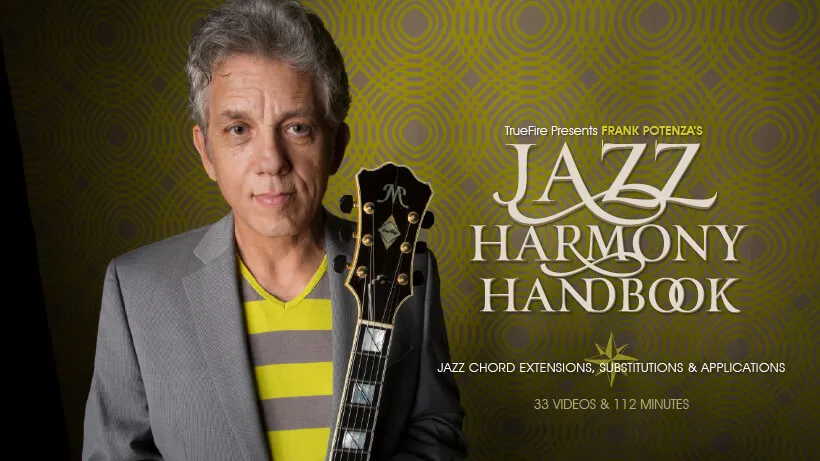
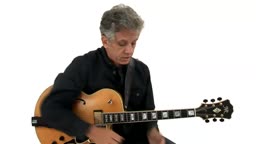
Jazz guitarists love the challenge of interpreting chord symbols and experimenting with extensions and chord substitutions, but this can often be a frustrating and daunting process, which takes most players years to master. With such a rich harmonic landscape to navigate, a little guidance from someone who’s been there and done that comes in very handy. Frank Potenza has indeed 'done that' and his Jazz Harmony Handbook guides you through many of the most powerful and versatile ways to add harmonic color and interest to your jazz guitar arrangements.
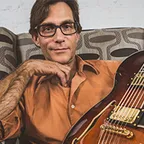
Recording artist and esteemed educator, Frank is a protege of the late, great Joe Pass with nine solo albums to his credit. He has performed with Dizzy Gillespie, George Van Eps, Joe Pass, Bud Shank, Mose Allison, James Moody, Brother Jack McDuff, and many others. Frank is also a passionate educator who is a full Professor and Chair of the Studio/Jazz Guitar Program at the University of Southern California. We’re thrilled to welcome Frank to the family with his first TrueFire course, the Jazz Harmony Handbook.
”In this Jazz Harmony Handbook, we'll be expanding our concept of interpreting jazz harmony on the guitar. We'll examine four fundamental forms – major blues, minor blues, circle changes and rhythm changes. For each form, we’ll start with shell voicings and then progress into the use of extensions, passing diminished chords, tritone substitution, back-cycling, diminished chord substitution, minor II/V’s and much more.”
Frank organized the Jazz Harmony Handbook into four sections, each of which features a variety of approaches that you can use to harmonize the most common changes you’ll encounter in the jazz songbook. In Section 1, Major Blues Harmony, you’ll start by playing through a major blues using extremely basic voicings made up of guide tones and then learn how to add color by extending the voicings to the 9th, 11th, and 13th, and by using a series of reharmonization techniques: Shell Voicings, Colorful Chord Extensions, Quick Switch & Turnaround, Two Fives & Back-cycling, Passing Diminished 1, Passing Diminished 2, Whole Steps & Tadd Dameron, Tritone Substitutions, and Extreme Substitution Example. Frank will then perform a full arrangement demonstrating many of these approaches in a musical context.
In Section 2, Minor Blues Harmony, you’ll follow the same approach of starting wit basic chords and then extending the voicings as well as applying colors from the use of minor II/V’s and diminished substitutes: Shell Voicings, Colorful Chord Extensions, Back-cycling & Diminished Subs, and then Minor Two Fives & More. Frank concludes this section with another full arrangement demonstration.
In Section 3, Frank introduces you to Circle Changes Harmony, a more harmonically complex blues progression that was prevalent in the bebop era. Again, you’ll begin by playing through the progression using guide tones, and then add color by extending the chords and applying substitution techniques. You'll also examine Bluesette, a jazz classic written by Toots Thielemans that’s closely related to circle changes.
In the fourth and final Section 4, you’ll examine and play through Rhythm Changes Harmony, a longer (32 bar) form. It’s based on George Gershwin’s I Got Rhythm, a standard tune that has become a jazz classic, and the basis for a great many contrafacts such as Charlie Parker’s Anthropology and Sonny Rollins’ Oleo. We'll begin by playing through the progression using guide tones, and then extend the chords and use reharmonization and substitution devices.
Frank demonstrates the examples and full arrangement performances over rhythm tracks. All of the performances are tabbed and notated for your practice, reference and study purposes. You’ll also get Guitar Pro files so that you can play, loop and/or slow down the tab and notation as you work through the lessons. Plus, Frank generously includes all of the rhythm tracks for you to work with on your own.
Grab your guitar and let’s jazz up our harmony with Frank Potenza!
What you'll learn
Use diminished chords to relocate on the fingerboard
Navigate multi-bar progressions through the circle of fifths
Apply quick 2-5 turnarounds in minor keys
Learn systematic approach to transposing material through all keys
Develop broader musical perspective by studying non-guitar instrumentalists
Hi, I'm Frank Potenza and welcome to the Jazz Harmony Handbook.
In this course, we'll be expanding our concept of interpreting jazz harmony on the guitar. We'll examine four fundamental forms – major and minor blues, circle changes and rhythm changes, starting with shell voicings and progressing into the use of extensions, passing diminished chords, tritone substitution, backcycling, diminished chord substitution, minor II/V’s and more.
I'll give you a performance at the end of each section, where I'll demonstrate how I'd approach harmonizing the changes with evolving complexity. Each example in the course comes with a lead sheet, tab, notation, and a live band jam track to best support each application. Alright, grab your guitar and let's play some jazz guitar harmony.
We'll begin by playing through a major blues using extremely basic voicings made up of guide tones, which are simply the 3rd and 7th of each chord. Then, we'll add color by extending these voicings to the 9th, 11th, and 13th, and by the use of reharmonization techniques.
In this lesson, we'll look at shell voicings that are made up of the 3rd and 7th of the chords, typically referred to as the "guide tones". These are a simple but powerful way of playing the essential harmony in a stripped down, bare bones sort of way. They provide a concise voice leading strategy that serves us well in playing blues progressions and much more. Notice how I often slide into them from one fret below to add nuance and vibe.
Here we'll begin to build on the shell voicings by adding other notes that are contained in the chords (roots and 5ths) and extensions (9ths, 11ths, and 13ths). This approach will make us much more aware of what we're using in our voicings and get us thinking about the use of moving lines as the top voice. We're also introduced to passing diminished chords and to several options for extending dominant chords in IIm7/V7 progressions.
In this segment, we'll add a quick switch to the IV chord in bar 2 of the blues as a typical way to add harmonic movement. We'll also look at the turnaround - a powerful way to set up the return to the top of the form. In the jam track, we have a IIm7/V7 in bar 4 to set up the IV chord in bar 5, and a full two-bar turnaround (F7/D7/ G7/C7/) at the end.
In this video, we examine the use of the IIm7/V7 progression in three different places in the progression as a way to add harmonic complexity and generate options that can be used at your own discretion. We're introduced to the use of a device known as backcycling, which provides a way to generate optional harmonic movement. Backcycling can be employed in blues progressions or in just about any song.
This lesson introduces the use of a passing diminished chord in Bar 6 (and NOT bar 5, as I say in the video). There is a discussion of the resolution of the bass line when using the passing diminished chord and related concerns. The two-bar turnaround in this segment is F7/D7/ G7/C7, a series of dominant 7th chords and another instance of backcycling that leaps from F7 to three steps back in the cycle of 5ths (D7) and then cycles back to the tonic chord.
Great course!
Must have especially the beginner
Learning Jazz is have to open your mind and to feel and practice everyday
Keep learning and garb your guitar and let’s beginning
D
Drew H.
04/26/21
Frank is top notch
Time well spent
J
jmsab99
Verified buyer
03/24/21
A world of Jazz harmony
It is a great course from Frank Potenza. He did a great job in the course to show the harmony around the world of jazz. All is there and more to understand et play the harmony of jazz. The course is well structured and his explanations are clear.
R
Revman2015
02/28/21
Craftmanship
Frank Potenza’s instruction is clear right from the get go! This course in particular is fantastic for learning the techniques of how to play and craft your playing on multiple layers, with the great set ups and voicings . Using visionary craftsmanship in different sections of the tune to fill out the sound its quite amazing his perspective compared to others. Genius..
O
Osokin
Verified buyer
02/25/21
Frankly Brilliant!
Expand your chordal vocabulary and knowledge of jazz harmony with Frank Potenza, who is both a great player and teacher. The course is very digestible with clear explanations and lots of examples. The real deal!