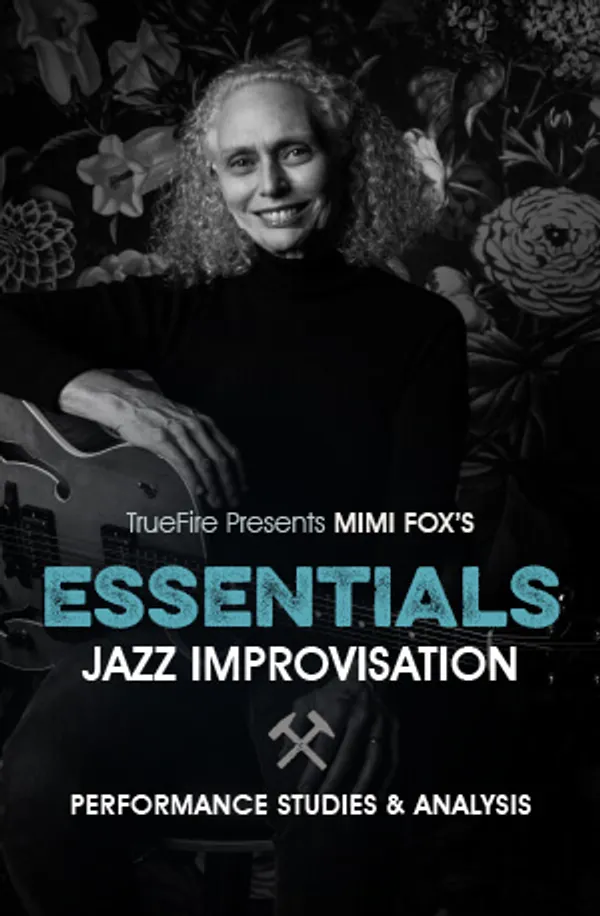










Jazz Trio Comping

Comping & Harmonic Approaches for the Jazz Guitarist

Marty FriedmanTommy EmmanuelSteve VaiEric GalesEric Johnson

Get this course and 1,000+ more with All Access

Try 14 days free. Cancel any time.

Purchase Individual Course for $19.99
Jazz Trio Comping

About this course

Comping in a trio setting is a critical skill for the jazz guitarist. Chord selection, locking in with the rhythm section, playing in different meters, establishing the harmonic texture and character of the tune -- these are all crucial responsibilities.

Play your way through the 10 comping performance studies in Mimi Fox’s Jazz Trio Comping course and you’ll be well-equipped to hold up your end of the bargain in any rhythm section, on any jazz bandstand.

Mimi will guide you through performance studies based on the most commonly-encountered jazz changes in a variety of feels, tempos and keys. Along the way, she’ll show you a a wide range of comping techniques, chord voicings, rhythm patterns, and harmonic approaches.

For each of the 10 comping performance studies, Mimi will first perform the parts over a backing track followed by a detailed analysis and application summary.

Mimi will explain and demonstrate all of the key concepts and approaches along the way.  You’ll get standard notation and tabs for all of the Comping Performance Studies. Plus, Mimi includes all of the rhythm tracks for you to work with on your own. In addition, you’ll be able to loop or slow down any of the videos so that you can work with the lessons at your own pace.

Grab your guitar and let’s comp some changes with Mimi Fox!

What you'll learn

  • Apply voice leading techniques to create smooth chord transitions
  • Integrate melodic movement within rhythm guitar comping
  • Create more musical and interesting accompaniment parts
  • Learn chord selection techniques for jazz comping
  • Understand the critical role of comping in jazz trio settings
Release date: 08/23/2018 • 2h 10m runtime
Start Course
Sample lessons
Completely Blues
Completely Blues
Overview
Completely Blues
Completely Blues
Performance
Completely Blues
Completely Blues
Analysis & Application
No Greater Changes
No Greater Changes
Overview

What's included

32 lessons • 10 charts • 10 Jam Tracks

Jazz Trio Comping
Hi, I'm Mimi Fox, and welcome to Jazz Trio Comping.

Comping in a trio setting is a critical skill for the jazz guitarist. Chord selection, locking in with the rhythm section, playing in different meters, establishing the harmonic texture and character of the tune — these are all crucial responsibilities.

In this course, we'll play through 10 performance studies. in a variety of feels, tempos and keys. Along the way, I'll show you a variety of comping techniques and harmonic approaches. Everything is tabbed and notated, plus you'll have the backing tracks to play along with on your own. You can loop and slow down the videos to work at your own pace.

Grab your guitar and lets get started!
Staying Home
For those new to jazz and jazz comping, these changes are a great place to start! They move through basic one, six, two, five chords and then the B section goes to the four chord.

Remember that though these voicings may be new to you, there is usually a more familiar chord in the same area of the neck (such as a triad) that can help you locate the new chords. For more experienced players, you can challenge yourself with all of these chords by adding the more complex voicings that I gradually add as the piece develops.

There's a lot that can be gleaned from getting these basic changes under your belt...transposed to other keys for example, you can apply these voicing to scores of tunes with similar changes.
Staying Home
The most important thing that you should take away from this performance is the way that I'm locking in with the rhythm section. The guitar part fits beautifully with the bass/drums and creates a great foundation for a horn player, or another soloist to play over.

A cool thing that is emblematic of my playing style is the chordal harmonic that I use over the G7 chord at one point. I hit the open harmonics on the 12th fret which basically creates a G major sixth chord. This is an easy and colorful way to create interest in a comping part.

Another really important aspect of this performance to take note of is how relaxed my right hand is when I'm playing. No matter how simple or how intricate the rhythm that I'm playing is, my right hand remains loose. This is a very important thing for playing the guitar in general but is especially true for successful comping.
Staying Home
One of the best things you can do while learning to comp is to listen to other guitarists and pianists comp. You can start with Freddie Green and your studies would logically lead you to pianists such as Cedar Walton, Tommy Flanagan, Chick Corea, McCoy Tyner, etc. There is a lot to be learned from how pianists approach comping. Well worth your time exploring. Of course, as with soloing, sometimes what you leave out may be as important as what you play! Space is important when you are supporting a soloist and so is dynamics. Listen closely to everyone you play with and try to compliment what they are playing in a sensitive and intelligent manner. Your fellow musicians will greatly appreciate your efforts!
Completely Blues
I strongly recommend that you listen to different versions of this piece. There are different versions of Miles Davis and his group performing it at various tempos and other artists have recorded it as well. I recorded a solo guitar version of this piece on my album Standards that has a very different feel/groove than the original. The song only has 4 basic chords so there is a lot of opportunity for embellishment and rhythmic variety. Try playing the song at different tempos to see how that affects what you play. Also, it's a good idea to play the song in different keys because you may be called upon to play the piece with a jazz vocalist who needs to have the song transposed in order to sing it comfortably. It's great practice to be able to play songs in different keys and this is an easy place to start!
Completely Blues
One of the things you should notice immediately when listening to this performance is how often I'm sliding into a given chord from a half step below. For example, many times I'm playing a Gb7 chord before I play the G7 chord. This approach adds color and is stylistically very important. Plus, it's fun and sounds hip! I strongly recommend that you play along with me and get a strong sense of how this sliding technique propels the comping forward and fits logically with the bass/drums.

What you play does not have to be complicated to greatly enhance the over all sound. Sometimes I am simply adding a 9th or an 11th to the chord and it creates added color very elegantly. The jazz rhythm section is essentially a kind of altruistic democracy where everyone contributes for the greater good of the group sound and cohesion. Your fellow musicians expect you to contribute richly and abundantly to make this happen! Practice these ideas at home by yourself and then you will be ready to apply them at the next rehearsal/jam session.
Completely Blues
Two important concepts that I demonstrate in this lesson concern double stops (intervals) and voice leading. Both of these concepts can lead you to some very cool and rich harmonic ideas! As with all of this material, everything should be practiced at a turtle clip. Practicing slowly is important for the hand/eye/ear coordination, but it also helps you to reinforce what you are learning and hence to remember the cool ideas you are working out.

For double stops, practice harmonizing a scales up-and-down the neck of the guitar. You should start with thirds and then try other intervals as well. You should practice playing your intervals on all string sets.

For voice leading, practice playing a chord with every note in a given scale. For this piece, start with the G Mixolydian scale. This is also the same scale as C major. Integrating intervals and voice leading into your comping will give you a more sophisticated sound and greatly enhance your musical palette.

+ 25 more lessons

Start Course

Reviews

18 results

Ohio5665

Verified buyer

11/12/23

I enjoyed these comping lessons by Mimi Fox very much.She presents you with different ideas,chord voicings and concepts to use over jazz standards and explains her ideas clearly. Love her rhythm changes lesson! Thank you.


ERIVELTO

Verified buyer

11/15/22

Comping trio

The course have great ideias for comping trio and essencial ideias for jazz style. Mimi Fox is a great player and great teacher too.

JThompsonUK

01/03/22

jazz trio comping

Another great course from Mimi Fox. I am new to jazz or at least trying to play, apart from some simple versions of some classics I know. I've long wanted to learn this style as I love the sounds and changes. Mimi offers the usual wealth of info and advice as she goes along, often demonstrating different voicings and giving explanations of what she is doing. I find she does leave some gaps but for me that is fine it is gaps in my knowledge and I should probably have gone through earlier courses but atm I am just looking around the courses and getting a grasp of what is in the courses, so I can decide where to start my practising and taking some things I really like along the way too :) I now have most of mimi fox's courses other than the new practise one but am a member now so can view that one as a member :)

kach

Verified buyer

10/07/21

Excelente guitarrista de jazz, una de las mejores instructoras de truefire y sus cursos son de los mejores. Buenos temas y el desarrollo que les da esta muy bien y muy buen material didáctico.

jkeith

07/09/21

Discovering the musical elements of guitar playing

Mimi Fox is one of the best teachers out there and one of my favorite jazz artists. Mimi uses an exploratory approach to teaching that I find very similar to Robben Ford's teaching style. She doesn't just *tell you* what to do but rather demonstrates the process of discovering the underlying musical elements of guitar playing in real time; it brings the student along the journey. I don't know how else to describe it. Whatever it is, it's been extremely effective for me. And it's fun!

Stop searching. Start improving with All Access.

Try 14 days free. Cancel any time.