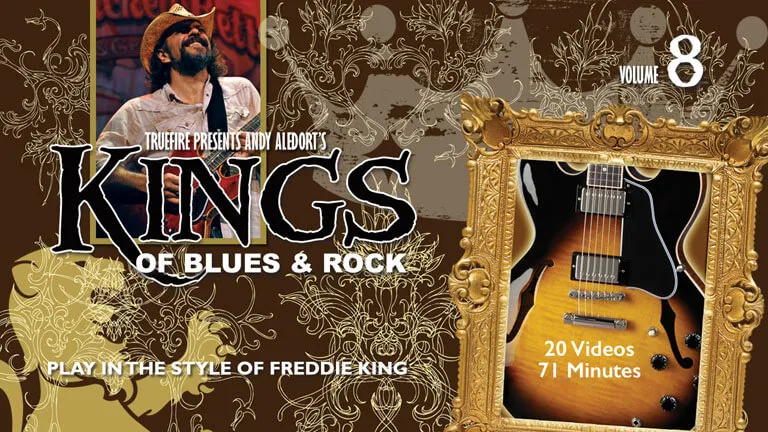
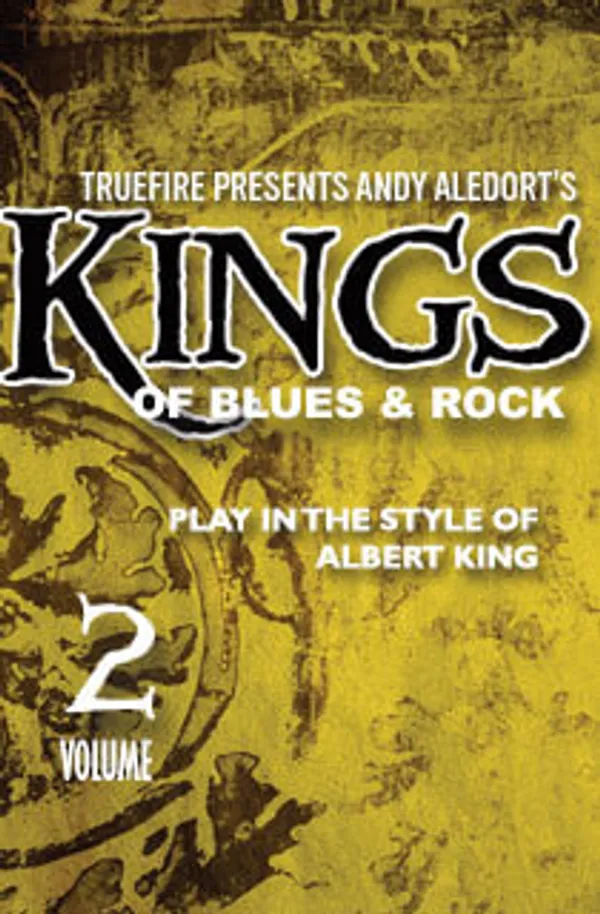
Kings of Blues & Rock examines the playing styles of eight of the greatest and most influential blues and rock guitarists that have ever lived: Eric Clapton, Duane Allman, Jimmy Page, Johnny Winter, T-Bone Walker, B. B. King, Albert King and Freddie King. Kings of Blues & Rock is presented in eight Volumes, one volume for each artist.
This volume of video guitar lessons examines the playing style of Freddie King. A little younger than his fellow "Kings," Freddie King was born in 1934 in Texas, and the combination of his youth and proximity lend a vibrant intensity to his playing that sets him apart from Albert and B.B. Freddie spent a lot of time in Chicago as a teenager, learning at the feet of Howlin' Wolf and Muddy Waters, and picked up many playing tips from Jimmy Rogers, Muddy's guitarist. Freddie first made a name for himself with a string of very successful instrumentals, like "Hideaway" - covered brilliantly by Eric Clapton with the Bluesbreakers - as well as "The Stumble," "San-Ho-Zay" and "Sen-Say-Shun."
Though there is a lot of B.B. in Freddie's early style, he soon created a sound all his own, one earmarked by fast, biting licks and incredible intensity. Also, he modernized the blues with his seminal Shelter recordings in the mid-70s, produced by Leon Russell, which focused on hard-driving funk as well as sophisticated modern blues.
Kings of Blues & Rock will impact your playing in two distinctly different but equally important ways: first, you will learn how to play guitar in the style of Freddie King; more importantly, you will be able to take this information and use it to create your own style and sound in rock and blues guitar.
The playing styles of each artist is examined in a variety of musical settings designed around the artists' signature style and performances. All of the solo segments are played first at tempo, over practice rhythm tracks, and then presented slowly with thorough explanations. Practice rhythm tracks are provided so that you can practice the solo examples as presented and work on creating your own solo variations and ideas. Also discussed is the type of guitar and amp each artist favors, and the means by which they achieve their distinct, signature sound.
What you'll learn
Navigate position shifts using BB King style techniques
Use quarter note triplets and rhythmic superimposition in blues solos
Apply chromatic triplet licks in the style of Freddie King
Incorporate chord tone targeting (6th chords, IV chord relationships)
Understand when to use flat 3rd vs. major 3rd in blues phrasing
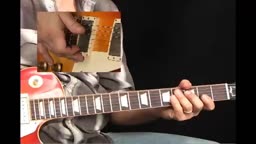
Freddie King was a little bit younger than B.B. and Albert King, and was greatly influenced by B.B. at the beginning of his career. But ultimately Freddie King developed his own immensely powerful, original sound, earmarked by a razor-sharp attack, gutbucket intensity and lyrically melodic phrasing. This track is a straight-ahead rocker in A, and bars 1 and 3 feature a stock Freddie-ism: the muted-string reverse rake that falls right on beat two of each bar. After fretting the initial C note on beat one of bars 1 and 3, lay the underside of the fret-hand index finger lightly across the top three strings without depressing the strings to the fretboard; then drag the pick from the first string to the third string in one continuous upstroke.
Another essential element in this solo is the fact that it is devised of a series of specific melodic phrases: the opening riff, which is played twice, is followed by a funky low-string thematic-type riff. Then another thematic phrase is introduced over the V7 and IV7 chords at the latter part of the progression.
Freddie King was a little bit younger than B.B. and Albert King, and was greatly influenced by B.B. at the beginning of his career. But ultimately Freddie King developed his own immensely powerful, original sound, earmarked by a razor-sharp attack, gutbucket intensity and lyrically melodic phrasing. This track is a straight-ahead rocker in A, and bars 1 and 3 feature a stock Freddie-ism: the muted-string reverse rake that falls right on beat two of each bar. After fretting the initial C note on beat one of bars 1 and 3, lay the underside of the fret-hand index finger lightly across the top three strings without depressing the strings to the fretboard; then drag the pick from the first string to the third string in one continuous upstroke.
Another essential element in this solo is the fact that it is devised of a series of specific melodic phrases: the opening riff, which is played twice, is followed by a funky low-string thematic-type riff. Then another thematic phrase is introduced over the V7 and IV7 chords at the latter part of the progression.
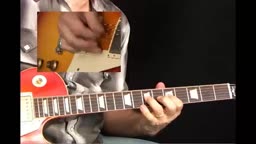
This solo excerpt begins with repeated trills from the open G string to A, sounded at the second fret. Each trill is picked in a rhythm of quarter-note triplets, which means that the first and second pair of beats in each bar are divided into three even subdivisions, also known as "threes on twos." Though all of these phrases are relatively simple, there is a sense of melodic development that carries through the entire 12-bar section. Notice also the sharpness in the picking attack, another earmark of Freddie's sound.
This solo excerpt begins with repeated trills from the open G string to A, sounded at the second fret. Each trill is picked in a rhythm of quarter-note triplets, which means that the first and second pair of beats in each bar are divided into three even subdivisions, also known as "threes on twos." Though all of these phrases are relatively simple, there is a sense of melodic development that carries through the entire 12-bar section. Notice also the sharpness in the picking attack, another earmark of Freddie's sound.
One of Freddie King's most famous slow blues is "Have You Ever Loved a Woman," covered exquisitely by Eric Clapton on the Derek and the Dominoes album Layla and Other Assorted Love Songs. This excerpt represents the first six bars of a slow 12-bar blues in C, and all of the licks here are based on C minor pentatonic (C Eb F G Bb). Many of the licks in this example indicate the B.B. King influence, but Freddie used a more aggressive attack and a sharper tone, courtesy of the bridge pickup and a little overdrive from cranking up the amplifier.
One of Freddie King's most famous slow blues is "Have You Ever Loved a Woman," covered exquisitely by Eric Clapton on the Derek and the Dominoes album Layla and Other Assorted Love Songs. This excerpt represents the first six bars of a slow 12-bar blues in C, and all of the licks here are based on C minor pentatonic (C Eb F G Bb). Many of the licks in this example indicate the B.B. King influence, but Freddie used a more aggressive attack and a sharper tone, courtesy of the bridge pickup and a little overdrive from cranking up the amplifier.
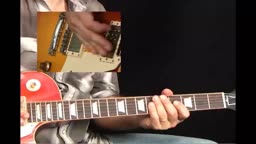
This excerpt represents the second half of the 12-bar progression, and the majority of these lines are based on C minor pentatonic. On beat two of bar one I create the top part of a C major triad-the E and G notes-by first barring the index finger across the eighth fret of the G and B strings, quickly hammering on from the eighth to the ninth fret on the G string, from Eb to E natural. The lines that follow combine 16th and eighth notes in a rhythmically interesting way, all articulated with a slightly "clipped" attack a la Freddie.
JUST GETTING STARTED ON THIS COURSE BUT I'M LOVING THE WAY THE MATERIAL IS PRESENTED AND SHOWN.
I'M SURE I'LL END UP PICKING UP SOME OF THE OTHERS IN THIS SERIES.
I
ibanezjs20
Verified buyer
08/17/21
This is the signature licks from this fenomenal player, its a keeper
H
hansjohn
Verified buyer
07/15/21
Nice lessons and great licks for all to play
W
wholmer
12/23/20
One of the Three Kings of the Blues Guitar
Andy Aledort’s King series is like a collection of the bible of the blues. I own 7 of them and the way Andy breaks down the solos AND telling why the notes fit together is a priceless education. Adding Freddie to the set completes the trinity of the Kings. Once again, thanks Andy!