Kings of Rock & Roll Vol. 5: Eric Clapton

Examine the blues guitar playing style and soloing of Eric Clapton

Marty FriedmanTommy EmmanuelSteve VaiEric GalesEric Johnson

Get this course and 1,000+ more with All Access

Try 14 days free. Cancel any time.

Purchase Individual Course for $9.99
Kings of Rock & Roll Vol. 5: Eric Clapton

About this course

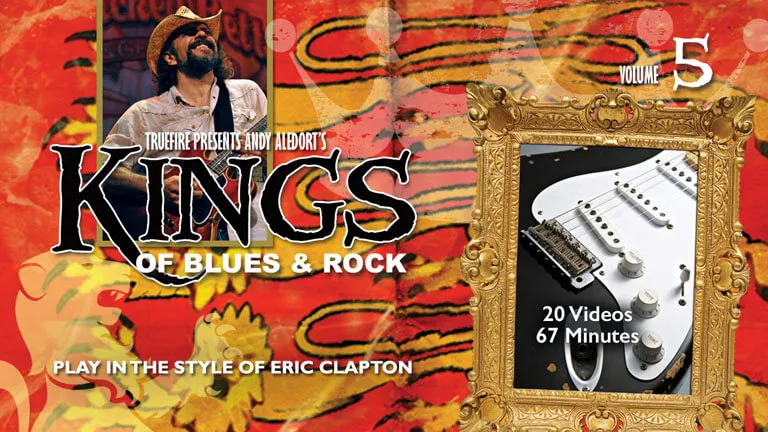
Kings of Blues & Rock examines the playing styles of eight of the greatest and most influential blues and rock guitarists that have ever lived: Eric Clapton, Duane Allman, Jimmy Page, Johnny Winter, T-Bone Walker, B. B. King, Albert King and Freddie King. Kings of Blues & Rock is presented in eight Volumes, one volume for each artist.

This volume of video guitar lessons examines the playing style of Eric Clapton. Without Eric Clapton, we may never have heard the sounds of blues/rock, hard rock, metal and everything that came after it. Born in 1945, Eric was the prime mover in the British Blues boom, first appearing as a member of the Yardbirds and releasing the essential proto-blues/rock recordings "I Ain't Got You" and "Got to Hurry." His move to John Mayall's Bluesbreakers resulted in the essential recording, Bluesbreakers: John Mayall with Eric Clapton, and Eric's mercurial, mind-boggling soloing on tracks like "Steppin' Out," "Hideaway" and "Double Crossing Time" soon earned Eric the nickname "God." One could easily count Jimi Hendrix, Jimmy Page, Jeff Beck, and Peter Green all as disciples of Eric's early work.

Eric is known for his incredibly deft phrasing and fluid vibrato, and, though influenced by B.B. King, Buddy Guy and Otis Rush, has a distinct quality all his own. His playing is very expressive and, at times, vocal-like, but also erupts in blasts of pure virtuosity. A complete study of Eric's playing is essential for any guitarist interested in playing either blues or blues/rock.

Kings of Blues & Rock will impact your playing in two distinctly different but equally important ways: first, you will learn how to play in the style of Eric Clapton; more importantly, you will be able to take this information and use it to create your own style and sound in rock and blues guitar.

The playing styles of each artist is examined in a variety of musical settings designed around the artists' signature style and performances. All of the solo segments are played first at tempo, over practice rhythm tracks, and then presented slowly with thorough explanations. Practice rhythm tracks are provided so that you can practice the solo examples as presented and work on creating your own solo variations and ideas. Also discussed is the type of guitar and amp each artist favors, and the means by which they achieve their distinct, signature sound.

What you'll learn

  • Apply Albert King influenced bending techniques in Clapton's style
  • Execute complex rhythmic subdivisions including 16th note triplets
  • Create tension and release through phrase density and pacing
  • Switch fluidly between minor and major pentatonic scales
  • Incorporate the 'twos on threes' polyrhythmic feel
Release date: 08/23/2007 • 1h 07m runtime
Start Course
Sample lessons
Badge: Ex. 1a
Badge: Ex. 1a
Breakdown
Badge: Ex. 1b
Badge: Ex. 1b
Performance
Badge: Ex. 1b
Badge: Ex. 1b
Breakdown

What's included

20 lessons • 10 charts • 5 Jam Tracks

Badge
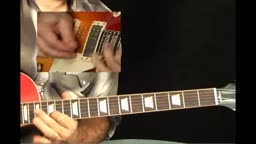
"Badge" is a song Eric Clapton recorded with Cream for the band's last album, Goodbye, and this solo excerpt is along the lines of what he played over the first eight bars: over a chord progression of Cadd9-G/B-D, I use a combination of the D minor pentatonic scale (D F G A C) and the D major pentatonic scale (D E F# A B); switching between these two scales is a staple of blues and blues/rock soloing, and, in Eric's case, reveals the strong influence of B.B. King on his playing.
Badge: Ex. 1a
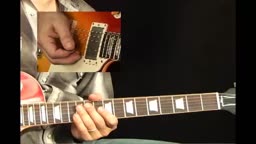
"Badge" is a song Eric Clapton recorded with Cream for the band's last album, Goodbye, and this solo excerpt is along the lines of what he played over the first eight bars: over a chord progression of Cadd9-G/B-D, I use a combination of the D minor pentatonic scale (D F G A C) and the D major pentatonic scale (D E F# A B); switching between these two scales is a staple of blues and blues/rock soloing, and, in Eric's case, reveals the strong influence of B.B. King on his playing.
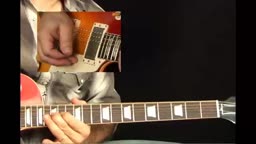
Badge: Ex. 1b
This excerpt represents the closing six bars of the "Badge" solo, at the end of which the chord progression resolves to Am and the return to the verse section. This excerpt begins with riffs played in what is known as the "B.B. box," so-called because of its close association with the blues master. In this excerpt, the "B.B. box" is located in 15th position, with the index finger functioning as the anchor on the B string at the 15th fret.
Badge: Ex. 1b
This excerpt represents the closing six bars of the "Badge" solo, at the end of which the chord progression resolves to Am and the return to the verse section. This excerpt begins with riffs played in what is known as the "B.B. box," so-called because of its close association with the blues master. In this excerpt, the "B.B. box" is located in 15th position, with the index finger functioning as the anchor on the B string at the 15th fret.
Crossroads
The solo Eric Clapton recorded for Cream's live version of "Crossroads," inspired by Delta blues master Robert Johnson's "Crossroad Blues" and featured on Cream's brilliant double album Wheels of Fire, remains one of the most essential blues/rock solos of all time - a must-learn for any aspiring blues or rock guitarist. This excerpt is played along the lines of Eric's first 12-bar solo, and alternates between A major pentatonic (A B C# E F#) and A minor pentatonic (A C D E G). The first two bars are based on A major pentatonic and then the lines shift seamlessly into A minor pentatonic.
Crossroads: Ex. 2a
The solo Eric Clapton recorded for Cream's live version of "Crossroads," inspired by Delta blues master Robert Johnson's "Crossroad Blues" and featured on Cream's brilliant double album Wheels of Fire, remains one of the most essential blues/rock solos of all time - a must-learn for any aspiring blues or rock guitarist. This excerpt is played along the lines of Eric's first 12-bar solo, and alternates between A major pentatonic (A B C# E F#) and A minor pentatonic (A C D E G). The first two bars are based on A major pentatonic and then the lines shift seamlessly into A minor pentatonic.
Crossroads: Ex. 2b
This excerpt offers another 12-bar example of soloing over a "Crossroads"-type groove, starting with A minor pentatonic in 13th position and then shifting to A major pentatonic in bars 5 & 6 before moving up to A minor pentatonic in 17th position for the rest of the solo. Ascending the fretboard in this way in the development of a solo is a staple of Clapton's style.

+ 13 more lessons

Start Course

Reviews

12 results

wintermelon

Verified buyer

03/24/24

First-class collection

Lots of good info and guidance for guitarists from a host of real pros. This is a great intro to a variety of approaches and styles.
Alexgiard

Verified buyer

08/27/23

Clapton style

Interesting and well explained to understand and repeat some famous Clapton songs

Stratotao

Verified buyer

09/09/22

EC

Clapton is the god! :)

psalm119

Verified buyer

08/25/22

Excellent

This is a must have instructional , Andy is a great teacher and player , absolutely. a must have series .

wholmer

12/23/20

Clapton is God!

Some of these lessons are quite a challenge. That's why they called him God! The stuff I couldn't get under my fingers I just took it and made them my own and it made a world of a difference. By adding these phrases to my vocabulary, I can add more complex ideas to my playing. Thanks, Andy, for making it all a little easier!

Stop searching. Start improving with All Access.

Try 14 days free. Cancel any time.