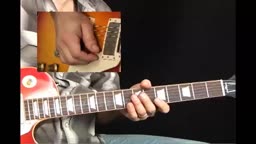
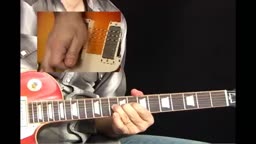
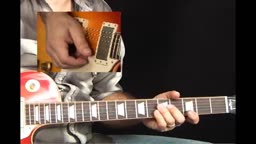
Kings of Blues & Rock examines the playing styles of eight of the greatest and most influential blues and rock guitarists that have ever lived: Eric Clapton, Duane Allman, Jimmy Page, Johnny Winter, T-Bone Walker, B. B. King, Albert King and Freddie King. Kings of Blues & Rock is presented in eight Volumes, one volume for each artist.
This volume of video guitar lessons examines the playing style of Albert King. Albert King is one of the most fiercely individual guitarists that ever lived, in any genre of music. Part of the uniqueness of his style stems from the fact that he took a right-handed guitar and it upside down and played it lefty; additionally, he tuned the strings down a full step and a half, making them very slinky and easy to bend, as string-bending is one of the most important elements in his approach.
Albert's style is deceptive in that it sounds way simpler than it really is: he had a horde of stock licks and phrases that he relied on, but he never, ever sounded predictable, always mixing up his improvised riffs with pure inspiration and intensity. He often bent the strings one and a half, two and two and a half steps - known as "overbends" - and would also bend multiple strings at a time, creating a thunderously expressive sound. It is these types of licks that influenced the likes of Jimi Hendrix, Stevie Ray Vaughan, Eric Clapton and Buddy Guy the most.
Kings of Blues & Rock will impact your playing in two distinctly different but equally important ways: first, you will learn how to play guitar in the style of Albert King; more importantly, you will be able to take this information and use it to create your own style and sound in rock and blues guitar.
The playing styles of each artist is examined in a variety of musical settings designed around the artists' signature style and performances. All of the solo segments are played first at tempo, over practice rhythm tracks, and then presented slowly with thorough explanations. Practice rhythm tracks are provided so that you can practice the solo examples as presented and work on creating your own solo variations and ideas. Also discussed is the type of guitar and amp each artist favors, and the means by which they achieve their distinct, signature sound.
What you'll learn
Perform pre-bends and releases in various rhythmic contexts
Apply Albert King-style bending vocabulary to blues solos
Play phrases using dotted quarter note triplets in 12/8 time
Coordinate right-hand muting with left-hand bend releases
The great Albert King redefined electric blues guitar with his incredible, explosive string bending and brilliant phrasing. Because he played in a wholly unorthodox manner-with the strings upside down (his guitar was strung for a righty but played left-handed) and tuned down one and a half steps-it is very difficult to recreate his sound and feel on a standard-tuned and strung guitar. But countless guitarists have been trying hard to do just that for more than four decades.
All of the riffs here, played over the first six bars of a standard 12-bar blues progression, are based on G minor pentatonic (G Bb C D F), and I use fingerpicking as opposed to flatpicking in order to pull up on the strings and snap them against the fretboard, which is an essential element in Albert's articulation. Pay close attention to your intonation when bending the strings; there are many variations and Albert always nailed every riff with absolute conviction.
The great Albert King redefined electric blues guitar with his incredible, explosive string bending and brilliant phrasing. Because he played in a wholly unorthodox manner-with the strings upside down (his guitar was strung for a righty but played left-handed) and tuned down one and a half steps-it is very difficult to recreate his sound and feel on a standard-tuned and strung guitar. But countless guitarists have been trying hard to do just that for more than four decades.
All of the riffs here, played over the first six bars of a standard 12-bar blues progression, are based on G minor pentatonic (G Bb C D F), and I use fingerpicking as opposed to flatpicking in order to pull up on the strings and snap them against the fretboard, which is an essential element in Albert's articulation. Pay close attention to your intonation when bending the strings; there are many variations and Albert always nailed every riff with absolute conviction.
This excerpt is played over the second half of a standard 12-bar blues progression, and begins with a brief reference to G major pentatonic (G A B D E) in bar 1, quickly moving right back within the same phrase-to G minor pentatonic. Because Albert's strings were upside-down, it was easier for him to pull down and put a big giant vibrato on the root note G fretted on the high E string. This is much more unnatural when strung normally, so it will take some practice to learn to apply this vibrato to good effect.
This excerpt is played over the second half of a standard 12-bar blues progression, and begins with a brief reference to G major pentatonic (G A B D E) in bar 1, quickly moving right back within the same phrase-to G minor pentatonic. Because Albert's strings were upside-down, it was easier for him to pull down and put a big giant vibrato on the root note G fretted on the high E string. This is much more unnatural when strung normally, so it will take some practice to learn to apply this vibrato to good effect.
A standard blues practice is for the band to play an expressive rhythmic figure in unison followed by silence, during which the guitar (or any soloing instrument, as well as a voice) drops in an improvised melodic idea. Albert Kings' recording of "Blues Power," from his classic album Live Wire/Blues Power, offers some of the greatest examples of this technique ever heard.
Across the first four bars of this example, just about every variety of bend-half-step, whole-step, one and a half-steps and two whole steps-is performed from the same high Bb fretted on the 11th fret of the B string. Albert's intonation was always perfect, so you will definitely have your work cut out for you.
A standard blues practice is for the band to play an expressive rhythmic figure in unison followed by silence, during which the guitar (or any soloing instrument, as well as a voice) drops in an improvised melodic idea. Albert Kings' recording of "Blues Power," from his classic album Live Wire/Blues Power, offers some of the greatest examples of this technique ever heard.
Across the first four bars of this example, just about every variety of bend-half-step, whole-step, one and a half-steps and two whole steps-is performed from the same high Bb fretted on the 11th fret of the B string. Albert's intonation was always perfect, so you will definitely have your work cut out for you.
Another essential Albert King technique involves multiple string bends: as illustrated right on beat one of bar 1 of the example, both the B and G strings are fretted with the fingertip of the ring finger, which is accomplished by first bending the B string and then catching the G string underneath the fretting finger. In this case, both strings are bent two whole steps, so you will have to put some muscle into it to achieve the desired effect. A great exercise is to practice all increments of bending from that same Bb note, and then do the same while fretting two and three strings simultaneously.
Ótimo curso para aprender frases desse mestre do blues. Essencial.
P
pmorey
Verified buyer
06/20/22
Some useful licks here
H
hansjohn
Verified buyer
07/20/21
Albert King
Great insight into Albert Kings style.
W
wholmer
12/23/20
Fly the Flying V
Albert King could make that flying V soar! Even with the respect that Albert gets from hard-core blues fans, he still is under-rated. Outstanding guitarist, great musician. Many times, I thought I was hearing BB only to find out it was Albert. Thanks, Andy, for bringing him back to life!
T
twizzler
Verified buyer
05/05/20
Great Blues Series
I have about 4 of the "Kings" series and they are consistently great ways to explore the blues stylings of these blues masters. Highly recommended.