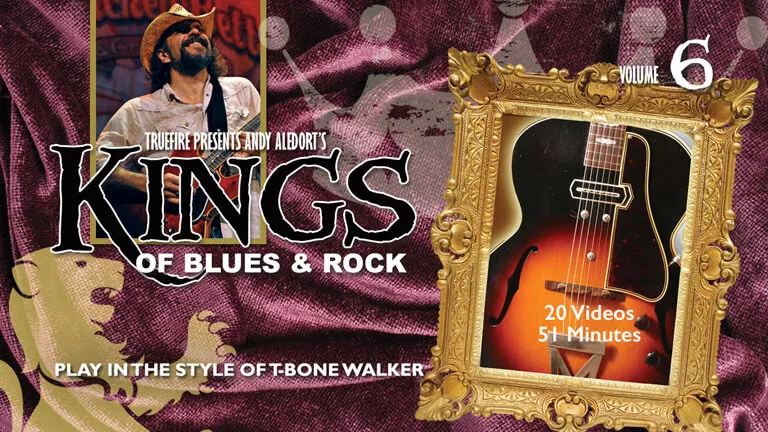

Kings of Blues & Rock Vol. 6: T-Bone Walker

Examine the blues guitar style and soloing techniques of T-Bone Walker

Marty FriedmanTommy EmmanuelSteve VaiEric GalesEric Johnson

Get this course and 1,000+ more with All Access

Try 14 days free. Cancel any time.

Purchase Individual Course for $9.99
Kings of Blues & Rock Vol. 6: T-Bone Walker

About this course

Kings of Blues & Rock examines the playing styles of eight of the greatest and most influential blues and rock guitarists that have ever lived: Eric Clapton, Duane Allman, Jimmy Page, Johnny Winter, T-Bone Walker, B. B. King, Albert King and Freddie King. Kings of Blues & Rock is presented in eight Volumes, one volume for each artist.

This volume of video guitar lessons examines the playing style of T-Bone Walker. Born in 1910, T-Bone is universally regarded as the father of the electric blues guitar. He learned about blues guitar directly from two blues giants, Blind Lemon Jefferson and Leadbelly. He was one of the genre's first electric players, and claimed that he got his first electric guitar as early as 1935. His 1947 recordings of his compositions "Call it Stormy Monday" and "T-Bone Shuffle" are among the most important and most influential blues recordings ever made, and have since become "standards" for all blues and blues/rock guitarists.

With his amplified electric offering greater volume and sustain, T-Bone was able to emulate the solo lines of saxophones and other horn players in his flatpicked single-note solos. T-Bone was one of the first guitarists to use string-bending as a major component in his approach, which was a prime influence on B.B. King, who has stated that it was T-Bone's solos that made him want to play blues guitar. He also was a virtuoso soloist, spinning out fast and complex jazz-like lines using alternate picking much of the time.

Kings of Blues & Rock will impact your playing in two distinctly different but equally important ways: first, you will learn how to play guitar in the style of T-Bone Walker; more importantly, you will be able to take this information and use it to create your own style and sound in rock and blues guitar.

The playing styles of each artist is examined in a variety of musical settings designed around the artists' signature style and performances. All of the solo segments are played first at tempo, over practice rhythm tracks, and then presented slowly with thorough explanations. Practice rhythm tracks are provided so that you can practice the solo examples as presented and work on creating your own solo variations and ideas. Also discussed is the type of guitar and amp each artist favors, and the means by which they achieve their distinct, signature sound.

What you'll learn

  • Use sliding 9th chord voicings as melodic devices
  • Target chord tones when soloing over chord changes
  • Play rhythmically daring phrases by superimposing different time feels over swing rhythm
  • Create melodic interest through rhythmic variation
  • Switch fluidly between different rhythmic feels (8th notes, 16th notes, triplets)
Release date: 08/23/2007 • 0h 54m runtime
Start Course
Sample lessons
Slow Blues: Ex. 1a
Slow Blues: Ex. 1a
Breakdown
Slow Blues: Ex. 1b
Slow Blues: Ex. 1b
Performance
Slow Blues: Ex. 1b
Slow Blues: Ex. 1b
Breakdown

What's included

20 lessons • 10 charts • 4 Jam Tracks

Slow Blues
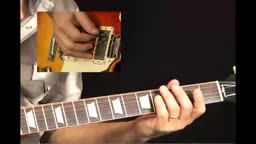
Aaron Thibeaux "T-Bone" Walker is without question one of the most important blues musicians in history. Born in 1910 in Linden, Texas, T-Bone is acknowledged as the first blues guitarist to use an amplified electric guitar. (Coincidentally, Charlie Christian, the primary progenitor of amplified electric jazz guitar, was a close friend of Walker's and both studied with the same teacher, Chuck Richardson.) T-Bone grew up in Oak Cliff, Texas (birthplace of two other blues masters, brothers Stevie Ray and Jimmie Vaughan) and learned blues guitar first-hand from playing with Blind Lemon Jefferson. This example is a slow blues played in the key of G, T-Bone's favorite key for a slow blues. This example represents the first six bars of a standard 12-bar blues progression: one bar of the I (one) chord, G7, followed by one bar of the IV (four) chord, C7, back to two bars of G7; bars 5 and 6 return to the IV, C7. The riff in bars 1 and 3 is based on the notes of a G7 arpeggio-G B D F-and is transposed to C in bar 2 and played identically. All of T-Bone's improvised lines are based on a combination of the Mixolydian mode (in G: G A B C D E F) and the Blues scale (in G: G Bb C Db D F). T-Bone always displayed an effortlessness in his playing style, but his lines are actually quite difficult to master. His phrasing is also very free-flowing, as illustrated in bar 4, as he shifts seamlessly from eighth notes to 16ths and 16th-note triplets. In recreating these lines, strive for the same absolutely clean articulation that is an essential part of T-Bone's sound.
Slow Blues: Ex. 1a
Aaron Thibeaux "T-Bone" Walker is without question one of the most important blues musicians in history. Born in 1910 in Linden, Texas, T-Bone is acknowledged as the first blues guitarist to use an amplified electric guitar. (Coincidentally, Charlie Christian, the primary progenitor of amplified electric jazz guitar, was a close friend of Walker's and both studied with the same teacher, Chuck Richardson.) T-Bone grew up in Oak Cliff, Texas (birthplace of two other blues masters, brothers Stevie Ray and Jimmie Vaughan) and learned blues guitar first-hand from playing with Blind Lemon Jefferson. This example is a slow blues played in the key of G, T-Bone's favorite key for a slow blues. This example represents the first six bars of a standard 12-bar blues progression: one bar of the I (one) chord, G7, followed by one bar of the IV (four) chord, C7, back to two bars of G7; bars 5 and 6 return to the IV, C7. The riff in bars 1 and 3 is based on the notes of a G7 arpeggio-G B D F-and is transposed to C in bar 2 and played identically. All of T-Bone's improvised lines are based on a combination of the Mixolydian mode (in G: G A B C D E F) and the Blues scale (in G: G Bb C Db D F). T-Bone always displayed an effortlessness in his playing style, but his lines are actually quite difficult to master. His phrasing is also very free-flowing, as illustrated in bar 4, as he shifts seamlessly from eighth notes to 16ths and 16th-note triplets. In recreating these lines, strive for the same absolutely clean articulation that is an essential part of T-Bone's sound.
Slow Blues: Ex. 1b
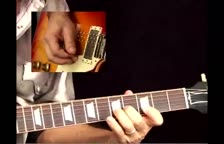
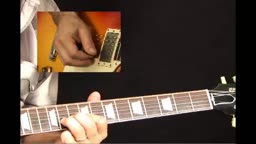
This segment represents the second half of a standard 12-bar blues progression (bars 7-12), beginning with two bars of the I chord, G7, followed by one bar each of the V chord, D7, and the IV chord, C7, wrapping up with G7-C7-G7-D7 across the last two bars. The segment ends with the chromatically descending chords Ab9-to-G9, a staple of the T-Bone sound. This segment begins with phrases based on 16ths and 16th-note triplets, similar to the previous example; some interesting twists are the quirky half-step bends in bars 2-into-3 of the example, followed by the "two against three" feel (accentuating a feel of two eighth notes against the time signature of eighth-note triplets) in bar 4 of the example.
Slow Blues: Ex. 1b
This segment represents the second half of a standard 12-bar blues progression (bars 7-12), beginning with two bars of the I chord, G7, followed by one bar each of the V chord, D7, and the IV chord, C7, wrapping up with G7-C7-G7-D7 across the last two bars. The segment ends with the chromatically descending chords Ab9-to-G9, a staple of the T-Bone sound. This segment begins with phrases based on 16ths and 16th-note triplets, similar to the previous example; some interesting twists are the quirky half-step bends in bars 2-into-3 of the example, followed by the "two against three" feel (accentuating a feel of two eighth notes against the time signature of eighth-note triplets) in bar 4 of the example.
Stormy
The solo phrases demonstrated here are along the lines of T-Bone's guitar work on his most famous composition, "(Call it) Stormy Monday," which is a twist on a standard 12-bar blues progression, played in the key of G. These solo phrases combine elements of the G Mixolydian mode (G A B C D E F) and the G Blues scale (G Bb C Db D F). T-Bone loved to superimpose different rhythms over a slow blues feel, as demonstrated by the 4:3 ratios in bar 1, wherein four notes are divided evenly over one beat in a 12/8 time signature. Bars 4-6 feature the use of different 9th-chord voicings, which are articulated by sliding up one whole step and then back to the root position.
Stormy: Ex. 2a
The solo phrases demonstrated here are along the lines of T-Bone's guitar work on his most famous composition, "(Call it) Stormy Monday," which is a twist on a standard 12-bar blues progression, played in the key of G. These solo phrases combine elements of the G Mixolydian mode (G A B C D E F) and the G Blues scale (G Bb C Db D F). T-Bone loved to superimpose different rhythms over a slow blues feel, as demonstrated by the 4:3 ratios in bar 1, wherein four notes are divided evenly over one beat in a 12/8 time signature. Bars 4-6 feature the use of different 9th-chord voicings, which are articulated by sliding up one whole step and then back to the root position.
Stormy: Ex. 2b
The second half of this chord progression offers a distinctive twist on a standard blues, moving to the ii (two minor), Am, the iii (three minor), Bm, the biii (flat three minor), Bbm, and then to the V7 (five dominant), D7. The subsequent iv (four minor), Cm, offers a different flavor, followed by a return to a typical I7-V7 (one dominant-five dominant) conclusion. Though the lines played over these unusual chords remain based in the G Mixolydian/Blues scale area, a sense of spontaneity is created with unusual rhythmic superimpositions, such as the pairs of triplets played on two even divisions of each beat, as illustrated in bars 3 and 4 of the example.

+ 13 more lessons

Start Course

Reviews

9 results

kyushukev1

Verified buyer

04/24/23

Great Intro to T-Bone

I really like this one. I wanted to get a good foundation with these style licks and this video is all that and more. A lot of fun to play, too.


oldintheway

Verified buyer

06/22/22

Nice insight

What a rich and fun style to learn! I'll pass it on to my grandkids.

dwaggitt

Verified buyer

06/16/22

T Bone

Course really good in principle but failed to download correctly. Some of tabs just would not load

Snooty31

Verified buyer

05/17/20

Awesome

Great lesson, learning some of the licks from the originators of the blues.

DYARTER

Verified buyer

04/15/20

EXCELLENT

JUST WHAT I WAS LOOKING FOR.

Stop searching. Start improving with All Access.

Try 14 days free. Cancel any time.