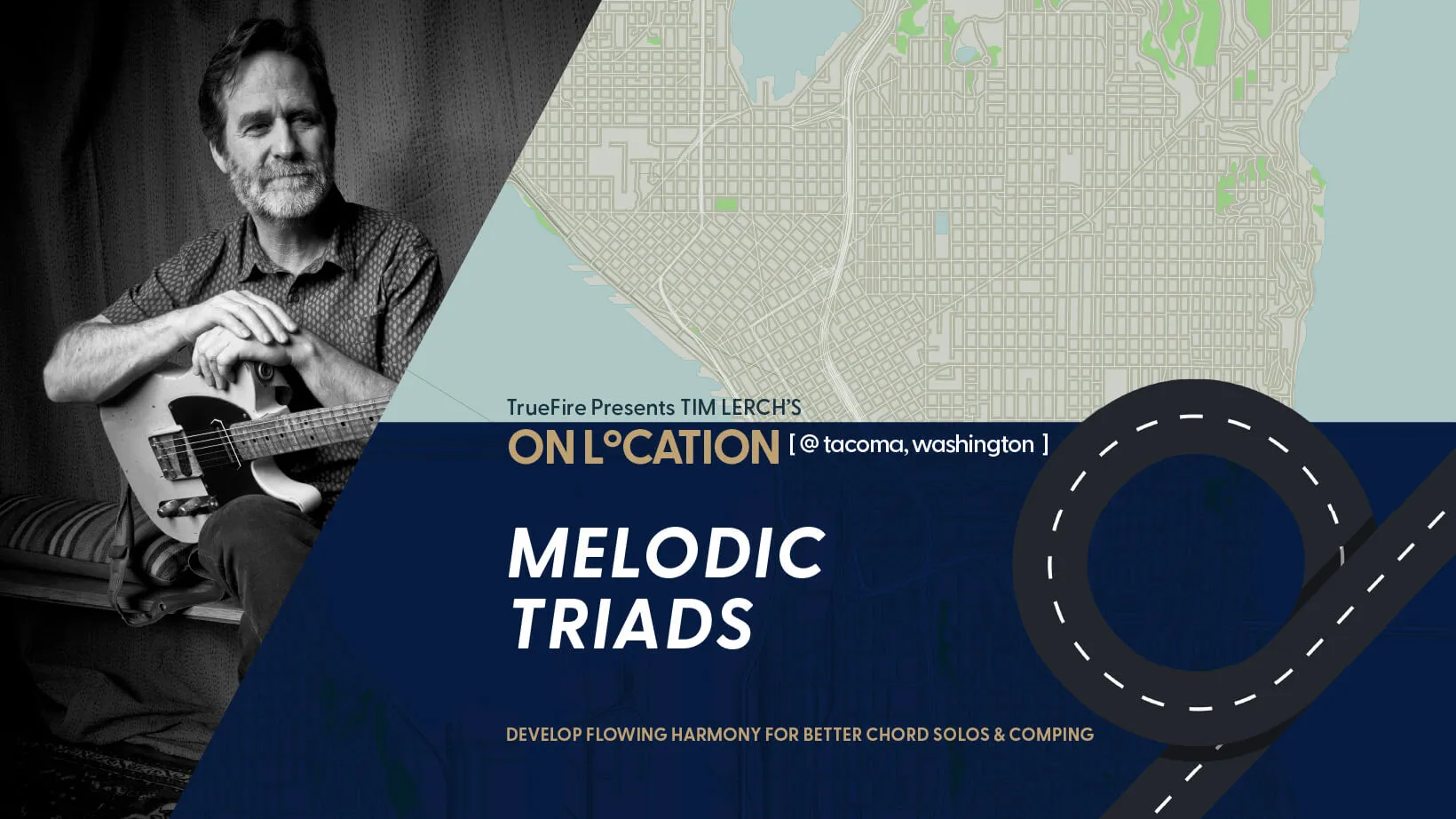
On Location: Melodic Triads

Triad Applications for Melodic Comping and Solo Jazz Guitar

Marty FriedmanTommy EmmanuelSteve VaiEric GalesEric Johnson

Get this course and 1,000+ more with All Access

Try 14 days free. Cancel any time.

Purchase Individual Course for $19.99
On Location: Melodic Triads

About this course

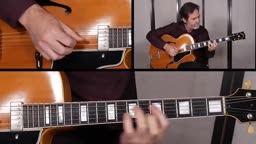
Shot on location at Tim Lerch’s West Coast studio, Melodic Triads is an examination of triads and effective ways to use them as a fluid harmonic approach for melodic jazz comping and solo jazz guitar.

”Triads are the foundation of western harmony. We often think that in order to sound “jazzy” or “hip” we need to play complicated, four or five note chords, but every one of those larger voicings have triads living inside of them that contain the most essential notes. To develop freedom on the guitar, it's profoundly important to have a good working knowledge of triads.

I’ve designed this course to help you develop a fluid harmonic approach to melodic comping and solo guitar. We’ll look at triad construction, triad scales, diatonic cycles and common progressions and we’ll keep it simple using just a few triad shapes on one string set. You’ll play your way through the course right along with me - just like we’re working on a lesson together in person!”


Melodic Triads is organized into six progressive lesson sets. Each set begins with a simple melodic triad workout and then you’ll put those skills to use in a solo etude which will help prepare you to create your own melodic chord solos.

”In our first set, we will take a close look at how to build triads, their inversions, and triad scales. The etude shows us how to play melodies up above the triads to create a flowing sequence of chords and melody.

Set two looks at voice leading the common progressions IV V I and ii V I and the various pluralities that exist in the world of triads. In set three, we explore the Diatonic Cycle of 4ths, voice leading, and the “melodic neighborhoods” throughout the key.

Set four explores the very common iii VI ii V progression adding just a bit of chromatic flavor to the key. In set 5 we’ll work on a fun tune that puts it all together in a 32 bar form. We’ll get more chromatic movement and learn what it sounds like to swing these triads.

And in the final set, we explore the chromatic nature of the music and the flexibility of these triads at a medium swing tempo as we play a tribute to the great George Van Eps.”


Tim will explain and demonstrate all of the key concepts and approaches along the way. You’ll get standard notation and tabs for all of the performance studies. Plus, you’ll be able to use TrueFire’s learning tools to sync the tab and notation to the video lesson. You can also loop or slow down the videos so that you can work with the lessons at your own pace. All of the backing tracks are included to work with on your own as well.

Grab your guitar and let’s get melodic with Tim Lerch!

What you'll learn

  • Navigate smooth voice leading through complex chord changes
  • Play the iii-VI7-ii-V7-I progression in multiple positions on the fretboard
  • Create flowing chord melodies using melodic triads
  • Add melodic content over chord progressions using chord tones and scale degrees
  • Build and identify triad inversions across the fretboard
Release date: 01/11/2021 • 1h 39m runtime
Start Course
Sample lessons
Big Red, Triads with Chromatic Colors
Performance
Putting it all Together
Concept 6
By George, Triad Solo ala GVE
Overview
By George, Triad Solo ala GVE
Performance

What's included

26 lessons • 10 charts

On Location: Melodic Triads
Hi I'm Tim Lerch. Welcome to this Melodic Triads edition of On Location.

Triads are the foundation of western harmony. We often think that in order to sound "jazzy" or "hip" we need to play complicated, four or five note chords, but every one of those larger voicings have triads living inside of them that contain the most essential notes. To develop freedom on the guitar, it's profoundly important to have a good working knowledge of triads.

I've designed this course to help you develop a fluid harmonic approach to melodic comping and solo guitar. We'll look at triad construction, triad scales, diatonic cycles and common progressions and we'll keep it simple using just a few triad shapes on one string set. You'll play your way through the course right along with me - just like we're working on a lesson together in person!

The course is organized into six progressive lesson sets. Each set begins with a simple melodic triad workout and then we'll put those skills to use in a solo etude which will help prepare you to create your own melodic chord solos.

All of the performances are tabbed and notated and you'll be able to sync the tab and notation to the video using TrueFire's learning tools. You can loop or slow down any of the videos so you can work with the lessons at your own pace.

Are you ready to get started? Join me in my studio, grab your guitar, and let's play some melodic triads!
Triad Scales and Inversions
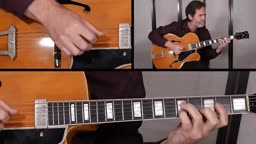
Here I lay it all out for you. The material presented in this short segment is what we will be using all through the rest of the sections. Take your time and learn it well. All three inversions of the triad scale in D major on string set 432. Then, we play them all in the cycle of 6ths.
Melodic Triads in D
First inversion triad scales have a very nice sound and are extremely useful and practical. In this segment, we'll use the chord scale with a simple melodic sequence above each voicing. Then in part two, we'll move the chords more quickly to discover the melodic possibilities of moving the triads around.
Melodic Triads in D
Take your time and pay close attention to the recommended fingerings. Let the chords ring and let the melody sing.
Melodic Triads in D
While this etude seems simple, getting it clean and memorized will be a big benefit as you go through the course. It will also lay the foundation for shapes and sounds that you will use for the rest of your life!
Triads in Progressions
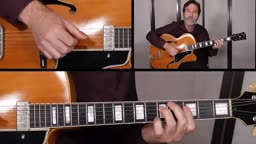
Ok, scales are great for learning the shapes and the sounds in an organized way, but eventually we need to use these triads in progressions. In this segment, we start with two of the most common progressions, IV V I and ii V I. Once again pay close attention to the fingerings and try to let the chords ring under the melodies.
Melodic Triads VI V I and ii V I
Remember that these triads can do double duty, that's why a IV V I can also be a ii V I. This pluralism makes playing melodic triads fun and often easy!

+ 19 more lessons

Start Course

Reviews

31 results

Mightygnat

Verified buyer

06/24/26

great

LouisPRS

Verified buyer

12/16/25

Fascinating knowledge of triads and inversions backing melodies across the neck!

Fascinating course on using diatonic triads across the neck and interspersing melodies. I've learned a lot about sequencing triad inversions that make different chords available in single positions. Highly recommended for all types of music.

hagshenry

Verified buyer

11/04/25

Excellent Course

Tim has a great way of teaching and communicating concepts and ideas in a way that's easy to digest. This is a good stepping stone to doing some of Tim's other courses, as understanding these fundamental triad concepts is essential to developing more complex chordal structures.

oboavida

Verified buyer

04/14/25

Great

It's a really great course.

Starglazer

Verified buyer

03/02/25

Great Title

I find it very I’m formative. Thanks.

Stop searching. Start improving with All Access.

Try 14 days free. Cancel any time.