
Jazz Blues Pathways

Interactive Video Masterclass on Jazz Blues Guitar

Marty FriedmanTommy EmmanuelSteve VaiEric GalesEric Johnson

Get this course and 1,000+ more with All Access

Try 14 days free. Cancel any time.

Purchase Individual Course for $24.99
Jazz Blues Pathways

About this course

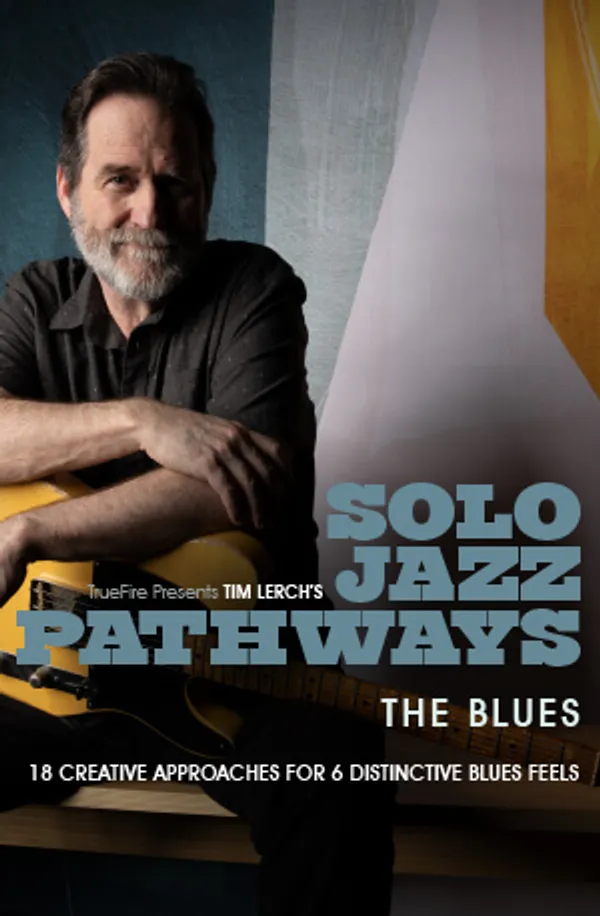
Tim Lerch’s Jazz Blues Pathways focuses on how to address more advanced chords when you’re soloing on a blues. Most players feel comfortable when improvising over a simple 1-4-5 chord progression, but throw in a few extra chords and you might find yourself in the weeds. The 10 tunes in this course make a progressive journey towards more elaborate chord progressions associated with jazz blues.

”I’ve always loved the blues and spent many years playing in R&B and blues bands. As a result that blues influence has always been present in my jazz playing. I guess you could say that I like my jazz playing to have a little grease in it, and I love blues with sophisticated harmonies. From a simple 2 5 turnaround to a chromatic back cycle, I’ll show you how to navigate comping those changes when improvising.

And if you’re going to play these tunes, you gotta know how to comp these changes too. I’ll show you rich voicings and rhythmic approaches that will allow you to be supportive of the soloist and a good team player cause that’s the name of the game when you’re in the rhythm section.”


Tim will guide you through a straightforward upbeat shuffle with a two-five on the turnaround, a minor blues with a modal character, a medium tempo funky blues in A with approach-from-above chords and some diminished harmony, and a six-eight blues with some Wes Montgomery inspired changes.

You’ll learn how to play a medium tempo D minor progression inspired by a great Ray Charles hit, a Latin tinged blues in D that features soloing with octaves and some block-chord playing, and a venerable gospel classic with a rhumba rhythm feel.

Next you’ll take on a cookin’ medium up jazz blues in D flat, a wonderful old tune with great bluesy changes and a nice slow-burning tempo, and finally an uptempo bebop-inspired blues in the style of Charlie Parker’s Blues for Alice.

Tim will explain and demonstrate all of the key concepts and approaches along the way. You’ll get standard notation and tabs for all of the performance studies. Plus, you’ll be able to use TrueFire’s learning tools to sync the tab and notation to the video lesson.

You can also loop or slow down the videos so that you can work with the lessons at your own pace. All of the backing tracks are included to work with on your own as well.

Grab your guitar and lets head down the jazz blues path with Tim Lerch!

What you'll learn

  • Use arpeggio surrounding tones for melodic interest
  • Solo over an AABA form using minor blues vocabulary
  • Comp through a jazz blues progression with sophisticated voicings
  • Comp through a minor jazz progression with appropriate voicings and rhythm
  • Maintain a groovy, not-too-busy feel at slow tempos
Release date: 06/15/2020 • 2h 41m runtime
Start Course
Sample lessons
Tacoma Blues
Tacoma Blues
Overview
Tacoma Blues
Tacoma Blues
Soloing Performance
Tacoma Blues
Tacoma Blues
Soloing Breakdown
Tacoma Blues
Tacoma Blues
Comping Performance

What's included

50 lessons • 19 charts • 10 Jam Tracks

Jazz Blues Pathways
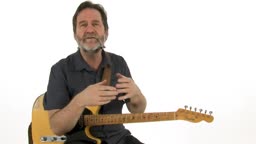
Hi, I'm Tim Lerch. Welcome to Jazz Blues Pathways.

I've always loved the blues and spent many years playing in R&B and blues bands. As a result that blues influence has always been present in my jazz playing. I guess you could say that I like my jazz playing to have a little grease in it, and I love blues with sophisticated harmonies.

In this course, I wanted to address what you do on those more advanced chords when you're soloing on a blues. Many of us feel pretty safe when it's just 1 4 5, but throw in a few extra chords and you find yourself in the weeds. The 10 tunes in this course make a progressive journey towards more elaborate chord progressions associated with jazz blues. From a simple 2 5 turnaround to a chromatic back cycle, I'll show you how to navigate comping those changes when improvising.

And if you're going to play these tunes, you gotta know how to comp these changes too. I'll show you rich voicings and rhythmic approaches that will allow you to be supportive of the soloist and a good team player cause that's the name of the game when you're in the rhythm section.

All of the performances are tabbed and notated and you'll be able to sync the tab and notation to the video using TrueFire's learning tools.

All of the backing tracks are included and you can loop or slow down the videos so you can work with the lessons at your own pace.

Ready to get started? Grab your guitar, and let's go.
Up Beat Blues
Starting things off with a pretty straight forward upbeat shuffle in C. I keep it pretty simple on the first chorus then have a bit more fun especially on the ii V turnaround in the 2nd and 3rd chourses. Try to lay back a bit on your 8th notes and especially any triplets so your time feel isn't too bouncy.
Up Beat Blues
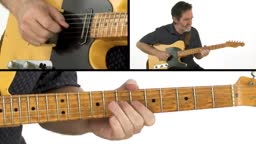
My approach to soloing always includes lots of reference to chord tones. Learn your arpeggios for the changes and it will be a big help. You don't have to learn every 2+ octave arpeggio fingering right at first. Just learn a few that are in the area that you are going to use the most. Notice how an arp doesn't sound very bluesy, it helps to decorate the arps with slurs between flat 3 and 3 and flat 5 and 5.
Up Beat Blues
My approach to soloing always includes lots of reference to chord tones. Learn your arpeggios for the changes and it will be a big help. You don't have to learn every 2+ octave arpeggio fingering right at first. Just learn a few that are in the area that you are going to use the most. Notice how an arp doesn't sound very bluesy, it helps to decorate the arps with slurs between flat 3 and 3 and flat 5 and 5.
Up Beat Blues
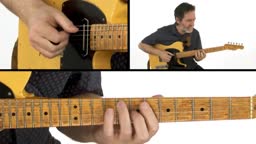
My primary concern when comping is to create a supportive environment for the soloist, so repeating rhythmic motifs is something I pay attention to. The other thing that makes for good comping is to listen for the soloists note choices. If there are lots of 6ths and 9ths in the solo line I'll use those in my voicings too.
Up Beat Blues
The first two choruses I keep the voicings pretty conventional and they work just fine. Rhythmic continuity and melodic cohesiveness are the theme of the day.In the 3rd chorus I use lots of rootless voicings with either the 3rd or the flat 7th in the bass. These voicings are quite magical and work particularly well on a blues.
Equal Knocks
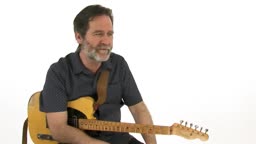
Now we're going to take a look at our second tune, called "Equal Knocks". It's based on this John Coltrane tune called "Equinox", a C minor blues that's not too different from something like B.B. King's "The Thrill is Gone". Let's check it out.

+ 43 more lessons

Start Course

Reviews

45 results

Hent03

Verified buyer

01/20/26

Lots of really cool ideas here that help build mastery and inspire further growth, not to mention just help build timing and rythm.

bbendimez

Verified buyer

09/16/25

Love it!

Great teacher who makes it easy for you to understand and play. Very cool jazz-blues licks!

Zaxan

Verified buyer

01/04/25

Jazz Blues Pathways - Great!!!

Clear, simple answers to a complex music genre. Beautiful musical approach as opposed to a lot of flash. Tim's low key style and superb command of the fretboard is inspiring. On top of a really enjoyable selection of tunes, Mr. Lerch's quiet manner makes you wish you knew him personally. Wonderful course all round, period.

amadablam

Verified buyer

12/24/24

Great

It was great. I can understand easily and mimic that.

Stop searching. Start improving with All Access.

Try 14 days free. Cancel any time.