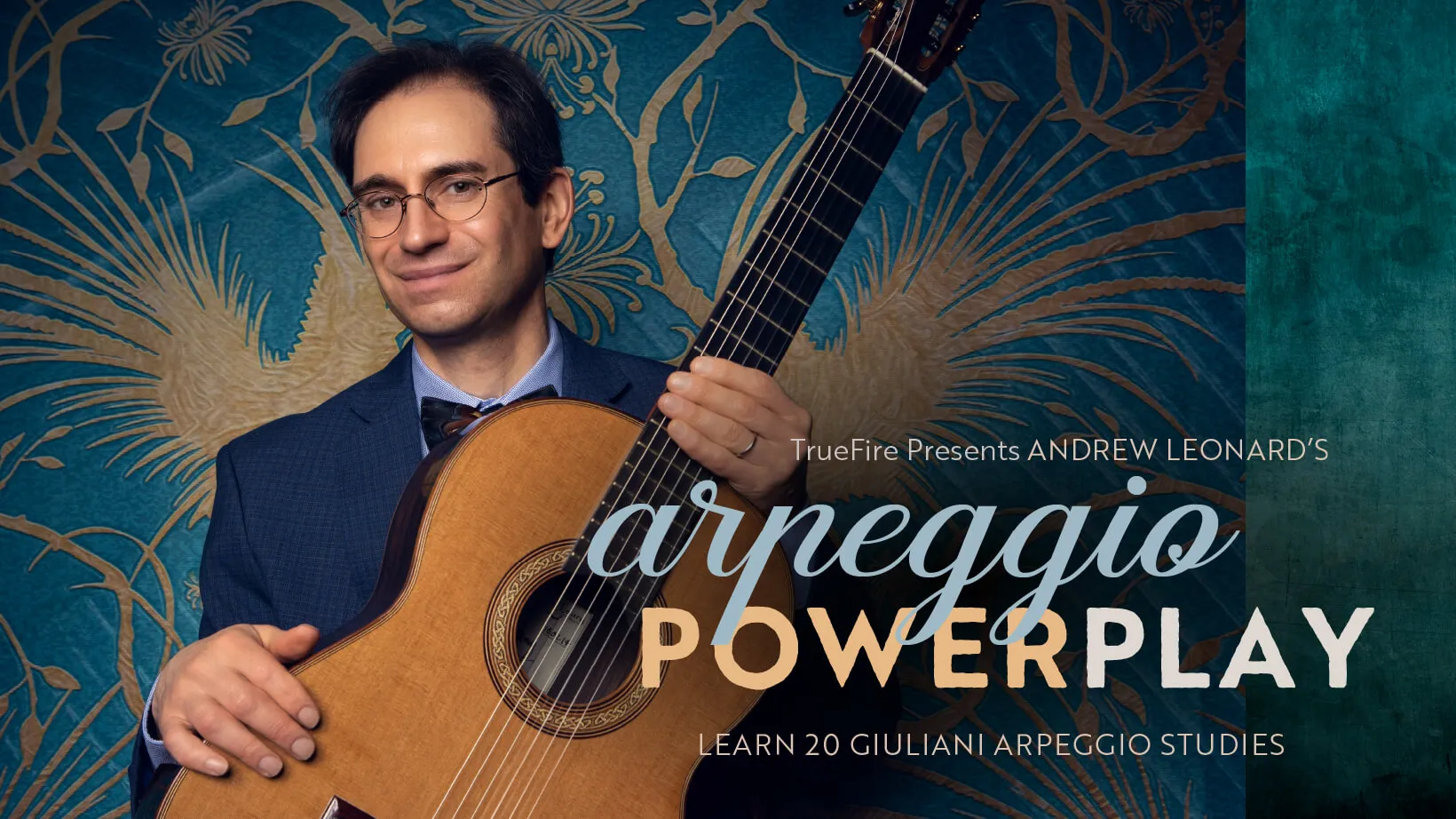
Arpeggio Power Play

Learn 20 Giuliani Arpeggio Studies

Marty FriedmanTommy EmmanuelSteve VaiEric GalesEric Johnson

Get this course and 1,000+ more with All Access

Try 14 days free. Cancel any time.

Purchase Individual Course for $14.99
Arpeggio Power Play

About this course

Considered one of the great classical guitar virtuosos of his time, Mauro Giuliani, was renowned for his right-hand arpeggio technique. In 1812, he published his “120 Right-Hand Arpeggio Studies -- today still an indispensable guide for developing right-hand classical guitar technique.
In Andrew Leonard’s Arpeggio Power Play, you’ll focus on 20 of those arpeggio studies considered by Andrew to be the building blocks of a powerful arpeggio technique.

”First, I’ll demonstrate the mechanics for how the fingers should properly move in combination with the thumb. Then, we’ll apply it to Giuliani studies to give you a practical exercise to develop the skill. Finally, we’ll apply it to one of 5 repertoire pieces.

We’ll apply single-direction arpeggios to play Caruli’s moderato. Next, we’ll use arpeggios with alternation to play Guiliani’s moderato in A minor. Stringing together alternation combinations and single-direction arpeggios we’ll play Giuliani’s allegro in A minor and then we’ll combine simultaneous playing of the thumb and fingers to create a 3-voice texture know as the Albert bass and perform an excerpt from one of Paganini’s Garabezo, number 41. And finally, you’ll have learned enough to perform a well-known concert piece by Mateo Carcasi.

As a bonus, I’ll perform one passage from Leyenda, by Issac Albeniz, to demonstrate how the arpeggios we’re studying are used in a virtuoso piece."


Andrew will explain and demonstrate all of the key concepts and approaches along the way. You’ll get standard notation and tabs for all of the performance studies. Plus, you’ll be able to use TrueFire’s learning tools to sync the tab and notation to the video lesson. You can also loop or slow down the videos so that you can work with the lessons at your own pace. All of the backing tracks are included to work with on your own as well.

Grab your guitar and let’s power play Guiliani’s arpeggios with Andrew Leonard!

What you'll learn

  • Execute triplet fingerpicking patterns with alternating bass notes
  • Apply PIM and PMI arpeggio patterns to complex musical contexts
  • Apply dynamic shaping (crescendo/decrescendo) to musical phrases
  • Connect slower arpeggio practice to faster virtuoso playing
  • Develop strategies for difficult left-hand transitions
Release date: 05/04/2020 • 3h 01m runtime
Start Course
Sample lessons
Allegro by Giuliani: Preparatory Study
Measures 17-20
Alternation Arpeggios: PIMI & PMIM
Overview
Alternation Arpeggios: PIMI & PMIM
Right Hand Mechanics
Alternation Arpeggios: PIMI & PMIM
Giuliani Studies Studies 81 & 82

What's included

59 lessons • 23 charts

Arpeggio Power Play
Hi I'm Andrew Leonard. Welcome to Arpeggio Power Play!

Considered one of the great classical guitar virtuosos of his time, Mauro Giuliani, was renowned for his right-hand arpeggio technique. In 1812, he published his "120 Right-Hand Arpeggio Studies -- today still an indispensable guide for developing right-hand classical guitar technique.

In this course, we'll focus on 20 of what I consider to be the building blocks of a powerful arpeggio technique.

First, I'll demonstrate the mechanics for how the fingers should properly move in combination with the thumb. Then, we'll apply it to Giuliani studies to give you a practical exercise to develop the skill. Finally, we'll apply it to one of 5 repertoire pieces.

As a bonus, I'll perform one passage from Leyenda, by Isaac Albeniz, to demonstrate how the arpeggios we're studying are used in a virtuoso piece.

All of the performances are transcribed and you'll be able to sync the tab and notation to the video using TrueFire's learning tools. You can loop or slow down the videos so you can work with the lessons at your own pace.

OK, grab your guitar, and let's get started.
Before We Begin
Welcome to the Overview Section of Arpeggio Power Play. Before we get started on playing classical guitar arpeggios and pieces, there are a few short videos explaining how the course is arranged.

I designed Arpeggio Power Play to start with the basics of right hand classical guitar arpeggios, ending with Matteo Carcassi's Etude 3 in A major. It is a beautiful piece at the late beginner possibly early intermediate level.

Along the way, I will guide you through different aspects of right hand classical guitar technique. In addition, you will learn some of Mauro Giuliani's 120 Studies. You can use these to develop your technique and build regular arpeggio practice routines.

If you are not familiar with Mauro Giuliani or his 120 Studies, the video with the same title will explain.

You will be ready to the final piece, Matteo Carcassi's Etude 3 in A major, by learning a number of right movements with the following approach:

Right Hand Mechanics: details of the right hand finger movements for each classical guitar arpeggio pattern will be taught on open strings. Eliminating the Left Hand will allow you to fully focus on Right Hand movements.

Mauro Giuliani Right Hand Studies: each arpeggio pattern will be applied to the corresponding study or studies from Mauro Giuliani's 120 Studies. If there is no corresponding study, I have created one for you.

Repertoire or Excerpt:
The final step is to apply classical guitar arpeggio patterns to music. I have selected a number of fun to play studies, pieces and excerpts from the classical guitar repertoire that correspond to the arpeggios discussed.

How to practice: throughout the course I will give suggestion on how to practice. Of course, the "How to Practice" video discusses this topic.

At the end of the course I have some practice routine suggestions for the 120 Right Hand Studies. I've created a list of practice suggestions and routines for shorter and longer practice sessions as well as routines that target different Right Hand Mechanics taught in the course.

How to "Go Through" the course: There are two ways I suggest you consider approaching this course.

1. Approach the course in order. Learn everything thoroughly before going on to the next lesson. Practice the "Right Hand Mechanics" exercises until your fingers move correctly on "auto pilot" then add the corresponding number of Giuliani's 120 Right Hand Studies. Then add the Repertoire piece from the lesson. As you go further into the course, continue to review (play regularly) either the Repertoire piece or the Giuliani Studies from the previous lessons.

2. Learn in order until you arrive at a Repertoire piece that you may need to slow down to learn. While learning this piece, continue going onward in the course to learn the next "Right Hand Mechanics" arpeggios and the corresponding of Giuliani's 120 Studies but not the new repertoire pieces. It is possible to be spending time slowly learning an earlier Repertoire piece and also be playing more advanced Giuliani Right Hand Studies. With this approach you prepare the Right Hand in advance for the next repertoire pieces. If you are also reviewing the previous patterns you will have a consistent arpeggio routine to develop Powerful Arpeggios.

Of course, you are free to learn at your own pace in any way you want.

I also want to share some information about the guitar notation in this course.  There are two scores available for the repertoire pieces, the 20 of the 120 Giuliani Studies taught in this course and Andrew’s Missing Studies.

Score one is an accompanying PDF file available as a download for you.  These scores are traditional classical guitar notation with tab. They contain all information associated with classical guitar music: left and right hand fingerings and dynamic markings etc

Score two is the “Lesson Materials” you will see when you view each video lesson.  These tab & notation scores were created with less detail to make them easy to view as you watch the video lesson.  These scores also allow you to take full advantage of all the video technology TrueFire provides in it’s courses. Some lessons including all the Performances have the SoundSlice technology that syncs the score and the video.  This amazing experience allows you to see exactly what both of my hands are doing on every note in the score.
Seating Position, Posture, & Finger Nail Considerations
There are two general classical guitar playing concepts that are important for us to address before you start this course - or any classical guitar course. They are: Classical Guitar Seating Position (posture and alignment) and Right Hand Fingernails.

This video covers both classical guitar seating position and fingernails. The fingernail discussion begins about halfway through the video. Also, you do not need fingernails. This is discussed below.

I realize you may already have your own approach to both concepts. I suggest you watch the video once and remember that it is a resource you can refer to at any time.

As you watch this lesson there are a few things to keep in mind:

There are many devices available to lift the guitar into the proper classical guitar seating position, instead of using the traditional footstool to lift the leg. If you need some guidance, contact me through my website (andrew-leonard.com) with any questions. Let me know what device you are considering and I will share what I know about the device or something similar. Be patient - it may take a little while to reply.

Of course, there are many very good classical guitarists who use footstools.

In this video, I am using the Murata Guitar Rest. I also went to a hardware store and bought an additional rod - the rod included with the Murata Guitar Rest is a standard size width. I did have to cut the rod to the right height for me and then file it to create smooth edges to fit into the Guitar Rest. You may find this "home repair" project of cutting and filing to be time consuming - be forewarned. Again, there are other options available.

Right Hand Fingernail Shaping:

There are two important parts of right hand classical guitar technique to consider when filing or shaping your fingernails. They are: the contact & release points.

While classical guitarists all have individual ways of filing their nails based on personal preference, these two factors are constant. You have to contact the string with the finger and let go of the string with the finger. This lesson takes you through, in great detail, how to file your nails and adhere to these two general concepts. Again, you may already have your own approach to nail shaping.

Note: I use Free Stroke position when shaping my nails - if you're not familiar with this concept, the 3 Step Set Up lesson a little later in the course will explain the proper way to position the Right Hand for classical guitar playing and filing.

No fingernails??? What if you don't want to use right hand fingernails or you want to use them but do not know how to get started? No problem! Just focus on the "contact point" - it does not involve the finger nail. Before the finger nail is used, the flesh of the finger tip makes contact with the string.

Before growing fingernails, I advise my private students to learn to consistently place the finger on the contact point and get a good sound. Once you can do this, then you are ready to grow and use fingernails.

Classical Guitar Fingernail Trivia:

At the time of Mauro Giuliani, the classical period, using the fingernails was up for debate. Some great guitarists, including Fernando Sor did not use fingernails. Dionisio Aguado did use fingernails. I have not seen any research on the fingernail topic that includes whether or not Mauro Giuliani used fingernails.

How to Practice
I believe in using repetitions to gain mastery. My goal for you is to achieve "unconscious competence" with your right hand classical guitar arpeggio playing. By practicing simple, repeatable movements that you understand and can easily do enough times, you can attain "unconscious competence."

This video shares my thoughts on achieving "unconscious competence" through a concept I use with my students based on 10,000 repetitions. This is different, and much easier for anyone to attain, than the concept of 10,000 hours you might be familiar with presented by the author Malcolm Gladwell.

I share this concept by using three quotes discussed in the video and below. As you read, please realize the number 10,000 does not have to be taken literally. The idea is that by practicing a simple movement many times beyond the amount of times necessary to have learned it, you are continuously reinforcing it which leads to "unconscious competence." The idea is to do a little every practice session. Again, the video explains in detail.

Although I have not come across any other teachers who apply this concept as I do, I am sure others teachers have very similar approaches. I am not claiming to have invented this concept!

The three quotes on the concept of attaining mastery are by Dr. Shinichi Suzuki the inventor of the Suzuki Method of teaching music, Bruce Lee the martial artist and yours truly.

Dr. Shinichi Suzuki's "Knowledge Does Not Equal Skill. Knowledge Plus 10,000 Times Equals Skill" quote gives you the big picture importance of why we need repetitions. You can think of "gaining the knowledge" when watching the "Right Hand Mechanics" videos.

Martial Artist Bruce Lee's "I Do Not Fear the Man Who Practiced 10,000 Kicks, I Fear the Man Who Has Practiced One Kick 10,000 times" quote helps us understand what specifically our repetitions should contain. You can apply this quote to the practicing of Right Hand Mechanics and Giuliani's 120 Right Hand Studies for classical guitar. Each has "one kick" you can easily practice many times.

My quote "Your Brain Must Be Ahead of Your Fingers at All Times" helps keep you on target during each repetition. Are you thinking ahead and reminding yourself what the fingers must do before you play each repetition? After each repetition are you asking yourself "what went well and what to improve during the next?"

I want you to know that I share these quotes with all my private students - often. These quotes have become part of their practice approach and most of my students have memorized these quotes because they hear me say them frequently. I have my quote on a sheet of paper that I hold up during a student's lesson to make sure they are playing repetitions correctly.

There is also mention of the importance of learning the left hand movements in each arpeggio. Your hands need to be synchronized to play arpeggio pieces well.

If you have not yet watched the video when reading this, I hope you are now curious and looking forward to find out what this video contains.
Mauro Giuliani's 120 Right Hand Studies
Mauro Giuliani's first published music in 1812, opus 1, was a collection of classical guitar studies for the right and left hand. The first part, "opus 1, #1" is his 120 Right Hand Studies.  More details of his life will be discussed in the video: Moderato in A minor, Overview & History.

As a Bonus for this course, I have included the complete 120 Right Hand Studies in standard notation for you as a pdf file.  This is an updated version I created working from the original published in 1812.

Mauro Giuliani lived from 1781-1828. He was one of the great classical guitar performers and composers of guitar music during the Classical Period. More details of his life will be discussed in the video section: Moderato in A minor, Overview & History.

Giuliani's first published music in 1812, opus 1, was a collection of classical guitar studies for the right and left hand. The first part, "opus 1, #1" was his 120 Right Hand Studies.

Mauro Giuliani's 120 Right Hand Studies take two chords: C & G7 and demonstrate 120 different ways to arpeggiate them. These studies have become one of the building blocks of right hand classical guitar technique. I remember my undergraduate teacher telling me "do not go to sleep until you have practiced your slurs, scales and 120 Right Hand Studies." I took him very seriously. I remember more than one late night where I had to get out of bed and head over the music building to practice the assigned Right Hand Studies of the week.

For this course, I have selected 20 of Mauro Giuliani's Right Hand studies that cover the basics of right hand classical guitar technique: thumb and finger alternation, single direction arpeggios, arpeggios with alternation of the fingers and combinations of different arpeggio technique.

I limited my choice to those that are "fixed finger" exercises. Fixed finger means that each finger always plays on the same string. This allows you to exclusively focus on finger movements.

By starting with these 20 and a few of my own creation, with consistent practice, you will develop a solid and "powerful" classical guitar arpeggio technique.
The 3-Step Setup
We begin Arpeggio Power Play by establishing the proper Right Hand free stroke position for playing classical guitar arpeggios. I have created a simple 3 Step Right Hand Set Up to place the thumb, knuckles and fingers in their proper alignment. In the video, I'll take you through all the details.

Once you understand and can apply this concept, you will be on your way towards playing Mauro Giuliani's 120 Right Hand Studies and the Repertoire in this course.

The goal of the 3 Set Up is to position the right hand so that the fingers and thumb can easily move through the strings without interfering with each other or move the hand while playing.

Pay close attention to these 3 Steps. They are the starting point for everything you will play in this course. You may want to refer to this video regularly (especially if this is new information for you) during the course.

My suggestion is to double check the 3 Step Set Up before playing all the material in this course - this is "Brain Ahead of Fingers." This will simply and easily guide your hand to the proper placement for right hand classical guitar arpeggio technique. Master this and your fingers will be well prepared for all the arpeggio combinations in this course.

By the way: if you were to exaggerate the free stroke motion of the fingers, you would end up with the fingers following though all the way into the hand where the fingertips would touch the bottom of the palm.

The 3 Step Set Up for right hand free strokes is quite simple. My goal as a teacher is to take complex ideas and figure out how explain them in an easy to follow systematic way.

Below is where you place the fingers before learning the three steps. Details are provided in the video.

-Thumb or "P" or 4th string D
-Index finger or "I" or 3rd string g
-Middle Finger or "M" on 2nd string B
-Ring finger or "A" on 1st string E

Once these fingers are placed on the correct strings, we can begin the 3 Step Set Up for right hand free stroke arpeggio playing:

1 - Thumb in front of fingers
2 - Knuckles over strings being played
3 - Fingers and Thumb on tips with the fingers curved not collapsed
The 3-Step Setup
Traditional classical guitar notation of this music with tab is available as a PDF download for you.

Of Mauro Giuliani's 120 Right Hand Studies, numbers 1, 51, 59 & 65 - and the remainder of numbers 51-65 are not "arpeggios" but they are definitely right hand studies. Regularly practicing a set of these will develop your 3 Step Right Hand Set Up and prepare you to play classical guitar arpeggios and arpeggio repertoire.

Studies 51-65, other than numbers 1, 51, 59 & 65 involve the thumb (P) playing on unusual parts of the beat. It is important to develop the ability to synchronize the thumb (P) to play on different parts of the beat.

Below are a few practicing strategies and ideas to create different practice routines. If you have an idea to share with others taking this course, please post below.

Practicing Strategy:
The most important thing to keep in mind is to make sure you are consistently practicing studies that involve the thumb (P) and fingers playing simultaneously. Playing any of amount of these studies will help accomplish this goal. These studies will deepen your ability to automatically place your right hand in the 3 Set Up position before playing.

Even if you only playing a few over and over and skip the others, you will be making progress. Play slowly and remember the "1 Kick" and "Brain Ahead of Fingers" concepts.

-Double check the 3 Step Right Hand Set Up before each repetition

-Listen to your sound, if you hear a lot of excess nail you may not be involving enough of the fingertip in the placement of the finger before playing. Flesh contacts the string first, then nail.

-Treat all bass notes as longer notes - let ring until next is needed or chords change.

-As you progress and these become easy, you can treat these as warm up studies

Practice Routine Ideas:
If time for only a few: #1, 51, 59, 65 cover the most often occurring thumb and finger combinations is classical guitar music.

-Only practice all that start with a certain part of the beat. For example - 52, 56 & 62 all start on the 2nd 16th note of each beat. Playing these will allow you to become very familiar with a certain off beat combination

-Divide up all the studies so you have a study that covers each off beat group: Thumb on second, third or fourth sixteenth note.

-Rotate through studies with different parts of beat for bass note. Selecting one, two or three of each group per practice is an idea:
4 have 1 bass notes per beat (51-54)
6 have 2 bass notes per beat (55-60)
4 have 3 bass notes per beat (61-64)
1 has all bass notes per beat (65)

+ 52 more lessons

Start Course

Reviews

13 results

mikecee

Verified buyer

12/31/24

Andrew Teaching Style is Great for Classical Fingerstyle

I have been a 3 chord strummer/pick guitar player for a while. Finally decided I really want to play fingerstyle/classical. Went looking for a good online course and came across Andrew’s courses on TrueFire. Really like his professional and thorough approach/style and that he has a professional academic (Master degree in Music from Yale University) background and also International performing & recordings. i. e. he is the ‘Real Deal’ to learn this style of playing, and he also seems a really nice guy so easy to listen to his instructions. I’m very happy I came across him on TrueFire.

flmponsen

Verified buyer

07/31/23

Inspirerend.

Duidelijke uitleg van muziektheorie en praktische zaken zoals houding etc. Mooie oefen stukken. Ik vond het weer leuk om na heel veel (en Lang) populaire muziek gespeeld te hebben weer een iets "klassieks" te spelen. Ik heb inmiddels meer van deze leraar gekocht.

ramoncandido

Verified buyer

12/11/22

Fingers Workout

PIMA PAMI , countring in various meter 3/4 4/4 , 16th notes in one measure is something I am clarified performing the classical guitar . I am delighted . Thanks.

sarradet

Verified buyer

06/11/21

Easy to use lessons

I like the pace of these lessons and his arrangements are designed for someone like me without a lot of classical guitar experience.

intelzombi

03/09/21

Excellent Arpeggio course

As an intermediate player this was a great reset on some things I've overlooked or forgotten in my practice. The three camera instruction with the snyc to the score is fabulous. I discovered a couple of new pieces that I had overlooked previously. Really a great course and not just for beginners.

Stop searching. Start improving with All Access.

Try 14 days free. Cancel any time.