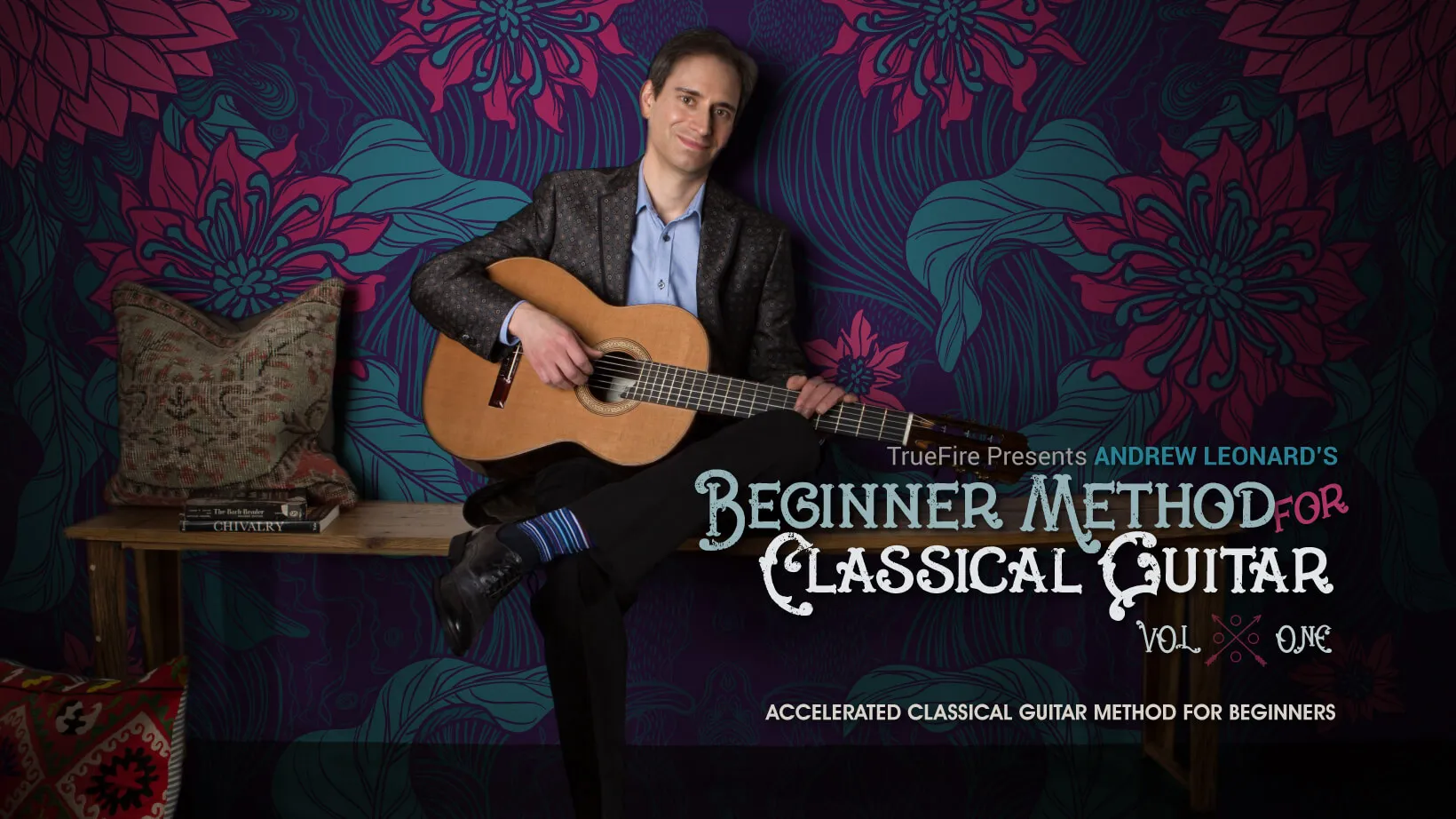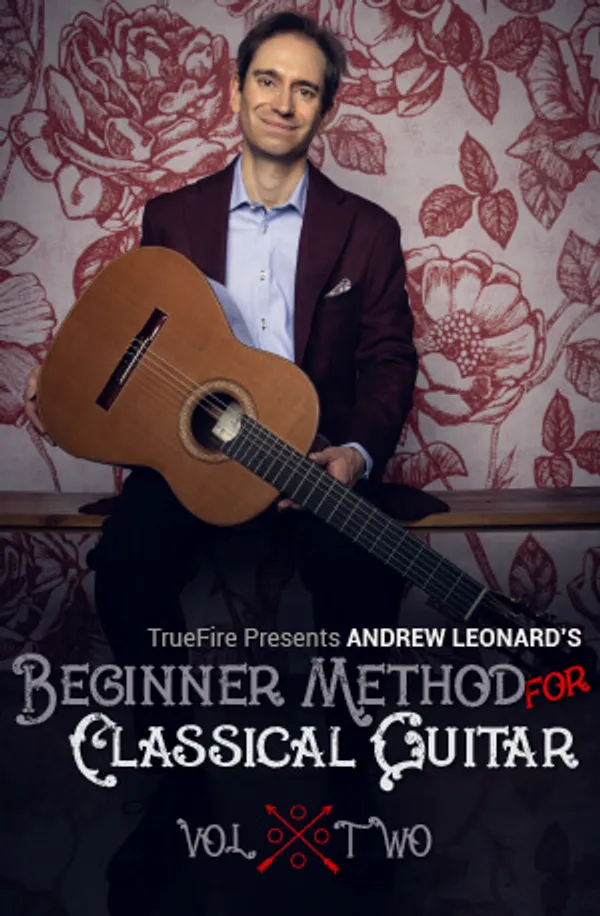

Beginner Method for Classical Guitar

Accelerated Classical Guitar Method for Beginners

Marty FriedmanTommy EmmanuelSteve VaiEric GalesEric Johnson

Get this course and 1,000+ more with All Access

Try 14 days free. Cancel any time.

Purchase Individual Course for $14.99
Beginner Method for Classical Guitar

About this course

Whether you're an experienced guitarist interested in adding classical technique and style to your playing, or a beginner starting from the ground up, this accelerated Beginner Method for Classical Guitar course from Andrew Leonard is the ideal study program for you.

”In this first volume, we’ll cover the most fundamental techniques. I’ll show you right-hand rest and free strokes to play scales and arpeggios, and my unique 4-position approach for the left-hand. Along the way, you'll play several etudes and you’ll wrap up the course with Milan's "Pavan 1", a well-known concert piece.”

Andrew Leonard has taught classical guitar at Wesleyan University and at the University of Kentucky, where he ran the guitar program. He studied at Yale University where he received a Master of Music Degree in Guitar Performance. Andrew has performed solo around the world and as a member of the Leonard-Smith Guitar Duo with Grammy Award winning fingerstyle guitarist Doug Smith.

We’re thrilled to welcome him to the family with his first TrueFire course, the Beginner Method for Classical Guitar!

Andrew designed this course with the TrueFire learning approach in mind and the goal of "demystifying" classical guitar technique. The course is organized into 4 sections, where each section introduces one or more aspects of classical guitar.

Every concept is explained, then broken down into simple exercises that isolates right or left hand movements. All four sections conclude with an etude, passage or piece by a well know classical guitar composer.

In the first section, Andrew guides you through foundational techniques and exercises: Posture, Foot Stools, & Fingernails, Right-Hand I & M Rest Stroke, Right-Hand Alternation Exercises, Left-Hand Parallel Position, Parallel Exercises, Right-Hand String Crossing, String Crossing Exercises, Major Scales, and Tárrega Exercise #7

In the second section, Andrew augments your classical technique with more essential techniques and exercises: Right-Hand Free Strokes, Single Note Free Stroke Exercise, Multiple Fingers with Free Strokes, Multi-Finger Free Stroke Exercise, Finger & Thumb Together Free Stroke, Finger & Thumb Free Stroke Exercise, Transverse Position, Transverse Position Exercise, Angled In and Angled Out Position, Chordal Movements, and Milan Pavan Chordal Passage.

The third section focuses on arpeggios: Playing Arpeggios, Fingers Only Arpeggios Exercise, Arpeggios Adding Thumb, Fingers & Thumb Arpeggio Exercise, and Aguado Arpeggio Etude.

In the fourth and final section, you’ll apply everything you’ve learned in the previous sections to play Luys Milán's "Pavan 1”.

If you already play guitar, learning to play classical guitar will refine your technique, improve your listening skills, and introduce you to a tradition of guitar that is centuries old.

If you're a beginner, you’ll find the step-by-step approach very easy to follow. In addition, you'll be learning the basic principles of proper guitar technique from the very beginning of your studies.

The course videos and accompanying text also contain practice tips and short discussions on the history of classical guitar. You'll learn a bit about the evolution of the guitar, from its Renaissance and Baroque period ancestors to the modern day instrument. You'll also get to know some of the influential classical guitarists from different eras and their most important concert pieces.

All of the key examples and are tabbed and notated. You can also loop or slow down any of the videos down so that you can work with the lessons at your own pace.

Grab your guitar, and let’s get classical with Andrew Leonard!

What you'll learn

  • Apply free stroke technique to chordal playing
  • Understanding how to apply arpeggios within left hand positions
  • Ability to read and interpret the complete Aguado piece
  • Count and execute proper rhythm for the passage
  • Framework for continuing practice and development
Release date: 07/02/2018 • 2h 59m runtime
Start Course
Sample lessons
Milan Pavan Chordal Passage
Overview
Milan Pavan Chordal Passage
Performance
Milan Pavan Chordal Passage
Breakdown
Aguado Arpeggio Etude
Performance

What's included

49 lessons • 23 charts

Beginner Method for Classical Guitar Vol. 1
Welcome to Andrew Leonard's Beginner Method for Classical Guitar Vol. 1.

Whether you're an experienced guitarist looking to add classical technique and style to your playing, or a beginner starting from the ground up, this accelerated method is the ideal study program for you.

In this first volume, you'll learn the foundational skills of classical guitar playing: right hand rest strokes & free strokes to play scales and arpeggios and Andrew's unique approach to left hand technique.

Along the way, you'll play several etudes and we'll wrap up with Milan's "Pavan 1", a well-known concert piece.

Andrew designed this course with the TrueFire learning approach in mind and the goal of "demystifying" classical guitar technique. The course is organized into 4 sections with tab and standard notation provided for all exercises.

Each section introduces one or more aspects of classical guitar. Every concept is explained, then broken down into simple exercises that isolates right or left hand movements. All four sections conclude with an etude, passage or piece by a well know classical guitar composer.

If you already play guitar, learning to play classical guitar will refine your technique, improve your listening skills and introduce you to a tradition of guitar playing that is centuries old.

If you're a beginner, you will find the step by step approach easy to follow. In addition, you'll be learning the basic principles of proper guitar technique from the beginning of your studies.

The course videos and accompanying text also contain practice tips and short discussions on the history of classical guitar. You'll learn a bit about the evolution of the guitar, from its Renaissance and Baroque period ancestors to the modern day instrument. You'll also get to know some of the influential classical guitarists from different eras and their most important concert pieces.

Andrew Leonard has taught classical guitar at Wesleyan University and at the University of Kentucky, where he ran the guitar program. He was also a Senior Instructor at the National Guitar Workshop and taught at its Classical Guitar Summit. He studied at Yale University where he received a Master of Music Degree in Guitar Performance.

As a performer, Andrew Leonard's concert schedule has taken him throughout the country, from Portland, Oregon to Portland, Maine and to Europe. Andrew also performed as a member of the Leonard-Smith Guitar Duo with Grammy Award winning fingerstyle guitarist Doug Smith.

Andrew's two solo recordings, A World of Guitar Music and Music of the Ages have been heard throughout the country on National Public Radio affiliates.

Andrew is an endorsee for D'Addario strings and performs in a wardrobe provided by Jackson & Connor, a menswear shop in Northampton, MA.

www.Andrew-Leonard.com
SECTION 1: Essential Foundation
This short video gives an overview of the topics covered in Section 1. The entire course has four sections. Each section covers one or more different aspects of classical guitar playing. Each section builds off the material from the previous section.

Along the way you will learn some of the history of the classical guitar and the composers whose pieces and exercises you will learn to play.
Posture, Foot Stools, & Fingernails
This is a very detailed video covering classical guitar seating position and the use of right hand fingernails. You may want to review it a few times or come back to it as you proceed through the course. Also, this is the longest video and most detailed section of text in the entire course. I think you'll find it useful to take a few minutes to read, possibly before watching. After viewing this video you'll have a good understanding of the foundational elements of classical guitar and we're ready to start playing

First, we will cover the basics of classical guitar seating position, body alignment and posture. How you position and hold the guitar is of utmost importance to playing classical guitar with as little effort or tension as possible.

The video begins with an explanation of proper alignment without a guitar. I provide several examples with and without a guitar.

What is BAD Posture & Alignment?
If you want to see an out of alignment leg, I have a quick example. At about 50 seconds into the video, my right leg is straight ahead. Right after I say, "out to the side," I move only my knee and keep my ankle and upper leg straight. If you try this, you'll notice it feels a lot less comfortable than when your legs are in alignment. Immediately afterward I move my entire leg to the side into a position to accommodate the guitar and foot stool.

At about 2:05, I demonstrate an out of alignment upper body. After I give the "thumbs up" for a good upper body position, I lean too far forward and then I sit up too much and my back is over straightened and over arched. Once I hold the guitar, there are plenty of demonstrations.

Footstools & the Murata Guitar Rest
At about 4:30 I demonstrate the traditional way to hold a classical guitar with a footstool. In addition, there are many devices that allow the classical guitarist to keep both feet on the floor. If you're curious, I use something called the Murata Guitar Rest. If you search on the internet, you'll find places to acquire one or something similar.

Right hand fingernails for playing classical guitar are discussed at approximately 5:35. I have provided a general "Classical Guitarists Guide" for shaping and filing the right hand fingernails. If you prefer not to use fingernails or are just beginning, fingernails are not necessary. The "contact point" and "release point" discussed in the course are quite similar with or without right hand fingernails.

The release point is discussed at about 7:55. You can see that my fingernail is now placed on the string beyond the line I drew for the contact point. One additional idea is to file the fingernail so the highest point is the "release point". You can do this by rounding the right side of the fingernail that's beyond the release point.

Although it is mentioned several times in the video, finding the correct nail shape is a work in progress. Also, sometimes my nail does not sound its best until a day or two after it has been filed. If you play daily, you may not need to refile your nails for a few days. Instead you can smooth them. See below for a lengthier explanation.

Another tip, after you finish filing, is to smooth out the nail with fine sandpaper and or a buffer. I use "500 Grit Tri-M-ite Free-Cut Sandpaper". It can be bought in sheets that are about 8"x10". You can cut it into small rectangles about 1 inch by 2 inches or whatever seems manageable to use. Each small rectangular piece will allow you to smooth your nails for at least a few days, so a sheet may last a few months.

As mentioned above, the video is very detailed — as is all the text you just read! But, if you would like even more information on seating position and fingernail filing, buffing and smoothing, visit my TrueFire Channel, Andrew Leonard's Classical Guitar Conservatory. I created several additional free videos for you. By clicking on “Channel” on the black banner at the top of the web page, you can find Andrew Leonard's Classical Guitar Conservatory.
Right Hand I & M Rest Stroke
This video covers classical guitar right hand placement. Once we make sure the wrist is in the mid-range of motion, we place our fingers on the strings. The first stroke to learn is the rest stroke. By placing the right hand thumb (P) on the fifth string (A string) we stabilize the hand. Remember to keep the thumb out in front of the fingers.

The "contact point" is the very tip area on the left side of the finger that is about to pluck the string. Plucking the string from this area allows you to easily move your finger through the string when playing. In this and following videos I refer to it as "left side of the fingertip" or the "high edge of the fingertip". I choose this to remind you of where to place the finger, since the phrase "contact point" is much less specific.

The fingering terminology for classical guitar needs a bit of explanation. The right hand fingers are P, I, M, A. P is the thumb, I is the index finger, M is the middle finger and A is the ring finger. We use these so we can differentiate from the left hand fingerings which are simply: 1, 2, 3, 4.

Lastly, if you want to get head start on using your right hand ring finger (the "A" finger) go right ahead!
Right Hand Alternation Exercises
Once you can play rest strokes with I & M, it's time to learn to "alternate" your fingers. This is an essential skill and an important part of building classical guitar technique. So, practice slowly at first so you can think ahead of your finger movements. Take your time and do as many repetitions with your thumb on each string until you feel comfortable and confident. Then move on. At about 4:35, you'll find the full exercise.

Part 1 keeps I & M alternating on the first string and the thumb (P) moving to lower strings. Part 2 keeps the thumb steady while the fingers play on descending strings. I'll take you slowly through the two different parts of the exercise.
Left Hand Parallel Position
Now that we have discussed right hand classical guitar technique, it's time to introduce left hand classical guitar technique. You'll learn how to create the "C shape" by curling you fingers, using the pad of the thumb, as well as playing on your fingertips and at the "high edge of the fret." We'll also discuss the first finger of the left hand leaning back a little bit when properly positioned.

Once you have the fingers properly positioned, you can learn to move from the knuckles. This is an essential aspect of left hand classical guitar technique. When you keep the fingers parallel to neck, you're in (you guessed it) parallel position.

If you play another style of guitar, you may find it interesting to know that the neck of a classical guitar is wider than any other type of guitar. Perhaps this is why left hand classical guitar technique pays so much attention to where and how the thumb is placed.

Oops! At 3:18 I say "3rd string" when I meant 3rd finger on the first string. I hope that by watching what my finger is doing it will make sense. My apologies for any confusion.
Parallel Exercises
Here are three left hand exercises to begin building your classical guitar technique. The first exercise, using adjacent fingers, is explained along with the right hand considerations for all three exercises.

At 3:30 the adjacent finger exercise is played. Remember to play each finger combination as many as ten times (or more) before going on.

At 5:05, Exercise 2 - Three Notes Groups of Adjacent Fingers

At 6:15, Exercise 3 combines adjacent & non-adjacent fingers. Again, they're ascending & descending

As you practice these exercises, pay close attention to when to hold down and when to lift your left hand fingers. Doing so will help you begin to develop finger independence, a very important part of left hand classical guitar technique.

Lastly, remember to alternate I & M rest strokes to continue to develop this important foundational classical guitar skill and to synchronize the left hand and right hand.

+ 42 more lessons

Start Course

Reviews

17 results

ramoncandido

Verified buyer

12/16/25

Importance of GP pro files

I have my aaron shearer and carcassi method books to further guide me . But the GPX pro files is the best .


funkyceltic

Verified buyer

09/03/25

Beginner's Classical Guitar

As an electric guitar player looking to get into some classical technique this was a good course to start with. Good explanations and examples to slowly work on to improve.

BarbaraAnn1

Verified buyer

12/22/24

Recent order

I haven't received it yet. It was ordered (and paid for!) on 7th December, so I'm hoping it hasn't got lost! I would be glad to hear from you about what you think might have happened. Barbara Mosse

Trafo

Verified buyer

12/08/24

Great place to start.

This is a great course. It really helps the complete beginner to learn classical guitar techniques and knowledge from excellent teacher who knows how to communicate effectively.

Orville1

08/13/23

Very good beginner course

I'm new to guitar. one of my interests is fingerstyle guitar and songwriting. Classical guitar wasn't on my radar at first but Andrew provides good explanations on basic technique. He then applies these techniques to a couple of etudes. Learning technique is great but being able to apply it is very gratifying.

Stop searching. Start improving with All Access.

Try 14 days free. Cancel any time.