Learn Bass 1: First Steps for Beginners (FREE)

Learn How To Play Bass for Free with this Sure-Fire Method for Beginners

Learn Bass 1: First Steps for Beginners (FREE)

About this course

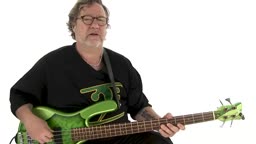
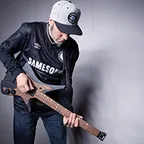
Hi, I’m Stu Hamm, one of TrueFire’s top bass instructors. Welcome to Learn Bass 1: First Steps for Beginners. This course is entirely FREE to TrueFire Students.

Over the past 25 years, I’ve taught thousands of people — beginners just like you — how to play bass. Our accelerated, hands-on method is specifically designed to get you up and running quickly and painlessly. From the very first lesson, you’ll be playing bass lines and making music. In fact, you’ll play your way through the entire course.

You’ll learn how to play essential bass lines and rhythms, how to build up your finger strength to play open and fretted notes, get a good solid tone, learn basic hand positions, transpose bass lines to different keys -- everything you need to start jamming with your buddies.

Our lessons are presented in easy-to-digest, bite-sized chunks so you’ll never feel overwhelmed or frustrated. And unlike other learning methods that show you something and then send you off to practice on your own, with our unique playalong practice sessions, I’ll guide you through each practice session, every step of the way. Plus, you’ll be able to apply everything you learn by playing along with our band tracks so you can hear how your bass parts sound with a real band.

Ready to learn how to play bass guitar? Grab your bass and let’s dig in.

What you'll learn

  • Establish effective practice habits from the beginning
  • Understand the numbering system for bass strings (1-4)
  • Learn to practice at slower tempos before advancing to faster ones
  • Understand the importance of sequential lesson progression
  • Develop patience and mastery-focused mindset
Release date: 06/07/2018 • 1h 11m runtime
Start Course
Sample lessons
Pick & The Fingers
Pick & The Fingers
Overview
Holding & Sounding Notes
Overview
A,D, and G Strings
A,D, and G Strings
Lesson 2: Demonstration
Practice Session 3
Practice Session 3
Playalong: Slow

What's included

28 lessons • 22 charts • 5 Jam Tracks

Learn Bass 1: First Steps for Beginners
Hi I'm Stu Hamm, one of TrueFire's top bass instructors. Welcome to Learn Bass 1: First Steps for Beginners.

Over the past 25 years, we've taught thousands of people — beginners just like you — how to play bass. Our accelerated, hands-on method is specifically designed to get you up and running quickly and painlessly. From the very first lesson, you'll be playing bass lines and making music. In fact, you'll play your way through the entire course.

You'll learn how to play essential bass lines and rhythms, how to build up your finger strength to play open and fretted notes, get a good solid tone, learn basic hand positions, transpose bass lines to different keys - everything you need to start jamming with your buddies.

Our lessons are presented in easy-to-digest, bite-sized chunks so you'll never feel overwhelmed or frustrated. And unlike other learning methods that show you something and then send you off to practice on your own, with our unique playalong practice sessions, I'll guide you through each practice session, every step of the way. Plus, you'll be able to apply everything you learn by playing along with our band tracks so you can hear how your bass parts sound with a real band.

Ready to learn how to play bass? Grab your bass and let's dig in.
How Do I Practice?
Let's talk really quickly about how to practice and how to use this course to become a better bass player. Every course is laid out sequentially, and it's very important that you master one lesson before you go on to the next one. This is the way you learn: by repetition, by learning a basic technique, then mastering it and expanding on it.
Warm-ups & Stretching
It's really important to stay loose and relaxed when you play, and to warm-up before you play. Let's talk about some basic things you can do to warm-up. The sooner in your career you take this seriously, the better chance that you'll have a longer pain-free music playing life.
Pick & The Fingers
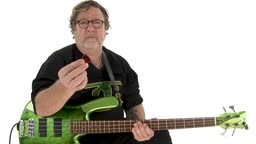
One of the first decisions that you'll have to make is how you're going to pluck the notes. Will you use your fingers, or will you use a pick? Most often times use their fingers, but there are times when the pick is used to give a different tone and for different styles of music.

We'll be using our fingers in this course, but if you are going to use a pick, you need to choose which way you'll stroke the strings. Some bass players' go to stroke is going down, and some go up. Up may be a little more natural for people who are used to using their fingers, as it's the same direction. Keep your hand loose, and don't hold the pick too tight.

When using your fingers, you alternate between your first and second fingers to play the notes. You don't have to pull the strings very hard to get a sound. Just rest your fingers on the bottom of the strings, and as you pluck it, you're just pulling the string towards your body. A nice, even stroke will help you achieve what you want. Remember: we're playing music, so it has to sound good!
Holding & Sounding Notes
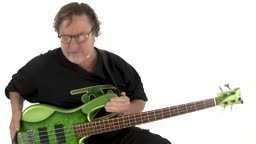
So, you've got a bass. Now what? You've got to learn to hold it first. I've got a strap here, and you have to decide how low the bass will hang depending on if you're sitting or standing. Luckily, I keep the bass about the same when I'm in both positions. Some people (like metal players) wear their basses super low. So, it's up to you!

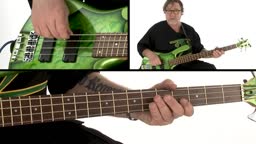
We use our left hand to fret the notes, but also to keep the notes quiet when we're playing other notes with our right hand. When fretting notes, you need to play it with your fingertips, and arching your fingers. The thumb is placed on the back of the neck, not on top. This will help us play the notes clean and clear, which is our first priority: music is supposed to sound good!

For the right hand when using the fingers, you need to figure out the angle of your wrist that works best for you. I personally have a little bit of curve in my wrist, although some would tell you that having a curved wrist is a bad thing. Take these suggestions along with what works for you - don't play something in a way that hurts. Especially when you're playing new things - if something starts to hurt, it's time to stop and come back later.

We're now ready to play the bass!
String Names
Let's get to know the bass. This is a 4-string bass - many people these days will play a 5-string or 6-string bass, but let's start here. Let's talk about the names of the strings. The E string is first, or the 1 string or the low string. The next string up the neck is the A string, or the second string. Next, we have the D string, which is the third string. Finally, we have the top string, which is the G string or fourth string.
Whole Notes on E
The first thing we need to do is to learn how to play our open E string. We'll be plucking the E string, playing what's called a whole note, which has four beats in it. We'll start slowly in Practice Session 1, and then go faster in Practice Session 2. Focus on getting a good sound out of the E string.

+ 21 more lessons

Start Course

Reviews

33 results

MartinHayden

Verified buyer

06/06/26

Best beginner bass

Fantastic work.

andrew.bighammer

Verified buyer

12/31/25

Restart

This is a great package to start

Chrisedd

Verified buyer

09/09/25

Great format to learn or improve playing an instrument.

I love Truefire's format. The interface is laid out nicely and easy to navigate. The video quality is top-notch. The pricing structure allows to purchase a single course or subscription plan at a fair price.

NeoSquonk

Verified buyer

02/04/25

I wish There was a camera view that was tire on the left front hand to see exact placement of fingers on the fretboard. But like how sheet music synchs with video.

theloniusk

Verified buyer

02/02/25

Great!!

Another great course!!

Stop searching. Start improving with All Access.

Try 14 days free. Cancel any time.