Modern Method for Guitar

A Comprehensive Study Plan for Mastering the Guitar

Marty FriedmanTommy EmmanuelSteve VaiEric GalesEric Johnson

Get this course and 1,000+ more with All Access

Try 14 days free. Cancel any time.

Purchase Individual Course for $19.99
Modern Method for Guitar

About this course

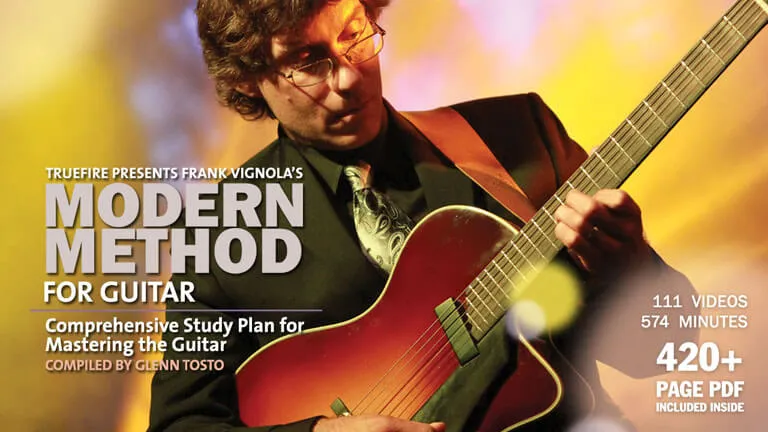
Modern Method is far more than a guitar course--as the name implies, it's a completely modern new method for playing the guitar.

Although Modern Method has been created by one of the great jazz guitarists of our time, the techniques Frank Vignola shares here are highly applicable to any style of guitar playing. The principles and concepts work as well for rock and metal as they do for the most complex jazz.

If you are already a fan of Vignola's other courses for TrueFire, studying his Modern Method will connect all the dots for you. Vignola shares the techniques and exercises he has refined over 10 years of teaching private lessons. He also lets you in on how he develops and maintains his staggering technique, and shows you how to build yours. Vignola also discusses his music philosophy as it applies to the art of improvisation--which is at the core of his method.
"I have dived into this course and it is amazingly thorough, well paced and presented in a relaxed manner. It has allowed me to learn so much about scales and theory that I never thought I would learn. The course is also amazing value for money given the detail and the size of the handbook. I highly recommend this course to anyone who wants to really hone their understanding of how the fretboard works." - Nathan W., TrueFire Student
Prepare for a series of lessons and flowing jam sessions with a master that will engage and inspire. You'll emerge on the other side with a profound new understanding of your instrument that will blast your playing to new heights.

Frank Vignola is no slouch and you won't be either by the time you are finished with Modern Method. To say these guitar lessons are thorough is an understatement, yet Vignola has created super-engaging jam tracks that get you turning technique into music from the get-go. He's also recorded a series of "play-along" tracks that will enable you to literally jam with him -- he plays a section and then gives you space to respond. Cool!

Expect to play every major scale vertically and horizontally, in all 12 keys. Expect to cover the minor tonalities -- natural minor, harmonic minor, melodic minor and dorian, for example. You'll also explore dominant tonalities from super locrian to diminished, and discover how they all relate to the dominant chord. He also teaches you over 100 ways to play arpeggios, horizontally and vertically, and provides picking techniques and finger control exercises to make it all begin to flow more easily.

Vignola's Modern Method also includes the entire Inversion Excursion e-Book featuring 62 sets of inversions, across all chord types and all string groups - 800 PDF pages of charts illustrate all 62 sets, in all 12 keys (see example chart) providing a handy reference for over 2,500 Root, 1st inversion, 2nd inversion and 3rd inversion chords.

Harmony is covered in depth as Vignola guides you through exploring intervals as they relate to each of the 12 scales. Learn to harmonize in thirds, seconds, fourths and to harmonize melodies, and apply chord voicings to chord melodies. Plenty of charts are provided so you can see what you're learning visually, as well, and have easy access to clear references.

In addition, you'll learn all the common chord progressions you need to play most songs, and you will spend a lot of time improvising over these progressions and interacting directly with Vignola via video.
"As an intermediate guitar player, I am in awe of Frank Vignola's grasp of music and the guitar's fretboard. This course has opened up new avenues for me, and has helped me to improve not only in the area of music theory, but also in that of application. Frank has a very inviting style of presentation. He is easy to understand, and tells you exactly what you need to do in order to practice purposefully. The included charts and jam tracks alone are worth the cost of the course. If you are a beginning or intermediate guitar player, you will definitely gain something by taking this course." - Matthew S., TrueFire Student


What you'll learn

  • Master major scales in all 12 keys with over 100 variations
  • Apply all techniques to improvisation across different tonal centers
  • Learn to harmonize melodies and scales
  • Learn multiple minor tonalities and their applications
  • Develop a complete, integrated approach to guitar playing applicable to any style
Release date: 11/09/2011 • 9h 35m runtime
Start Course
Sample lessons
The Cycle of 4ths (and 5ths)
Segment 9: Instruction
Horiz. & Vertical Minor Scales
Segment 23: Instruction
7: Horiz. & Vert. Arpeggios
Segment 32: Overview
10: Harmonizing Melodies
Segment 44: Overview

What's included

111 lessons • 80 charts • 14 Jam Tracks

Modern Method for Guitar
Welcome to my course: Modern Method for Guitar. This course represents my complete approach to learning the guitar, and I am happy to share it with you. Please be sure to start out by downloading the full manual before you begin. Download the manual by clicking on the chart button above and then start to get to know the structure of the course. Each chapter begins with an overview followed by step-by-step instructions that correspond to the video segments. This is a supplement to the video and has many of the lessons from the video written out in all 12 keys. After you have watched the video segment, use this as a refresher to remind you of the lesson you are working on.For more guidance: notation, tablatures, chord grids, and examples are also provided after the text sections in the manual, and are viewable in the software as well.Some lessons include graphic displays of chord shapes with fingerings. Rather than starting with the chord grids and memorizing the shapes, I suggest you work through the lessons first to increase your knowledge of the fret board. Refer to these pages when needed and for confirmation that you have done the lesson correctly.Theory is covered throughout the course and can be very helpful to understand. I encourage you to study this material but do not get hung up on it. If a concept is unclear or confusing, work through it and move on. If you review the theory after you have worked through the lesson you will likely have a better grasp of it.Let's get started!
Chapter 1: The Fretboard
In addition to explaining the guitar's layout, the first lesson covers basic concepts and terms that will be used throughout the book.

1. From lowest pitch to highest, the six guitar strings are named E-A-D-G-B-E.

2. We refer to each string with a number. The top E string, which is highest in pitch, is the 1st string, the 2nd is B, the 3rd - G, the 4th - D, the 5th - A, and the 6th is Low E, the bottom string.

3. From the low E to the A string is an interval called a 4th. From the strings A to the D and the D to the G are also a 4th apart. From the G string to the B string is a 3rd and then from the B to the high E is another 4th.

4. The frets are metal wires embedded in the fingerboard. They are numbered from 1 up, starting at the 1st, the fret farthest from your body.

5. Each fret is a 1/2 step. A whole step is made up of 2 frets.

6. The fret board is arranged based on the chromatic scale, which contains all 12 notes played sequentially.

7. The musical alphabet is 7 letters: A, B, C, D, E, F, G.

8. There is a whole step between notes A and B; there is a natural 1/2 step between notes B and C, whole steps between C-D, D-E and another half step between E and F.

9. Think of a piano keyboard: the white keys that are not separated by a black key are B and C and E and F. Unlike the guitar, which is arranged on the chromatic scale, the keyboard is laid out based on the major scale.

10. If you start at C on the piano and play every white key until you get to the next C (octave), you play the C major scale.

11. Each note or step of any major scale can be referred to by Roman numerals. More commonly we refer to notes in the scale with numbers, such as the 3rd, 4th, 5th, etc.

12. Roman numerals refer to the chords that can be built on each note of the major scale. I, ii, iii, IV, V, vi, and vii. The root chord is built on the first note of the major scale, so the first note here is the I chord; the chord built on the 5th note of the major scale is referred to as the V chord. Uppercase Roman numerals indicate a major chord; lowercase indicate a minor chord.
Horizontal Chromatic Scales
In this segment we play the horizontal chromatic scale. In the play-along that follows we will use the following approach.

1. Starting on the open top string, play each note up to the octave and back. Remember there is a natural 1/2 step between the E and F and B and C.

2. Play all down strokes with your picking hand. Pick through the string and allow the pick to rest on the string below.

3. Do not lift your fingers after you place them down on the fret board. Once you play to the 4th fret, shift your hand up the fret board and play the next note at the 5th fret with your 1st finger.

4. When descending, shift all 4 fingers into place one finger per fret.

5. Strive to make each note clean and even with a good tone.

6. Continue the same steps on each string.

7. Occasionally, think of the names of the note you are playing.
Horizontal Chromatic Scales
1. Play the horizontal chromatic scale as demonstrated in the video and written in the notation that follows.

2. Play the horizontal chromatic scales on each string, starting on the high E string up to the 12th fret and back.

3. When ascending, keep your fingers on the fingerboard once they are placed.

4. When descending, shift your hand down into place, positioning one finger over each fret.

5. Test yourself by naming the notes as you play them.

6. Play to this video every day as a quick warm-up.
Horizontal Chromatic Scales
1. Play the horizontal chromatic scale as demonstrated in the video and written in the notation that follows.

2. Play this exercise slowly striving for a good tone. Eventually build to a faster tempo.

3. Begin on the low E string, playing 4 notes before shifting your hand up to the next position. Play up to the octave and down before moving to the next string.

4. When ascending, keep your fingers on the fingerboard once they are placed.

5. When descending, shift your hand down into place, positioning one finger over each fret.

6. Play to this video every day as a quick warm-up.
Vertical Chromatic Scales
In this segment we play the vertical chromatic scale. In the play-along that follows we will use the following approach.

1. Start on the low open E and play each note up to the 4th fret, then move to the open A string, play each note up to the 4th fret then move to the open D, etc.

2. Play all down strokes with your picking hand. Pick through the string and allow the pick to rest on the string below.

3. Be aware that when you get to the G string you only play up to the 3rd fret before moving up to the open B string. This is due to an anomaly in the way the guitar is tuned: The interval between each of the open strings is a 4th except for the G to B string, which is a 3rd.

4. Once you get to the high E string, descend playing the same chromatic scale in reverse.

5. Next, test yourself by randomly choosing notes and finding all of them on the fret board.
Vertical Chromatic Scales
1. Play the vertical chromatic scale as demonstrated in the video and written in the notation that follows.

2. Play from the low E to the high E at a nice slow tempo.

3. Focus on a good clean tone.

4. Do this every day, building your tempo over time.

+ 104 more lessons

Start Course

Reviews

55 results

Charmazazz

Verified buyer

06/28/26

Maybe the most complete method for guitar available on the web.

johannesbrugman

Verified buyer

06/10/26

a thorough understanding and knowledge of the guitsar is possible if on follows this course

derickaflorian

Verified buyer

06/06/26

This Course Builds Fundamentals

I love this course so far. Frank doesn't shy away from the fact that it takes work but it is paying off. In two weeks I am starting to memorize the fretboard. Take this course slow, but from what I see the payoff is more than worth it.

Aton1

Verified buyer

05/11/26

A meaningful and enriching experience

For me, the course is fantastic. I like Frank Vignola’s calm demeanor, the way he explains things, and his music. When you practice his music, you’ll have a meaningful and enriching experience.

hemanth.shanmugam

Verified buyer

01/08/26

An in depth course content

All concepts were in depth and was explained clearly. The course is at a good pace which was not too fast nor too slow. Kudos to Frank Vignola for coming up with excellent content.

Stop searching. Start improving with All Access.

Try 14 days free. Cancel any time.