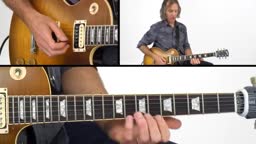
Classical Concepts for Rock Guitar

Classical insight and harmonic approaches for contemporary rock guitar

Marty FriedmanTommy EmmanuelSteve VaiEric GalesEric Johnson

Get this course and 1,000+ more with All Access

Try 14 days free. Cancel any time.

Purchase Individual Course for $9.99
Classical Concepts for Rock Guitar

About this course

Who doesn't remember that YouTube video of funtwo (and countless other YouTuber copycats) playing that rock guitar version of Pachelbel’s Canon?! Tens of millions of views and all that controversy about who really performed the piece made front page news all over the world (it was Lim Jeong-hyun). One thing's for sure though -- we guitar players watched and listened to that video with our mouths wide open. And not just because of the technique; the music itself grabbed our ears and wouldn’t let go until the very last note.

Classical influences on rock music has tickled our ears for decades and will continue to do so for decades to come. That’s why Dave Celentano’s Classical Concepts for Rock Guitar belongs in every rock guitarist’s practice studio.

The Moody Blues, Nice, Deep Purple, King Crimson, Emerson-Lake-Palmer, Genesis, Gentle Giant, Pink Floyd, Yes, Focus, Rick Wakeman, Camel, Electric Light Orchestra, Muse and hundreds of other bands draw heavily from classical music in their compositions and performances. Guitarists Randy Rhoads, Paul Gilbert, Ritchie Blackmore, Edward Van Halen, Yngwie Malmsteen and Marty Friedman (to name just a few) likewise take advantage of classical techniques and harmony in their playing.

Art rock, progressive rock, neo-progressive, symphonic metal, neo-classical metal and a dozen other modern styles of music pull influences and inspiration directly from the classical playbook BUT really, ALL music taps into classical harmony, progressions, chord voicings, techniques and vocabulary in one way or another. Classical Concepts for Rock Guitar drills down on several core and essential classical elements that you can put to work immediately in your playing without having to take formal classical lessons.

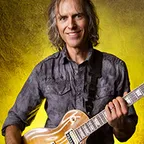
Recording artist, performer and monster player Dave Celentano is also one of the most prolific and sought-out educators in the biz today. Dave has authored and published over 40 books, videos, DVDs and albums. Classical Concepts for Rock Guitar is Dave’s first interactive video project and we’re proud to welcome him to the TrueFire family!

Dave organized his curriculum in a very innovative and engaging way. No tedious exercises or boring theory to work through -- you will play your way through the lesson material and then immediately apply the key learnings in a contemporary rock musical context.

The curriculum is organized into 10 sets of lessons. For each of the 10 sets, you’ll first learn a classical piece arranged for electric guitar, which in itself will give you a variety of cool classical tunage to get a grip on and play for family and friends.

Dave then extrapolates and demonstrates the key classical concepts and techniques from that piece -- these are the tools you’ll be using in your own playing. These include triads and inversions, alternate picking, sweep picking, two-hand tapping, pedal points, hammer-ons from nowhere, string skipping arpeggios, trills, hybrid picking, legato technique and volume swells with a dotted eighth note delay.

Next, you’ll apply those key learnings over a practice rock rhythm track as you play-along with Dave so that you can learn how to pull your new-found classical influences into your own performances and solos. All of the critical material is tabbed and notated, plus you’ll get the practice rhythm tracks to work with on your own.

“It's easy to play any musical instrument: all you have to do is touch the right key at the right time and the instrument will play itself.” - Johann Sebastian Bach

What you'll learn

  • Apply arpeggios over appropriate chord progressions
  • Create smooth, continuous melodic lines using sweep picking
  • Play the lower (left hand) bass/accompaniment part
  • Connect downstroke and upstroke sweeps seamlessly
  • Observe classical guitar performance technique
Release date: 10/08/2013 • 2h 08m runtime
Start Course
Sample lessons
Badinerie
Badinerie
Performance
Crossing Strings with Triads
Concept 1
Pedal Points
Pedal Points
Concept 3
Hammer-ons From Nowhere
Concept 4

What's included

66 lessons • 31 charts • 13 Jam Tracks

Classical Concepts
Thanks for checking out my course "Classical Concepts for Rock Guitar". This course uses popular classical tunes to help develop and ultimately master important techniques and a broader understanding of music theory on the guitar. Guitarists Randy Rhoads, Paul Gilbert, Ritchie Blackmore, Edward Van Halen, Yngwie Malmsteen, and Marty Friedman (to name just a few) have all been influenced by and used classical techniques in their playing. These concepts include triads and inversions, alternate picking, sweep picking, two hand tapping, pedal points, hammer-ons from nowhere, string skipping arpeggios, trills, hybrid picking, legato technique, and volume swells with a dotted eighth note delay. Although the examples sound impressive performed at a fast tempo, the student should practice with a metronome at a slow enough tempo to play steadily with the beat and without mistakes.
Prelude in D Minor
Written by J.S. Bach (1685-1750), a German composer who was considered by many to be the greatest composer of all time. This abbreviated version of "Prelude in D minor" is taken from Bach's "Well-Tempered Clavier" book one and develops triads and their inversions. For tone, we'll use a bit of distortion and the bridge pickup for a nice crispy tone.
Prelude in D Minor
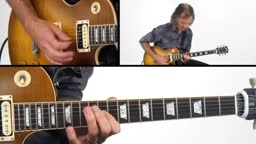
This piano piece was originally written as 16th note triplets, but in this example I've changed it to 8th note triplets and enter on the down beat of beat 3. The tune uses all three diatonic triad types: major, minor, and diminished, and most of their inversions. The position shifts between arpeggios require swift movements of the fretting hand, which should be rehearsed slow enough to make the move smoothly and without breaking the beat. Use this economical picking pattern for each triad: up stroke - pull off - down stroke.
Major Triads & Inversions
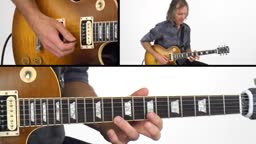
Exploring the major triad and its inversions: 'root inversion, 1st inversion, and 2nd inversion on the top two strings. Additionally, these shapes work on any adjacent pair of strings, except G-B combination, where the G string fret position is lowered one fret to accommodate the major 3rd tuning between the two strings.
Major Triads & Inversions
The backing track chord progression consists of the following major chords: C - G - Bb - F. Begin by playing slow ideas using the root position triad for each chord as demonstrated on the video. Next, play slightly faster using triplets and play each triad four times. Make sure the transition to each chord is smooth and without a break in tempo. The last approach is the most efficient and combines different inversions to minimize left hand movement. Check out the end of the solo in the Eagles "Hotel California" for a grand demonstration of triads and their inversions.
Minor Triads & Inversions
Exploring the minor triad and its inversions: root inversion, 1st inversion, and 2nd inversion on the top two strings. These shapes work on any adjacent pair of strings, except G-B combination, where the G string fret position is lowered one fret to accommodate the major 3rd tuning between the two strings.
Minor Triads & Inversions
This backing track consists of the following chords: Am - Dm - Em - Am. First, using the root inversion triads for each chord, follow along by playing each triad once and sustaining the last note three beats. Next, play along using steady eighth notes and focus on switching positions steadily with the beat. The last approach combines several triad inversions and uses efficient left hand movements.

+ 59 more lessons

Start Course

Reviews

8 results

alessandroramos

Verified buyer

08/29/24

Solid base and its applications

Great stuff! Dave brings the concepts with very solid theory base and show the applications.
bparham79

01/04/23

Killer Course for Classical Guitar Concepts

I've been a massive fan of Dave's for a long-time now. He's a true rock/metal/classical guitar master and a fantastic teacher! This is easily the best course on the topic available.

jeff h.

07/14/20

classical concepts for rock guitar

I have been familiar with Mr. Celentano for 30 plus years, and he is a first rate teacher on metal/rock guitar. One of my very first book/cassette packages I ever purchased was his Speed metal book. The cassette tape has been long ago worn out and I missed having the audio companion to the book. This course covers a lot of the material found in the speed metal book, and updated at that. Want to increase your speed picking? Its here in the course. An intro to sweeping? Its covered. This is a great introduction to neoclassical guitar if you have always wanted to learn but didn't know how to begin. It is not completely comprehensive but it is a very good platform to start with. I have several other instructional books/audio courses from Mr. Celentano and they are all top notch. This is one course I have purchased from truefire that I will refer to again and again for years to come.

makermann

Verified buyer

03/27/20

Very cool and inspiring stuff here. Well done Dave.

Jeffrey B.

Verified buyer

09/25/16

Classical Concepts for Rock Guitar has a lot of great ideas in it. It will help you get some 'shreddy' sounding classical style licks if that's what you want. I really liked it as an expose' into how some of the classical masters think. It's a challenging course technically. I'm wanting to knock together 'Flight of the Bumble Bee' as both a legato and speed picking exercise and Dave Celantano has an excellent version in here. There all sorts of etudes for working techniques and plenty of great melodic ideas in this course. The techniques are shown individually and then in a 'Putting it All Together' section where you use the techniques covered in context. There's alternate picking, tapping, sweep picking, legato and more. This is great course to get some classical techniques and thinking into your playing.

Stop searching. Start improving with All Access.

Try 14 days free. Cancel any time.