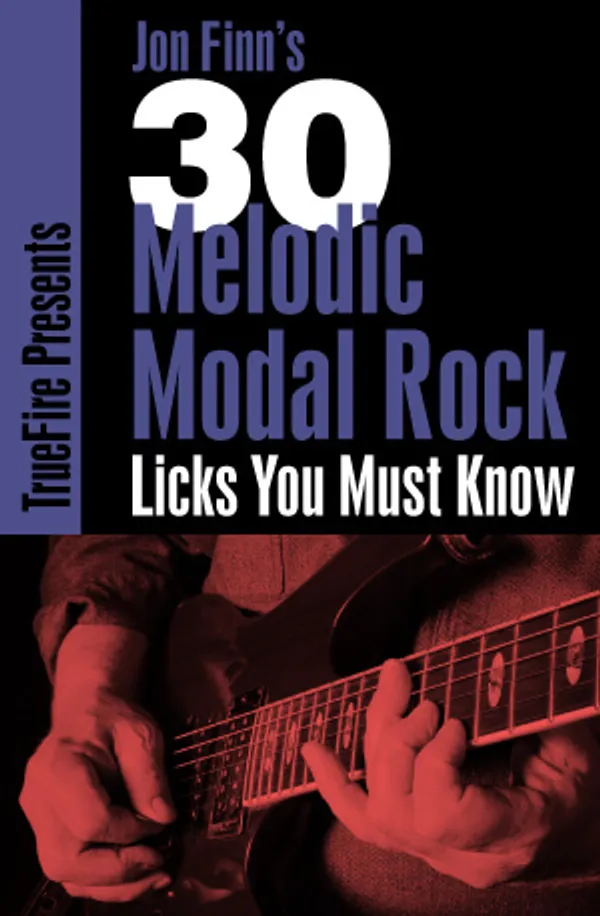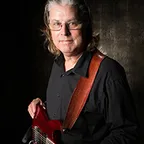
Modal Rock Soloing

The definitive modal improvisation system for rock guitarists.

Marty FriedmanTommy EmmanuelSteve VaiEric GalesEric Johnson

Get this course and 1,000+ more with All Access

Try 14 days free. Cancel any time.

Purchase Individual Course for $9.99
Modal Rock Soloing

About this course

What is the most frequently asked question fielded by guitar teachers? Survey says... “What scale do I use?” There are hundreds of correct answers to that simple question. Some of those correct answers are also simple while some require a degree in higher math and rocket science to understand. Our mission as music students is to find the correct answers that click in our head and then proceed with our studies accordingly.

Ultimately though, a proficient improvisor is NEVER thinking about scales or modes when they are playing. An accomplished musician is playing by a creative intuition that is fueled by that knowledge but certainly not driven by that knowledge. Meanwhile, what scale do we use...?

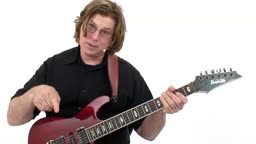
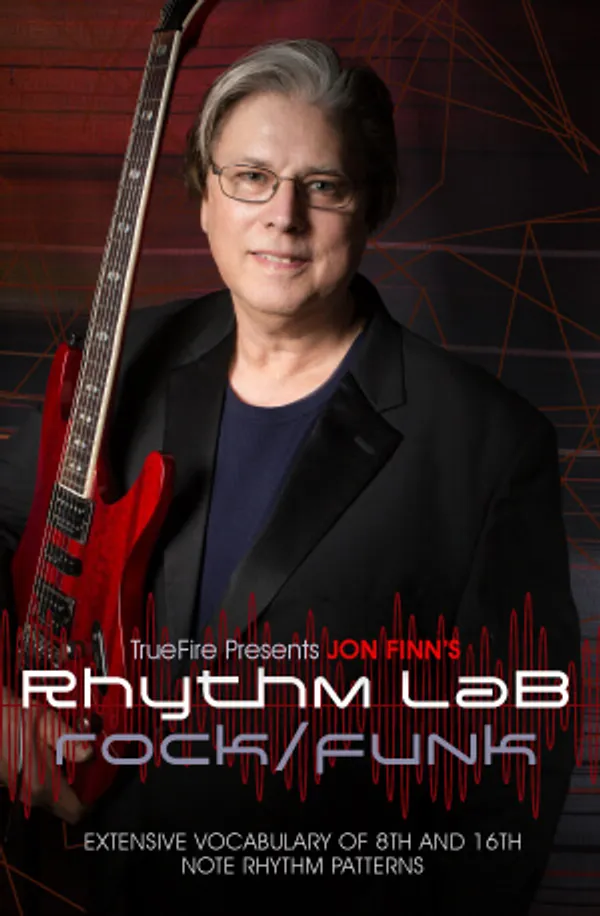
Jon Finn will not only answer that question in a simple and very illuminating way, he’ll also guide your own creative intuition skills with a technique he calls “Ear/Hand Coordination.” It’s all here in Modal Rock Soloing.

“The goal of this course it to help develop a technique I call "Ear/Hand" Coordination. Fully developed, Ear/Hand Coordination enables you to play what you hear in your head without any thought or hesitation.”

Jon organized his Modal Rock Soloing curriculum into two sections. In the first section, Modal Studies, Jon answers the ‘what scales to play’ question by presenting his modal system, which adapts beautifully to modern rock because the vast majority of modern rock progressions are based on modes.

Jon’s presentation of modal harmony and how to apply modes in your soloing and improvisations is refreshingly clear and accessible. Jon will show you three ways to view modes: 1) a major scale starting and ending on any degree other than the first.; 2) a major scale with notes altered; and/or 3) a pentatonic scale with with notes added. One or all three of those approaches will indeed ‘click’ in your head.

As you explore the modes Jon will make a series of insightful observations about the mode’s usage, color and characteristic notes. No greek. No rocket science. No nonsense. At last, you will know what scale to play in pretty much any musical situation.

In the second section, You’ll play your way through six soloing studies during which Jon will demonstrate how to apply your newfound harmonic insight in a real-world musical context. It’s here that you’ll start to develop your Ear/Hand Coordination and creative intuition.

Each study features a rhythm track. Jon will first teach you how to analyze the track and its underlying progression to determine which scales and modes you can call on. Jon then demonstrates a solo based on that determination and harmonic approach. And then you’ll playalong with Jon over that same track, trading measures and developing your ears.

All the rhythm parts are tabbed and notated and so you are certainly welcome to cop any of Jon’s lines and add them to your own vocabulary. While there are certainly some sweet lines that might appeal to you, this course is more about developing your ability craft your own lines on the fly without thinking about it. You’ll have all of the rhythm tracks to work with on your own to do just that.

So, what scales do you use? Survey says... jump on this course immediately!

What you'll learn

  • Play Dorian scales in multiple fretboard positions
  • Integrate required melodic licks into improvised solos
  • Identify appropriate Dorian scales for different chord progressions
  • Count measures accurately while improvising
  • Emphasize the natural 6th to bring out Dorian character
Release date: 10/22/2013 • 2h 50m runtime
Start Course
Sample lessons
Modal Study #1
Modal Study #1
Analysis
Modal Study #1
Modal Study #1
Lydian Soloing Example
Modal Study #1
Modal Study #1
Playalong
Soloing Study #1
Soloing Study #1
Rhythm Track Overview

What's included

56 lessons • 52 charts • 51 Jam Tracks

Modal Rock Soloing
What scale do I use? This is one of the most common questions I get asked as a teacher at Berklee, or at clinics when I'm on the road. There seems to be a lot of discussion on the internet on this topic too. The most common responses I see tend to fall in to two camps:

1) "I never use scales, I just play what I feel."
2) "After I've done a thorough analysis, my knowledge of music theory will lead me to the correct notes to play."

When I get asked that question, I give the short answer first: "The scale I use is the one that sounds good."

Of course there's more to it than that. It's important to remember that when we improvise, we're really trying to tell a story. One that advances the meaning of the song. To overthink the process can get in the way of storytelling. But not thinking at all doesn't allow us to give the story any momentum. Rather, we're just rambling aimlessly.

Certain sounds can invoke certain emotions. Major chords sound happy and minor chords sound sad. Choosing just the right note to play within a chord progression can be like that too. Even though I can't give you "The Right Notes to Play", there are certain tendencies that can be observed. Knowing how to conjur those sounds up gives you more control.

In this course, we'll learn a few ways to play scales and modes. We'll learn a little bit about how to figure out what scales you can use within certain types of chord progressions.

The goal of this course is to help develop a technique I like to call ear/hand coordination. Fully developed ear/hand coordination means you hear something in your head, and it comes out of your fingers without any hesitation. To do that, you must be able to hear something in your head and be able to instantly identify two things:

1) What it is and
2) Where it is.

I wish I could say that I have this mastered, but to be honest, I don't. Like you, I'm a student of guitar who's just trying to get better.

In these videos, I will keep the explanations relatively short because most of the learning takes place when you're playing the guitar and thinking about the meaning of everything you play. Because these videos are designed for repeated listenings, we won't spend a lot of time on each example. That's what the rewind button is for. If it feels like the pace is too fast when you first watch it, it'll feel just right when you go back for review.

As a teacher, it's important to me that my students develop their own voice. That means you take the information given and do something else. This system shows in detail many of the steps I've taken to develop what I do. If you like what you hear me doing, do exactly as I do.

If you want to get the most out of this course, I would suggest that you work through the entire program doing every example exactly as it is laid out. As you do that, formulate your own opinions about the information given. Your personal style is based on your opinions. Repeat that process several times because more information gets revealed in repeated practice. In fact, it's likely that you'll be able to repeat the program more than 10 times and still be able to extract new information. That's what my experience has been with this approach. The further up the hill you go, the more of the horizon you can see. Let's get started.
Modal Studies
This course is divided into two sections. The first, Modal Studies, looks at each mode and makes a series of observations about things like usage, color and characteristic notes.
3 Ways To Think About Modes
One of the distinctions I want to make is the difference between a mode and a modal fingering. When the music, the melodies and chords center around one strongest note, that note is said to be the tonal center. When the tonal center is the 1st degree of a major scale (think "doe, a deer, a female deer"), then the mode is said to be Ionian. More commonly, it's just called the major scale.

If you take that same group of notes and phrase them in a way where the 6th degree (or "La") of that same scale seems to be strongest, then you're playing a minor scale (or relative minor). In these two examples, you could use the same fingering. What makes the difference is which notes are emphasized in the musical phrases.

Therefore, one fingering of a major scale can produce any mode based on a major scale.

Conversely, playing the correct modal fingerings does not NECESSARILY mean you're playing in a certain mode:

A MODE is when the tonal center (strongest note) of the meldody and chord progression comes from a major scale, but does NOT center on the 1st degree.

A MODAL FINGERING is when the scale comes from a major scale, but the lowest note of the fingering is not the 1st degree.

Because a lot of modern rock chord progressions are based on modes, it's important to understand their tendencies.

Let's start with these three definitions:

1) A MODE is a major scale starting and ending on any other degree other than the first.
Ex: A Dorian in a G major scale starting from it's 2nd degree

2) A MODE is a major scale with notes altered.
Ex: A Dorian is an A major scale with lowered 3rd and 7th degrees.

3) A MODE is a pentatonic scale with notes added.
Ex. A Dorian is an A minor pentatonic with the 2nd and 6th degrees added.

All three definitions are important because each gives a unique perspective. Your home looks different from the inside than it does from outside. Further, the back looks different from the front. But your mind accepts all of those perspectives as "your home" if you catch my drift. So it is with modes. Learning modes from all three points of view gives you a far deeper understanding.

This next set of modal fingerings all start from G, but are related to different keys. Further, the fingerings are simplified to one octave. This is done so that the fingerings are easy to learn. For now, focaus on how they're related, but also on how they're different in tone and character.
Modal Study #1
Here, Jon demonstrates the C lydian scale, and it's characteristics: C Lydian is a G major scale starting from its 4th degree (C). -C Lydian is a C major with a raised 4th degree. C Lydian is a C major pentatonic scale with a #4 (F#) and 7th (B) added. Since Lydian is the only major mode with a #4 (F# in this case), #4 is said to be the characteristic note of Lydian. If you want your solo to convey a distinctly Lydian sound, feature the #4 of the scale a lot. Conversely, avoid it if you want to be less obvious.
Modal Study #1
Jon explains and improvises using the C Lydian scale. Notice that not all the scale tones are used right away. Notice further that the same notes can be found in several places on the neck.
Modal Study #1
This is a solo trading exercise. Trade licks with Jon every 4 measures. If you can keep up and make it sound like a musical conversation, you'll know you have it mastered.
Modal Study #2
Here Jon demonstrates the Ionian scale and discusses its characteristics: C Ionian is simply a C major scale. Just play all the white keys on the piano from C to C. C Ionian is a C major pentatonic scale with a 4 (F) and 7th (B) added. If you want to convey a distinctively Ionian sound, including the 4th degree (F) makes it sound not Lydian and including the 7th degree (B) makes it sound not mixolydian. Both notes are needed to convey a true Ionian sound. After going through all this material, reviewing will be very helpful if you don't understand it all the first time.

+ 49 more lessons

Start Course

Reviews

15 results

s..v..e..n

Verified buyer

11/17/25

Highly recommended :-)

I really appreciate Jon Finn’s playing and teaching style, and these lessons are genuinely helpful for me!

vjuracak

Verified buyer

03/31/25

Excellent . . .

bparham79

02/06/24

Fantastic Course!

I've been working through this course for the past month, and it's opened up my playing profoundly. Thanks, Jon!

Osokin

Verified buyer

05/19/23

A Modal System For Rock Guitarists!

Jon Finn's course of lessons on how to apply modes and scales to your rock soloing is very well laid out, and will undoubtedly raise the level of both your playing and your understanding. Great stuff!

solinski

Verified buyer

03/02/21

Great course for learning modes

This course is great for learning modes. Each mode is clearly explained. Jon does a great job of explaining the characteristics of each mode. The second section applies the knowledge taught in Section 1. The examples are presented as if in actual songs, making them very practical. Overall a great course.

Stop searching. Start improving with All Access.

Try 14 days free. Cancel any time.