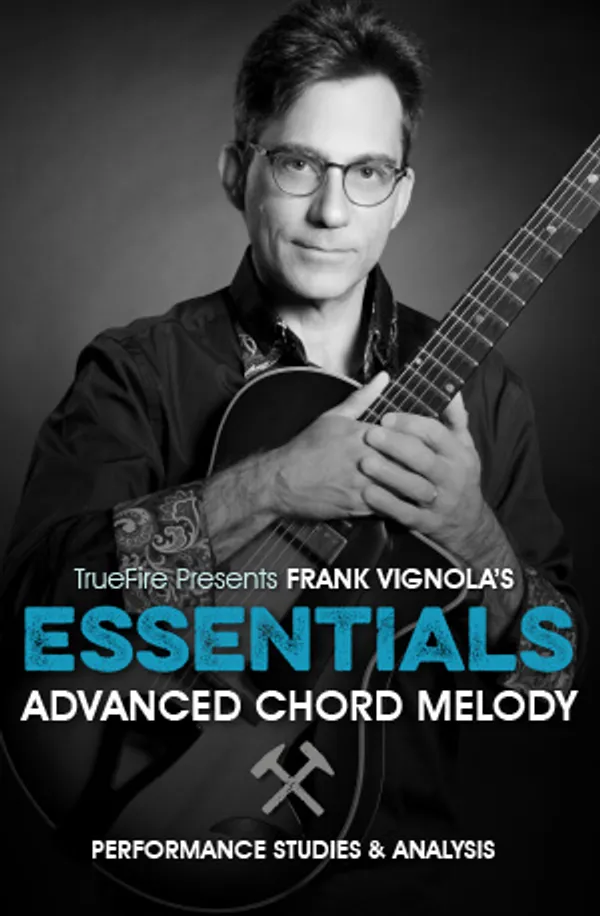

Take 5: Jazz Chord Tone Soloing

Jazz Chord Tone Soloing Essentials for Guitarists

Marty FriedmanTommy EmmanuelSteve VaiEric GalesEric Johnson

Get this course and 1,000+ more with All Access

Try 14 days free. Cancel any time.

Purchase Individual Course for $14.99
Take 5: Jazz Chord Tone Soloing

About this course

An essential skill for any jazz guitarist, and the key to improvising over chord changes, is knowing how to target, start, or resolve your lines to a chord tone. You can target the root of a chord, its 3rd or 5th, you can even target extensions of a chord like its 7th or a 9th, which gives your lines that real jazzy feel.

Frank Vignola’s Jazz Chord Tone Soloing edition of Take 5 drills down deep into these essential improvisational skills providing both a solid understanding of the approach and a series of performance studies where you will put those approaches to work over backing tracks.

”We’ll start this course with a chord tone soloing primer where I’ll pass on my approach for resolving and starting my lines when improvising. I’ll show you ways to find chord tones on the neck, how to craft lines that lead to a chord tone using neighboring, chromatic, and scale tones, and some approaches for embellishing your lines using expressions.”

After the primer, Frank guides you through 5 Chord Tone Soloing performance studies, from basic approaches to more sophisticated and challenging approaches. For each of the 5 studies, he’ll focus on a specific chord tone so that you can get a solid grip on the approach.

Frank will explain and demonstrate all of the key concepts and approaches along the way.  You’ll get standard notation and tabs for each of the performance studies. Plus, Frank includes all of the backing tracks for you to work with on your own. In addition, you’ll be able to loop or slow down any of the videos so that you can work with the lessons at your own pace.

Grab your guitar and let’s target tones with Frank Vignola!

What you'll learn

  • Navigate arpeggios from 5th to 5th across chord changes
  • Apply chord tone soloing concepts to the Autumn Leaves progression
  • Integrate blues vocabulary while landing on targeted chord tones
  • Combine scales and arpeggios to connect chord tones smoothly
  • Locate chord tones across the fretboard
Release date: 04/04/2019 • 0h 56m runtime
Start Course
Sample lessons
Level 5: Jazz Chord Tone Soloing
Overview
Level 5: Jazz Chord Tone Soloing
Performance
Level 5: Jazz Chord Tone Soloing
Breakdown

What's included

19 lessons • 5 charts • 5 Jam Tracks

Take 5: Jazz Chord Tone Soloing
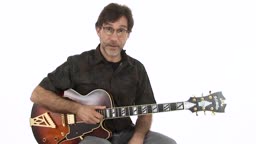
Hi, I'm Frank Vignola. Welcome to this Jazz Chord Tone Soloing edition of Take 5.

An essential skill for any jazz guitarist, and the key to improvising over chord changes, is knowing how to target, start or resolve your lines to a chord tone. You can target the root of a chord, its 3rd or 5th, you can even target extensions of a chord like its 7th or a 9th, which gives your lines that real jazzy feel.

We'll start this course with a chord tone soloing primer where I'll pass on my approach for resolving and starting my lines when improvising. I'll show you ways to find chord tones on the neck, how to craft lines that lead to a chord tone using neighboring, chromatic, and scale tones, and some approaches for embellishing your lines using expressions.

I'll then guide you through 5 Chord Tone Soloing performance studies, from basic to more sophisticated and challenging approaches. For each of the 5 studies, we'll focus on a specific chord tone so that you can really get a grip on the approach.

All of the performance studies are tabbed and notated and you'll have the jam tracks to work with on your own. You can loop and slow down the videos so you can work with the lessons at your own pace.

Grab your guitar and let's get started!
Chord Tone Soloing Approach
Before we get into our 5 studies, I discuss what exactly is chord tone soloing: Chord tone soloing is targeting chord tones. We start by targeting the root, then the 3rd, etc. So, tune up and dig right in!
Level 1: Jazz Chord Tone Soloing
In our Level 1 study, we're going to take a 2-5-1 in the key of G and play the root note of each of the chords in the 2-5-1 progression. Then we connect the roots by using neighboring tones and scalar patterns. Since the 2-5-1 progression is in just about every jazz standard you can name, I thought it would be a good idea to start targeting tones from this all important progression.
Level 1: Jazz Chord Tone Soloing
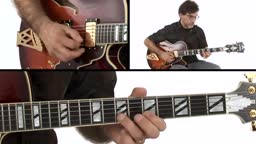
In this performance study, you can see and hear how I connect the chord tones using neighboring tones and scalar patterns. In our Level 1 study, we're going to take a 2-5-1 in the key of G and play the root note of each of the chords in the 2-5-1 progression. Then,we connect the roots by using neighboring tones and scalar patterns. Since the 2-5-1 progression is in just about every jazz standard you can name, I thought it would be a good idea to start targeting tones from this all important progression.
Level 1: Jazz Chord Tone Soloing
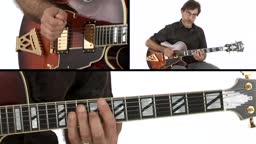
Here I'll break down the performance and give numerous examples and really dig into the concepts. We've taken a 2-5-1 in the key of G and played the root note of each of the chords in the 2-5-1 progression. Then, we connected the roots by using neighboring tones and scalar patterns. Since the 2-5-1 progression is in just about every jazz standard you can name, I thought it would be a good idea to start targeting tones from this all important progression.
Level 2: Jazz Chord Tone Soloing
In our Level 2 study, we're going to take the same 2-5-1 in the key of G and play the 3rd of each of the chords in the 2-5-1 progression. Then, we connect the 3rds by using neighboring tones and scalar patterns. Since the 2-5-1 progression is in just about every jazz standard you can name, I thought it would be a good idea to start targeting tones from this all important progression.
Level 2: Jazz Chord Tone Soloing
This is the performance of the Level 2 study, where you can see and hear how I connect the chord tones using neighboring tones and scalar patterns. In this one, we're going to take the same 2-5-1 in the key of G and play the 3rd of each of the chords in the 2-5-1 progression. Then we connect the 3rds by using neighboring tones and scalar patterns. Since the 2-5-1 progression is in just about every jazz standard you can name, I thought it would be a good idea to start targeting tones from this all important progression.

+ 12 more lessons

Start Course

Reviews

29 results

Le

02/22/26

Very Nice Course

Help you to nail one of the most fundamental and essentials skills when playing through changes
Houndslide

Verified buyer

12/24/24

Jazz Chord Tone Soloing

Great Lesson, thanks !!!!

swing73

Verified buyer

09/07/24

Chord tone soloing

Frank is so clear to understand. I really like his courses. I particularly like how he gives various levels of detail so you can pitch yourself without being over faced. What I want next is a roadmap to get from beginner to intermediate and beyond. Long live Frank vignola - he’s got so much to teach us!

Starglazer

Verified buyer

10/15/23

Another great course from frank it lines you up with the right approach for improvising.Has excellent explanations.Thanks.

trader46

Verified buyer

07/02/23

Solid Fundamentals

Frank is an especially strong communicator - he tells you what to do, why it works and how to improve... in clear easy to follow ways. There are few more fundamental platforms for improvising from than chord tones. This course has a logical immensely doable but demanding and rewarding structure. This course sets up re-usable, generic essentials for anyone.

Stop searching. Start improving with All Access.

Try 14 days free. Cancel any time.