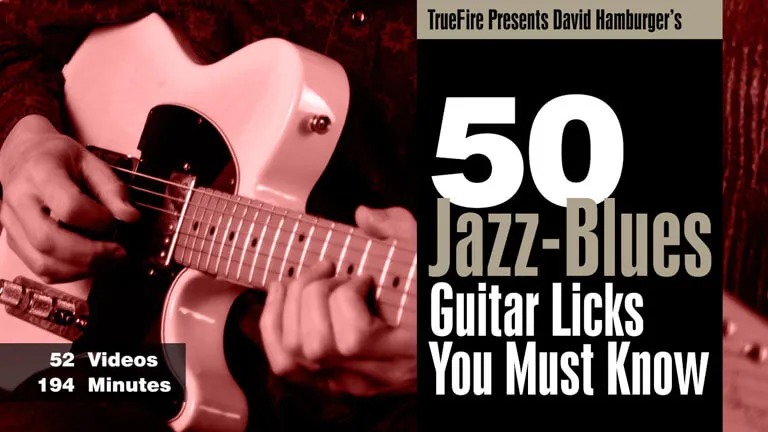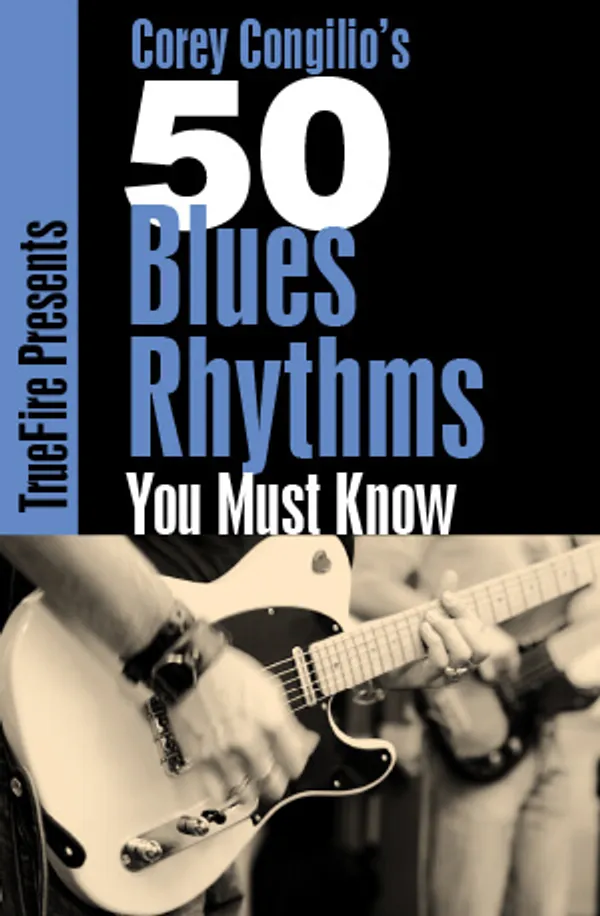

50 Jazz-Blues Licks You MUST Know

50 of the baddest, bopping-est, funkiest and bluesiest licks you must know

Marty FriedmanTommy EmmanuelSteve VaiEric GalesEric Johnson

Get this course and 1,000+ more with All Access

Try 14 days free. Cancel any time.

Purchase Individual Course for $14.99
50 Jazz-Blues Licks You MUST Know

About this course

The path from pentatonic sameness to heavy jazzed blues cat-itude often appears strewn with mystifying theoretical explanations and effete bossa renditions of "The Days of Wine and Roses." Feh! David Hamburger's 50 Jazz-Blues Licks You MUST Know cuts right to the chase, offering up some of the baddest, bopping-est, funkiest and bluesiest ways to navigate through any shuffle, boogaloo, minor blues or jazz-blues chord changes.

Hamburger digs deep into the 50s and 60s, when labels like Blue Note, Prestige and Riverside were serving up the funky, down-home music of guitarists like Kenny Burrell, Grant Green and Wes Montgomery, all of whom inspired some of the jazzed blues lickage in this collection. These alone are worth the price of admission, but as we all know, Hamburger is the consummate over-achiever and he sure didn't stop there...

For maximum groovalocity, Hamburger also explores the bluesy-funky-jazzy stylings of saxophonists Stanley Turrentine, Hank Mobley, Lou Donaldson and Jimmy Forrest, trumpeters Blue Mitchell, Kenny Dorham and Lee Morgan, and pianists Tommy Flanagan, Oscar Peterson and Hank Jones. Learning to play these horn and piano licks on guitar will take you places on the fretboard that you've never been before, both physically and sonically. Wanna turn heads at the gig? Get a grip on these fresh melodic and harmonic approaches for getting around chord changes.

50 Jazz-Blues Licks will have you blowing the changes through every possible transition of a 12-bar blues, from I to IV, from IV back to I, from V to IV to I, and from ii to V to I. With the material organized this way, you won't just learn a bunch of licks - at each step of the way, you'll know exactly how each lick works in the context of the blues progression and know exactly how to incorporate it into your playing, whether that's over a I-IV-V shuffle, a bop blues with a iii-VI-ii-V turnaround, or a funky straight-eighths tune.

All of the licks are presented in context over a rhythm track, which you'll later use to practice with. Hamburger first performs the example and then breaks it down for you note-by-note, technique-by-technique. All of the examples are tabbed, notated and also formatted as Power Tab and Guitar Pro files.

50 Jazz-Blues Licks You MUST Know shows you how to steal fire from the soulful heights of the classic hard bop era and bring it back down to earth to shed new light on the blues - and burn up the fretboard doing so!

What you'll learn

  • Use chord tones for melodic construction
  • Navigate a blues turnaround
  • Create melodic interest through half-step movements
  • Learn chromatic resolution techniques
  • Develop bebop improvisation skills
Release date: 08/30/2012 • 3h 14m runtime
Start Course
Sample lessons
Hey, Kenny Baby!
Hey, Kenny Baby!
Lick 3
Uptown Eddie
Uptown Eddie
Lick 9
Dorhamitory
Dorhamitory
Lick 11
In Walked Blue
In Walked Blue
Lick 17

What's included

52 lessons • 50 charts • 50 Jam Tracks

50 Jazz-Blues Licks
For blues guitarists looking to expand their vocabulary and find new ways through those twelve bars, “playing the changes” shimmers on the horizon, but the path from pentatonic sameness to heavy jazz cat-itude is often appears strewn with mystifying theoretical explanations and effete bossa renditions of “The Days of Wine and Roses.” Feh! 50 Jazz Blues Licks cuts right to the chase, offering up some of the baddest, bopping-est, and yes, bluesy-est ways to navigate through a shuffle, boogaloo, minor blues or the jazz-blues changes. You want to play standards? Knock yourself out - but please do it elsewhere. In this course, we’re here to steal fire from the soulful heights of the classic hard bop era and bring it back down to earth to shed new light on the blues - and burn up the fret board doing so!

For this course we dig deep into the 1950s and 1960s, when labels like Blue Note, Prestige, and Riverside were serving up the funky, down-home music of musicians like Kenny Burrell, Grant Green, and Wes Montgomery. But 50 Jazz-Blues Licks is not just about guitar players! We also dig into the styles of saxophonists Stanley Turrentine, Hank Mobley, Lou Donaldson and Jimmy Forrest, trumpeters Blue Mitchell, Kenny Dorham and Lee Morgan, and pianists Tommy Flanagan, Oscar Peterson, and Hank Jones. As you learn to play these cool chromatic licks, altered sounds, pianistic double stops and double-time blues licks, you’ll be building a new vocabulary on the guitar, both physically and conceptually. By learning moves in the styles of various horn and piano players, you’ll be working out new ways to get around the fingerboard, even as you’re soaking up new melodic and harmonic ways to get around the chord changes.

50 Jazz-Blues Licks will have you blowing the changes through every possible transition of a 12-bar blues, from I to IV, from IV back to I, from V to IV to I, and from ii to V to I. With the material organized this way, you won’t just learn a bunch of licks - at each step of the way, you’ll know exactly how each lick works in the context of the blues progression and know exactly how to incorporate it into your playing, whether that’s over a I-IV-V shuffle, a bop blues with a iii-VI-ii-V turnaround, or a funky straight-eighths tune.
George's Thang
George Benson made "New Boss Guitar," his first album as a leader, in 1964 when he was 21 years old. He already had at least three more solo records and a dozen sideman sessions with organist Jack McDuff under his belt by the time he played on alto saxophonist Lou Donaldson’s Blue Note classic Alligator Boogaloo in 1967.

With Lonnie Smith also featured on organ, the title cut went on to be one of Donaldson’s big hits for the label. As he explained in an interview over forty years later, "We made the date and we were three minutes short. I said we don’t have no more material. And the guy said just play anything for three minutes so we can fill out the time. So I just made the riff and naturally the guys could follow it. That’s the only damn thing that sold on the record. All that other stuff we had been rehearsing, our relatives wouldn’t even buy it. Music is a funny thing."

I’ll say.
Cafe Kenny
Trumpeter Kenny Dorham has two of the highest-contrast bona fides imaginable in jazz: he was a working and recording member of Charlie Parker’s quintet, and at any given moment his composition "Blue Bossa" is being massacred by thousands of perplexed high school jazz students worldwide. (I say this with authority because I have walked the walk, duly massacring that lovely tune myself on more than one occasion in more than one classroom in my checkered, jazz-essaying past.)

Less well known, certainly to me until recently, is that he led a group of his own with the fabulous sobriquet the Jazz Prophets, a group which included no less than Bobby Timmons on piano (composer of another great if somewhat less-frequently massacred classic, "Moanin’") and, sitting in for a live 1956 recording at New York’s Cafe Bohemia, one Kenny Burrell on guitar.
Hey, Kenny Baby!
Everyone knows that the artwork on the 50s and 60s Blue Note LPs was every bit as cool as the music inside, but in lieu of the usual mood-setting Frank Wolff photography, the cover of Kenny Burrell’s Blue Lights album featured a line drawing by designer Reid Miles’ friend Andy, who was short on gigs at the time. That’d be Andy Warhol - you may be familiar with his later work?

Blue Lights was not unlike other jam session records of the period that featured minimal arrangements, a small handful of luminary soloists, and tracks that filled anywhere from a third to the entirety of an LP side. Often critically derided even at the time as mere "blowing dates" and as such virtually antithetical to the general Blue Note practice of tight, well-rehearsed arrangements of original material played by a recurring stable of musicians, Burrell nevertheless made several such records for the label, including All Night Long, All Day Long, and of course, Blue Lights Volume II.
Pass the Blues
I bought Joe Pass and Herb Ellis' quartet record Concord/Jazz my freshman year of college, which means it formed part of my basic aesthetic DNA, along with Mike Bloomfield’s Between the Hard Place and the Ground, Dylan’s Blood on the Tracks and my impeccably cool housemate’s collection of Delmark, JSP and Alligator blues LPs. So much so that when, a couple of years later, a roommate of mine got a reel-to-reel and we figured out how to run off half-speed, octave-down copies of our favorite records, "Good News Blues" was the first thing I took and transcribed, using brute force and sheer determination to get all five choruses of Joe Pass’ solo down on paper.

Since then, I will admit, I have had a tendency to forget how amazing Pass is. I love his duets with Ella Fitzgerald, and I heretically find I generally have better things to do than listen to his solo Virtuoso recordings, but whenever I put him on in a band setting playing the blues I’m floored all over by the clarity of his sound and ideas.

As my buddy Bret says, "his lines sound like he’s worked out every last detail - but he hasn’t worked out anything."
Later Peterson
The first time someone played me a recording of the Oscar Peterson Trio, the thing I noticed, of course, was the guitar player - which happened to be Joe Pass. Pass and Peterson went on to make about a jillion records together for Norman Granz’ Pablo label, but that was much later in Pass’ career.

For the most part, the classic early Peterson trio records all featured Herb Ellis, which was certainly not a drag either. But my favorite Oscar Peterson playing is on a pair of LPs he made with the toweringly great tenor saxophonist Ben Webster, often reissued on Verve as a set titled Soulville (and with Ellis on half the tracks).

I love all the tunes on these albums, but there are a pair of blues which feature both Peterson and Webster grooving away at their most relaxed and inventive, and these two cuts - "Soulville" and "Late Date" - are alone worth the price of admission. Although if you stick around to check out their version of Harold Arlen’s "Ill Wind," you won’t be sorry.
Rollin' With Oscar
Now, listen up, kids. Blowing people’s minds onstage is nice and all, but don’t make the mistake, like so many of us do, of aiming low. Before his death in 2007, sure, Oscar Peterson earned a worldwide reputation as a piano virtuoso, routine comparisons to Art Tatum, and emphatic, four-letter praise from Ray Charles. He played with Coleman Hawkins, Milt Jackson, Stephane Grappelli, Count Basie, Dizzy Gillespie, Ella Fitzgerald and oh, um, Billie Holiday and Louis Armstrong. Yeah. And he learned to play by getting the Bach Preludes and Fugues and Rachmaninoff’s Second Piano Concerto under his fingers (and, presumably, keeping them there until they were as burnin’ as his jazz chops became). And that’s all good, and worth aspiring to, as is making over 200 records in your lifetime and touring the world. Yes, yes.

But if you’re looking for some New Year’s Goals come December 31st, here are a few to add to the list, after "learning the modes" and "practicing more:" 1. Become Chancellor of a University (Peterson, York University in Toronto, 1991-94) 2. Be considered for the position of Lieutenant Governor (Peterson was offered the gig by incoming Ontario governor Jean Chretien in 1993, but turned it down) or, perhaps best of all, 3. Get a dormitory named after you ("Oscar Peterson Hall" on the University of Toronto Missassauga campus, 2008.)

+ 45 more lessons

Start Course

Reviews

19 results

Ohio5665

Verified buyer

03/30/26

Great collection of licks! great teacher!
2canoe

Verified buyer

11/26/25

Add a Jazz lean to your Blues

David's 50 jazz-blues licks is a great mix of established guitar licks plus a variety of horn licks he has transcribed for guitar. Eye and ear opening stuff. David is a fantastic teacher. Thanks

Jangling J.

Verified buyer

06/26/25

Highly recommended

Mr. Hamburger is certainly one of the greatest guitar instructors out there. What I liked about this course is that he also dives into some of the theory behind the licks and gives you a very good detail of what you are playing. The licks themselves are varied and exciting, they will certainly challenge you but also feel very satisfying to master. Can't recommend enough if you love jazz and blues.

Steveblue

Verified buyer

09/13/24

Some great jazz blues licks presented here by David Hamburger.

Steve T.

12/22/22

David Hamburger's 50 Jazz-Blues Licks You MUST Know

Hamburger is a wonderful teacher, whether in acoustic or electric blues. However, I think he should focus on a video of electric blues played with the fingers. A' la Otis Rush and Albert Collins. this could open up a new world for a lot of players. I'm a full access subscriber.

Stop searching. Start improving with All Access.

Try 14 days free. Cancel any time.