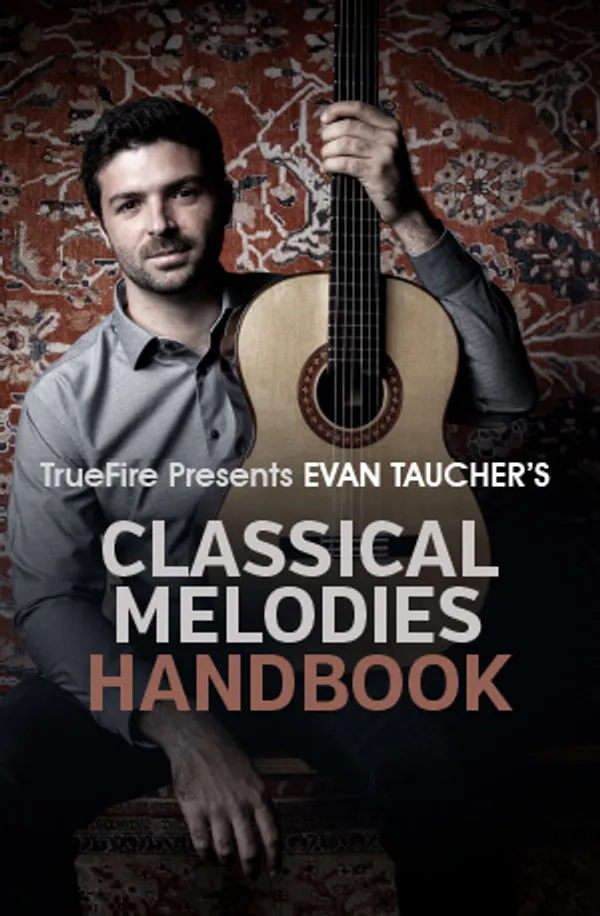
Classical guitar is rich with tradition—but not all traditions serve today’s players equally well. In Modern Method for Classical Guitar, acclaimed guitarist Evan Taucher rethinks outdated conventions and offers a forward-thinking, scientifically grounded approach to help players build real technical fluency and musical confidence faster and more efficiently.
This course is designed for classical guitarists who are looking for more than just exercises—they want clarity, purpose, and modern insight. Through 55 in-depth lessons, Evan takes you step by step through everything from proper posture and hand positioning to rest strokes, free strokes, arpeggios, slurs, tremolo, rasgueados, and advanced scale techniques like AMI patterns and bursts. But more importantly, he explains the why behind each movement, incorporating biomechanics, tension-release principles, and practice strategies that optimize results and prevent injury.
Throughout the course, you'll work through dedicated etudes that combine elements of right-hand precision, left-hand clarity, and musical expression. Evan also addresses often-overlooked topics like nail shaping, tone production, and how to overcome performance anxiety, giving you a complete toolkit for building not just your technique but your mindset as a classical guitarist.
Whether you're starting your classical journey or refining years of study, this method brings classical guitar into the 21st century with intelligence, care, and musicality. It’s not just about playing better—it’s about learning smarter and making music with freedom and control.
What you'll learn
Execute a D major scale pattern starting at 7th fret G string
Play 4 notes per click at 60 BPM with proper preparation
Execute chromatic exercises while maintaining string clearance
Balance volume between melody and chord accompaniment
In the classical guitar world, there seems to be a lot outdated instructional advice. And while this type of information can be helpful for some, the road to technical and music fluency can be traveled much quicker when you are supplied with modern technical ideas combined with scientific thought. Evan Taucher introduces us to to some of the tools he'll be using in his course that helped him build his chops from the ground up.
Before we play any notes, let's get back to the basics of just sitting with the guitar and exploring proper body alignment. While it's tempting to skip this section, it's important to know that even Evan revisits these concepts periodically throughout his career, and it almost always results in a breakthrough after reconsidering this information!
Aligning your right hand might be the most important part of setting up your playing position when starting classical guitar, especially if you’re coming from playing another style of guitar playing. Preparing your fingers is essential to making sure you develop a consistent and accurate movement and sound on the guitar.
Aligning your right hand might be the most important part of setting up your playing position when starting classical guitar, especially if you’re coming from playing another style of guitar playing. Preparing your fingers is essential to making sure you develop a consistent and accurate movement and sound on the guitar.
Nails are the way that classical guitarists make a louder and more clear and accurate sound. That being said, it is actually possible to play without them, but with using nails, you also learn to use the flesh of your fingers in conjunction with the use of nails. Having nails can only add possibilities. It’s important to understand that people’s nails come in all sizes, shapes, and strengths. And not just nails, but how the tips of our fingers are shaped . In this lesson, Evan is going to show you his method of shaping nails that helps you determine what shape might be right for you.
Now, lets talk about some perspectives about sound and our instrument. Perhaps the three most important characteristics of a good sound are consistency, the direction the string is pushed, and the release of the string. Of course in many ways, tone is a personal preference, and in this lesson, we get get a close up look of Evan's preferences!
Now, lets talk about some perspectives about sound and our instrument. Perhaps the three most important characteristics of a good sound are consistency, the direction the string is pushed, and the release of the string. Of course in many ways, tone is a personal preference, and in this lesson, we get get a close up look of Evan's preferences!
I was Looking for a well structured and comprehensive description of all aspects of technique, rather than jumping around YouTube a being confused. And this is it! Evan adds some interesting compositions to apply and even add to a repertoire. Thank you!
T
troglio
Verified buyer
03/05/25
Good help un my growth
F
Fred7
Verified buyer
10/29/24
Good course
Still at beginning of course and so far do good.Things explained clearly and progress is happening! Recommended.