
SimonG8
Verified buyer
04/17/26
Great.




Get this course and 1,000+ more with All Access
Try 7 days free. Cancel any time.
About this course
What you'll learn

38 lessons • 15 charts • 15 Jam Tracks
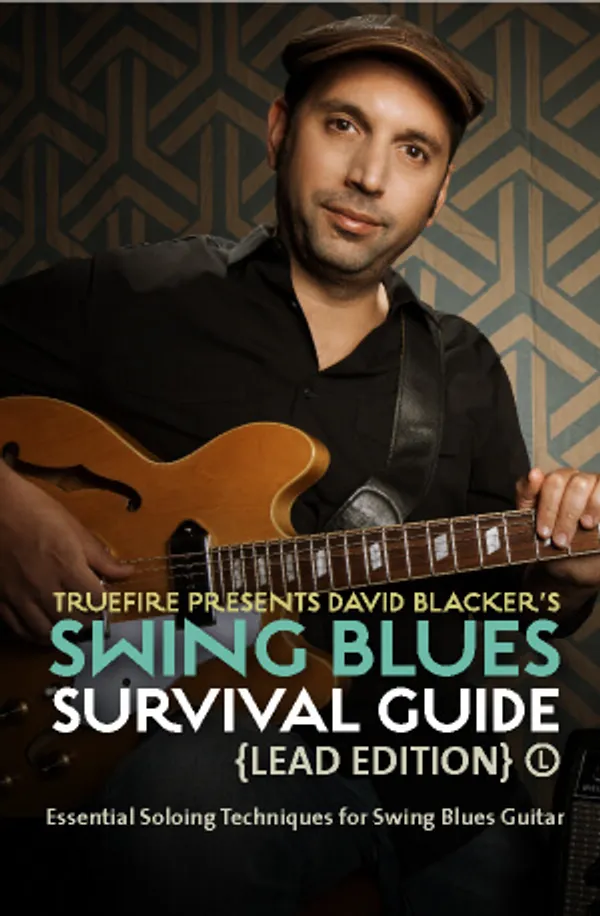
Hi, I'm David Blacker and welcome to the rhythm edition of Swing Blues Survival Guide. Swing blues rhythm styles cover a range of genres, from classic swing to western swing, rockabilly, jump blues, west coast blues and bebop. Having a range of these sounds and textures to play with is the key to solid swing blues rhythm playing.
Aside from absorbing a new rhythmic vocabulary, playing swing blues rhythm requires an advanced understanding of blues harmony and chord substitutions. This understanding is required for both rhythm and lead playing, which is why this course also serves as the foundation for the lead edition of Swing Blues Survival Guide.
I've broken this course into two sections, looking first at the key concepts that form the theoretical basis for playing swing blues rhythm, also examining a few key techniques which are used frequently. In the second section, we'll work through specific performance studies designed to give you the chordal and rhythmic vocabulary of some of the great swing blues guitarists.
In this section, we'll cover five studies that will introduce some key concepts such as four to the bar comping, advanced swing blues harmony, half step approaches, and a range of interesting chord voicings.
In this exercise, we'll look at a four-to-the-bar comping pattern in the style of Freddie Green, the guitarist from the Count Basie orchestra. Freddie played big chunky chord voicings located primarily on the 6th, 4th & 3rd strings. These voicings are a great introduction to swing blues harmony, incorporating unique inversions of standard chords and lending themselves to some nice movement and transitions.
It's important to remember that Freddie Green played an acoustic archtop, so these chunky chord voicings were somewhat necessary to project over the orchestra. But if you're playing an electric guitar, you definitely want to apply a soft touch when playing these types of inversions, allowing the rhythm to be "felt" rather than heard. We'll also be substituting a II - V - I turnaround for the standard V - IV - I blues turnaround over this track.
In this one, we'll begin very much like the first exercise until we get to the 4th measure where we'll incorporate a dominant 7 chord (as opposed to major), setting up the change to the IV chord really nicely with voice leading. We'll also have some nice chord substitutions in the 8th measure leading us into the II - V - I turnaround.
Half-step approaches to chords help create motion through tension and release. In this exercise, we'll kind of overdo a bit to hammer the concept home. Pay attention to the transition over the 7th and 8th measure, and the final chromatic turnaround (after the II - V - I turnaround) in the 12th measure. Starting to hear half-step approaches is the key to opening the door to lots of other chromatic ideas.
In our first comping study, we'll look at some chord voicings that center around the D, G, & B strings. These voicings will typically be your "go to" shapes for louder, more electrified styles. Similar to the Freddie Green style voicings, these shapes lend themselves to some nice tight voice leading moves on the higher strings.
Many of these shapes are built using only three notes, comprising multiple chords all using the same notes. For example, a chord that's built off the 6th fret of D and the 7th frets of the G & B strings could be either a Bb7#5/G# or an E9/G#—sharing the same key chord tones.
It's good to start looking for these different relationships, as it opens up lots of possibilities for re-harmonizing a 12 bar blues. It takes some thinking and analyzing at first, but after a while you begin to see patterns emerge that you can transpose and apply all over the neck.
In this study, we'll add the high E string into the mix to build some lush four note voicings. This piece incorporates a lot of half-step moves and great voice leading elements, opening up with a Bb 6/9 chord, which has a really sweet swingin' flavor.
As we transition into the IV chord from the 4th measure, we'll use a great voice leading move with descending motion on both the high E and B strings. Then, in the 6th measure (2nd measure of the IV chord), we'll introduce a diminished or dominant 7b9 substitution. This is a really key substitution that players use on the 2nd measure of the IV chord to build tension back into the I chord in the 7th measure. This four note shape can moved up and down the neck in three fret intervals, while still remaining the same chord. This substitution offers a nice way to create the feeling of movement, and sets up a nice tension/release when it resolves back to the I. In the 8th measure, we'll introduce a dominant 7b9 leading into the II - V - I turnaround. The last voicing is on the V of the II - V - I, with an F7b9add13 (that's a mouthful!).
+ 31 more lessons
12 results
SimonG8
Verified buyer
04/17/26
Great.
neilg63
Verified buyer
02/05/25
Great swing blues course!
I’m enjoying this course a lot. It’s very easy to follow. David Blacker is an excellent instructor.
cussy180
Verified buyer
12/31/24
Swing blues
Brilliant course well explained and shows you how to start from the beginning of learning swing blues 5 star
Ben
01/30/23
Swing Blues Survival Guide: Rhythm
Another superb course from David Blacker! This takes you though Swing Blues rhythm in a clear, step by step way and builds gently in terms of sophistication. The explanations are brilliantly clear and everything about the course is well thought out: so useful!!!
jaimeguillenmd
Verified buyer
10/09/22
excelent
Try 14 days free. Cancel any time.