In the same way people learn their native language with ease, Shin'ichi Suzuki reasoned that people could also learn music environmentally simply by being immersed in an enjoyable musical and nurturing environment, an osmosis of sorts. "If a child hears fine music from the day of his birth and learns to play it himself, he develops sensitivity, discipline and endurance. He gets a beautiful heart."
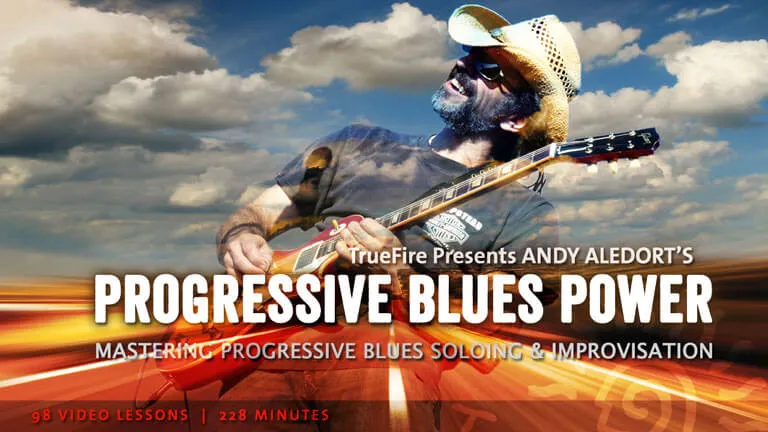
Learning through osmosis, as opposed to a more formal approach, is also the learning path that most guitar students choose primarily because it is more enjoyable, more accessible and more practical. If you too desire a ‘beautiful heart' and blues is your bag, than no better joint to immerse yourself in than Andy Aledort's Progressive Blues Power.
Talk about learning through osmosis... Andy has authored over 200 books and DVDs, gigs with Buddy Guy, Dickie Betts, the Allman Brothers, Double Trouble and was called upon to recreate the legendary Hendrix Band of Gypsy performances with Bill Cox and Buddy Miles. That's some pretty heavy osmosis that Andy will pass on to you across the 98 video lessons that span this four-hour interactive learning experience.
"Progressive Blues Power is the most ambitious, in-depth and intensive instruction vehicle I have ever created. With over 300 musical examples, Progressive Blues Power offers a complete, step-by-step approach to learning to play improvised solos in a modern blues and blues-rock style. These lessons -- built upon the concept of developing one's lick vocabulary -- are presented in nine different keys, presented across dozens of fretboard positions for each individual key and showcased within the context of a great variety of styles and grooves. After absorbing these lessons, you will speak the language of the blues and blues-rock more fluently and with greater precision and control."
In SECTION 1 of Progressive Blues Power, Andy steps you through scale choices, licks and fretboard navigation approaches for a slow shuffle groove, a medium shuffle, a slow voodoo groove, and a fast groove -- all in the key of E. Andy performs and then breakdowns soloing applications for all of the grooves.
SECTION 2 tackles the key of D with more versatile lick vocabulary across a shuffle groove, a slow Hendrix groove and a fast rock groove. Andy also demonstrates SRV and Hendrix strumming approaches in this section. Again, the soloing applications are performed and then broken down note-for-note.
A slow groove, a boogie and a Rollin' and Tumblin' groove are presented in SECTION 3, all now in the key of G. More lick vocabulary, fretboard insight, performances and breakdowns are all included in this section.
The key of A is next with SECTION 4 where Andy adds even more to your lick vocabulary and fretboard awareness. Another boogie groove and a Crossroads groove are focused on with the requisite performance and breakdowns.
The slow blues is drilled down on in both SECTION 5 and SECTION 6, keys of B and C respectively. More tasty licks, performances and breakdowns. More insight. And a few cool tricks of the slow blues trade worth the price of admission alone. SECTION 7 features a medium blues in the key of F# (very cool!).
SECTION 8 takes on the key of F and SECTION 9 introduces you to the key of C# with a vibey performance and breakdown for a C# to B to F# groove.
All in all, Andy has packed more blues power into this course than ever before and there's enough material to keep you busy for a lifetime. It's all transcribed, notated and all of the rhythm tracks are included for your practicing pleasure.
Andy's blues osmosis can now be your blues osmosis -- simply click to start the process!
What you'll learn
Apply previously learned scale positions over boogie grooves
Create aggressive distorted tones using bridge pickup
For me, "Progressive Blues Power" is the most ambitious, in-depth and intensive instruction vehicle I have ever created. With over 300 musical examples, "Progressive Blues Power" offers a complete, step-by-step approach to learning to play improvised solos in a modern blues and blues/rock style. These lessons, built upon the concept of developing one's lick vocabulary, are presented in nine different keys, presented across dozens of fretboard positions for each individual key and showcased within the context of a great variety of styles and grooves. After absorbing these lessons, you will speak the language of the blues and blues/rock more fluently with greater precision and control.
"Progressive Blues Power" is all you need to master modern blues/rock improvisation while simultaneously laying solid groundwork towards the acquisition of a deeper understanding of the guitar and grand architecture of the fretboard.
Let's begin in the key of E, which is certainly the most commonly used key in blues and blues/rock. One of the great advantages of this key is that all of the guitar's open (unfretted) strings can be used liberally for soloing or for playing rhythm parts. First up is the E blues scale (E G A Bb B D), played in open position, meaning that open strings are included in the scale position. Be sure to practice the scale ascending and descending many times in order to memorize it and for it to become comfortable under your fingers.
Also, try playing the scale in different groupings such as ascending threes, fours, fives and sixes as well as descending threes, fours, fives and sixes. Then adjust your focus to smaller parts of the scale, using just a few strings at a time.
Now let's begin developing our lick vocabulary in the key of E using the E blues scale. This is done by taking small elements of the scale and developing a variety of melodic and rhythmic inventions and permutations that will form the basis of your improvised solos and melodies. Each one of these little phrases can function as puzzle pieces that can be put together in an infinite number of ways in the development of one's improvisational ability.
Though I consider this 1st position, in actuality I include second and third position licks to allow myself more melodic freedom while maintaining the same basic approach.
The shuffle is the most widely used, universally accepted and well-loved rhythm for blues and blues/rock guitar. Classic blues songs like Jimmy Reed's "Bright Lights, Big City" and "Baby What You Want Me to Do," "Statesboro Blues," "Sweet Home Chicago" and many, many others are based on this distinct, rocking rhythmic feel. The rhythm part shown here lays down the basics for how to play a solid, deceptively complex mid-tempo shuffle in the key of E.
I begin this pattern by focusing on the bottom two strings, using the open low E as the root note, with the fifth, B, the sixth, C# and the flatted seventh, D, sounded simultaneously on the A string while incorporating palm muting. Palm muting is accomplished by resting the edge of the pick-hand palm across all of the strings by the bridge saddles in order to attain a more percussive attack. In this part, I combine flatpicking and fingerpicking, known as hybrid picking, to achieve an interesting rhythm part.
Now let's try playing a solo over that E shuffle rhythm part, focusing on the melodic ideas presented in Lick Vocabulary 1 and using the E blues scale as the basis for improvisation.
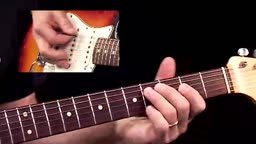
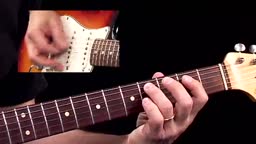
I begin the solo by moving up chromatically (one fret at a time) from the b5 (flatted fifth), Bb, to the fifth, B, which is played simultaneously with a b7 (flatted seventh), D. While sustaining both notes, I apply a wide vibrato by shaking the guitar neck with the fret hand. Keep the fret hand fingers firm to create a strong vibrato. Though this is an improvisation, my goal is to create memorable, melodic lines, so the very first riff I play becomes a theme that I revisit later in the solo in a few different ways. Notice also the way in which I incorporate open strings throughout to attain a full, ringing sound.
This is probably my gavorite course on Truefire. Eventhough the author explains the basic positions of the pentatonic scale, this is in no way a beginers course. There's lots of hard work and the author asumes you have your chops together because he goes straigh into the applications. I particularly like the licks vocabulary sections. Just be patient and work bit by bit, you're gonna learn a lot here.
P
panc10
Verified buyer
07/03/21
Great course!
T
Thomas M.
04/15/21
Andy Aledort's Progressive Blues Power
This is the one you wished you were stranded on the desert island with. Fishing, coconuts, and THE BLUES!
Andy is the real deal with the gift of breaking it down for those wanting to learn. Running close to 4hrs.this one is an endless well to quench your thirst. Get it, grab your guitar, and set sail.
W
wholmer
12/31/20
Best class I have taken for making solos
I give this class 5 stars because I have had trouble in the past trying to learn to connect licks into solos and following strumming progressions. The structure is well planned and progress is from easy to not so easy but you are ready for it if you follow along and practice!