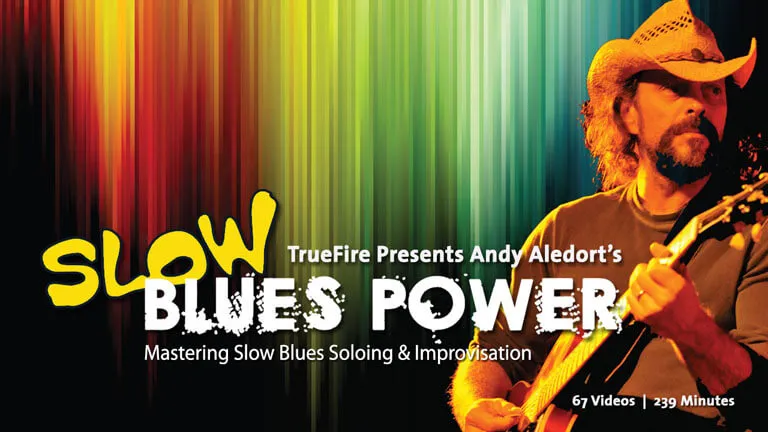
Only a handful of people on the planet can deliver the instructional goods on slow blues as well as Andy Aledort. Andy has served as senior editor for several top guitar magazines, has authored over 200 guitar instruction books, and has studied the styles and techniques of virtually every major electric blues and rock guitar artist in history. You'd be hard pressed to find anyone better qualified to present a more thorough slow blues curriculum than Andy Aledort.
Andy covers a diverse range of soloing styles and techniques within the context of eight different key centers (E, F, G, A, Bb, C and D). Each key center series of lessons features different forms, feels and progressions and includes performances and detailed breakdowns covering requisite techniques, solo development, improvisation and application of theory. The soloing examples demonstrate a wide spectrum of both right- and left-hand articulation techniques, phrasing concepts and the stylistic signatures that are found in the playing of all blues guitar masters, ranging from Albert King, B.B. King, T-Bone Walker, Buddy Guy, and Freddie King, to the blues/rock virtuosos such as Jimi Hendrix, Duane Allman, Johnny Winter, Jeff Beck, Eric Clapton and Stevie Ray Vaughan.
Aledort also takes you to grad school on doublestop sixths, sliding sixths, triads, opens strings, vibrato, hammers, ghost bends, pull-offs, fingerpicks, rolls, diminished 7th lines, cascading lines, expressions, forearm vibrato, B.B.'s box, thematic soloing, improvisation, two-to-three equivalency, repeating triplets, anticipating changes, stretching time, repetition, solo development, dynamics, oblique bends, slides, intervallic jumps, tremolo picking, ascending the fretboard, trills, glissandos and applications of composite blues, Mixolydian, Dorian, and major, minor, and dominant pentatonic scales.
Slow Blues Power is an extraordinary learning experience and bottomless resource of insight for any student of electric blues guitar.
SIDE NOTE! Andy also happens to be a very well-respected blues player in his own right, earning accolades from the likes of Johnny Winter, Joe Satriani, Warren Haynes, John Scofield, Billy Cox, Mike Stern and dozens of others. Andy filmed and wrote this course while rehearsing and touring with the Dickey Betts band. Aledort was clearly “in the zone” during the making of Slow Blues Power - his demos, breakdowns, and commentary are not just especially insightful, inspirational and educational – they comprise and represent perhaps his best work ever on the subject.
What you'll learn
How to play chord tones over a minor iv chord in a blues progression
Using sixth intervals as melodic devices over different chords
Creating vocal-like phrasing through sophisticated bending techniques
Techniques for dramatic positional shifts across the fretboard
How to blur major and minor sounds for expressive playing
Welcome to my latest instructional course, Slow Blues Power: Mastering Slow Blues Soloing and Improvisation. Over the course of these lessons I’ll be covering a variety of soloing styles and techniques within the context of eight different key centers, presented within a variety of different feels, grooves and forms, from standard 12-bar blues forms to the more unusual eight-bar blues forms. Also, I’ll be covering the standard I-IV-V (one-four-five) type of blues progression as well as I-VI-II-V (one-six-two-five) progressions, and some other progressions as well.
Each of the following soloing examples address a wide spectrum of both right-and-left-hand articulation techniques, phrasing concepts and stylistic signatures that are found in the playing of all of the true blues guitar masters, such as Albert King, B.B. King, T-Bone Walker, Buddy Guy, and Freddie King, to the blues/rock virtuosos like Jimi Hendrix, Duane Allman, Johnny Winter, Jeff Beck, Eric Clapton, Stevie Ray Vaughan and many others.
This first instructional segment is a slow blues played in the key of E, and in this lesson I am focusing on the lower portion of the fretboard and utilizing a lot of open strings in the licks and phrases. One of the great things about playing blues on the guitar in the key of E—and a prime reason why it is a key that is so favored by blues guitarists—is that every one of the open strings sounds a pitch that is a part of the E minor pentatonic scale (E G A B D), the primary scale used for soloing within the blues idiom.
Let’s examine the E minor pentatonic scale, played in first position and using open strings. We begin with a low E, sounded by the open sixth string, followed by G (sixth string/third fret), A (open fifth string), B (fifth string/second fret), D (open fourth string), E (fourth string/second fret), G (open third string), A (third string/second fret), B (open second string), D (second string/third fret), E (open first string) and G (first string/third fret). In this solo, I additionally utilize the E Blues scale, which is the same as E minor pentatonic but includes the flatted fifth, Bb, located at the first fret of the fifth string and the third fret of the third string.
These scales, incidentally, are also used prevalently in rock as well as many different styles of music, and are essential scales for all guitar players, regardless of the style of music they play, to be well familiar with.
Within the context of slow blues, these scales played in this position are incredibly useful, as one can take great advantage of the open strings to play fast licks articulated with pull-offs, hammer-ons and slides. Be sure to experiment with these scales in this position to discover some interesting variables of your own.
Another of the techniques that is utilized within this chorus of slow blues soloing is doublestop sixths: a doublestop is a two-note figure, and sixths are two notes that are an interval of a sixth apart, within the major scale structure. This blues is played in the key of E dominant, also known as dominant seventh (as opposed to being a minor blues). This means that all of the chords present are dominant seventh chords; in the key of E, the I (one) chord is E7, the IV (four) chord is A7 and the V (five) chord is B7. The scale that works best with these chords is known as the E Mixolydian mode (E F# G# A B C# D). The first, third and fifth notes of the scale, E, G# and B, when played together, sound a major triad and an E major chord. Add the seventh scale degree, D, and you have what’s known as an E7 (or E dominant seventh) chord.
I begin this solo with notes that are sixths apart, diatonic to (within the scale structure of) E Mixolydian: in bar 1, on the downbeat of beat one, I slide up to B on the G string, and G# on the high E string; these two notes are sixths apart. Additionally, I play a D note on the B string, forming an E7 chord voicing. At the end of bar 1, I trill (quickly alternate) between the minor third, G, and the major third, G#; moving back and forth between minor and major thirds is an essential part of blues soloing.
Starting with the E7 voicing on the top three strings, I use all upstrokes to strum this chord so that the higher strings in the chord will sound more prominently. On beat two, while strumming the chord, I alternate between the G# on the high E string and an open high E, providing a bit of melody to the improvisation. On beat three, I pick the top two strings individually but allow the notes to ring into each other.
Over the A7 chord in the next bar, I simply lower the notes on the top two strings one fret and sound C# and G simultaneously; as C# and G are both chord tones of A7 (A C# E G), they make clear reference to the chord and sound very effective. Looking closely at the intervals, C# is the sixth of E, but it is the major third of A, the chord that this riff is played over. The notes of A Mixolydian are A B C# D E F# G.
I alternate between the top two strings in order to make this figure sound interesting both melodically and rhythmically; the melody is provided by the descending notes on the high E while the C# remains constant. On beat three, I play another trill, this time between the open B string and C#, and end the bar with the same quick slide-down on the G string that was played on beat four of bar 1.
In bar 3, I bring the initial E7 triad on the top three strings back into play, utilizing a pull-off from the G# to the E on the top string on beat three, and again end the phrase similarly. Bar 4, however, is where I really take advantage of the open strings, starting with a hammer from the open G to G# at the first fret, followed by unison high E notes, sliding up to the fifth fret of the B string and playing that E against the open high E string.
In all of the guitar lines up to this point, the phrasing has been based on either eighth notes or a combination of eighths and 16ths; here in bar 4, I really stretch the time by playing very freely over the beat, cramming in fast flurries of notes, phrased in shifting rhythms. The flowing, rhythmically free nature of the lines are intended to create the feeling of “tension and release,” an expressive quality that is what blues soloing is all about. As you will notice, the fret-hand index finger does a lot of the work on a riff like this.
Once you’ve gotten a handle on playing the phrase as it’s shown here, experiment with different ways to speed up and slow down when playing lines like this. This technique is especially effective when it is balanced against phrases played in more regimented time.
Over the IV chord in bar 5, I play a simple melodic line based on the notes of an A7 chord (A C# E G) and the A Mixolydian mode, ending on the G note; the G sounds great because, while it serves as the dominant seventh over A, it’s also the minor third over E, so a little of that “E reference” remains present.
In bar 6, I take the melodic idea from bar 5 and move it up one octave, again using the notes C#, E and G, with a quick pull-off, from G to E on the B string, on beat two. Bar 6 ends with a half step bend-and-release, from F# to G and back to F#, which makes reference to E major pentatonic (E F# G# B C#), another of the more commonly used scales in blues soloing.
Once we get up to fifth position, it’s useful to stay in that position and explore some soloing opportunities. One useful option is to bend F#, second string/seventh fret, up one whole step to G# instead of moving up the fretboard; bending strings is, of course, one of the best ways to add expressiveness to any solo, as it accentuates the vocal-like qualities of the guitar.
Over A, we bend that F# up a half step to G, as G is the flatted seventh of A and is a chord tone of A7; over E, we can then bend F# a whole step up to G#, as G# is a chord tone of E7.
Wide range of approaches and techniques. I highly recommend this course.
M
marcnoriega1965
Verified buyer
07/21/21
Wonderful Breakdown!
This Instructor plays you the entire solo, then takes you step by step though each lick. Great breakdown showing scales and techniques needed for each lick.