Cult figure, rock & roll legend and music writer, Cub Koda defined Jump Blues as "an up-tempo, jazz-tinged style of blues that first came to prominence in the mid- to late '40s. Usually featuring a vocalist in front of a large, horn-driven orchestra or medium sized combo with multiple horns, the style is earmarked by a driving rhythm, intensely shouted vocals, and honking tenor saxophone solos - all of those very elements a precursor to rock & roll. The lyrics are almost always celebratory in nature, full of braggadocio and swagger. Jump blues was the bridge between the older styles of blues - primarily those in a small band context - and the big band jazz sound of the 1940s."
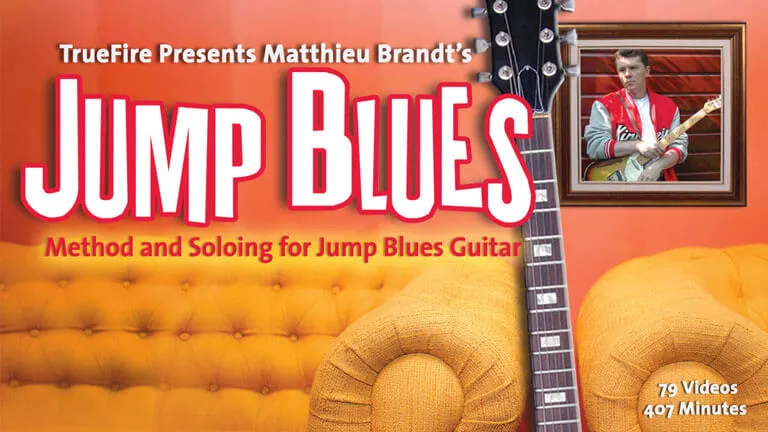
Dutch recording artist and top European guitar educator, Matthieu Brandt, spent the better part of the last decade examining Jump Blues in preparation for this TrueFire course. Brandt interviewed and studied with many of the originators to document the style and create TrueFire's Jump Blues syllabus.
Jump Blues is presented as a methodology covering theory, comping, accompanist riffs, horn lines arranged for guitar, and several approaches for soloing drilling down on many approaches for opening up the neck for the scales, arps and riffs that are employed in swing and Jump Blues guitar.
Jump Blues also ices the cake with 12 tasty solos, followed by in-depth analysis of several Jump Blues giants such as Brian Setzer, T-Bone Walker, Charlie Christian, Gatemouth Brown and Freddie King, all of whom have their own signature jump blues sound.
Accompanying vocalists and soloists is a big part of the Jump Blues style and is as challenging and rewarding as soloing. A sizable chunk of Jump Blues is dedicated to voicings, pulling off various rhythms and locking up with the rhythm section.
A comprehensive overview with dozens of examples is presented laying out the groundwork for Jump Blues. Rhythm, comping and bass lines are thoroughly examined with dozens of examples and rhythm studies. Twelve full-chorus signature-style solos are presented, broken down and analyzed in depth. Dozens of essential horn lines and accompanist riffs, arranged for guitar, are presented and demonstrated.
What you'll learn
Play Charlie Christian-style licks on the V chord
Apply Mixolydian scale concepts to blues soloing
Play T-Bone Walker style solos mixing blues and standard riffs
Execute the 'forward whip' technique popularized by Clarence Gatemouth Brown
Mix eighth note and sixteenth note timing for excitement
Jump Blues is a style that originated in the Big Bands of the late 40's and early 50's.
Although guitar players played mostly rhythm in those days, the uptempo, open and fresh sound has had a major influence on blues guitar players and their solos.
Copying the feel and rhythm parts of the horn sections that were featured in those Big Bands has found it's way into modern day jump blues. Playing these accompaniments makes playing backup as interesting and as challenging as playing a solo.
This has made Jump Blues one of the most popular styles of blues in the last decades. Many modern blues bands use swing and jump riffs, licks and chord tricks that originated in those days. This "uptown" danceable kind of blues has a happier feel than the down home Delta style and is mostly played uptempo.
It does require a little bit more studying, because we're using more than the minor pentatonic or blues scale. This course is designed in a way that you can introduce some new scales and chords to your solos and accompaniment, without having to study till your fingers bleed.
It is a great way to break out of the "blues box" and can also be used as an introduction to playing jazz.
Jump Blues is a style that originated in the Big Bands of the late 40's and early 50's.
Although guitar players played mostly rhythm in those days, the uptempo, open and fresh sound has had a major influence on blues guitar players and their solos.
Copying the feel and rhythm parts of the horn sections that were featured in those Big Bands has found it's way into modern day jump blues. Playing these accompaniments makes playing backup as interesting and as challenging as playing a solo.
This has made Jump Blues one of the most popular styles of blues in the last decades. Many modern blues bands use swing and jump riffs, licks and chord tricks that originated in those days. This "uptown" danceable kind of blues has a happier feel than the down home Delta style and is mostly played uptempo.
It does require a little bit more studying, because we're using more than the minor pentatonic or blues scale. This course is designed in a way that you can introduce some new scales and chords to your solos and accompaniment, without having to study till your fingers bleed.
It is a great way to break out of the "blues box" and can also be used as an introduction to playing jazz.
This course is about adding the notes from the mixolydian scale to the accompaniment and solos we play in a jump blues.
This scale is a major scale with 7 notes. It's a regular major scale ("Doe a Deer, ...") but with it's 7th note lowered 1/2 note. The scale has a major 3rd and a flatted 7th.
If we want to use this scale we have to "move with the chords". This means that every dominant 7th chord we use in a blues progression, has it's own mixolydian scale.
Most of the time we're playing 3 chords in a jump blues progression, for instance : G7 , C7 and D7. Each of these chords has a mixolydian scale which we HAVE TO use, if the band is playing that chord.
The blues scale will fit on top of all three chords, but if you want to use the more hip uptown mixolydian scale, you've gotta use the right scale at the right time. To be able to do this, you have to know where the tonic of the chord you are on is ALL THE TIME.
This course is about adding the notes from the mixolydian scale to the accompaniment and solos we play in a jump blues.
This scale is a major scale with 7 notes. It's a regular major scale ("Doe a Deer, ...") but with it's 7th note lowered 1/2 note. The scale has a major 3rd and a flatted 7th.
If we want to use this scale we have to "move with the chords". This means that every dominant 7th chord we use in a blues progression, has it's own mixolydian scale.
Most of the time we're playing 3 chords in a jump blues progression, for instance : G7 , C7 and D7. Each of these chords has a mixolydian scale which we HAVE TO use, if the band is playing that chord.
The blues scale will fit on top of all three chords, but if you want to use the more hip uptown mixolydian scale, you've gotta use the right scale at the right time. To be able to do this, you have to know where the tonic of the chord you are on is ALL THE TIME.
Connecting all the mixolydian scales and chords to each other is crucial to create hip up-town solos and accompaniments.
There is an "inner logic" connecting all the scales and chords. Whenever you move from a I to a IV chord, the major 3rd and the flat 7th of that chord want to move down 1 fret.
This is also the case when you're moving from a V to a I chord.
This "inner logic" can help you move around the fretboard in a more logical way. It'll spice up your accompaniment and help you develop strong solo lines.
Timing is of the essence in jump blues. Most of time we're playing swing timing, also called a shuffle feel. This timing is based on triplets, with the second note of the triplet left out.
Connecting all the mixolydian scales and chords to each other is crucial to create hip up-town solos and accompaniments.
There is an "inner logic" connecting all the scales and chords. Whenever you move from a I to a IV chord, the major 3rd and the flat 7th of that chord want to move down 1 fret.
This is also the case when you're moving from a V to a I chord.
This "inner logic" can help you move around the fretboard in a more logical way. It'll spice up your accompaniment and help you develop strong solo lines.
Timing is of the essence in jump blues. Most of time we're playing swing timing, also called a shuffle feel. This timing is based on triplets, with the second note of the triplet left out.
Bass Line and Intervals are a great way of accompanying in a Jump Blues tune. Instead of chopping away bar chords, waiting for your solo slot, you can spice up your playing by using these techniques.
We'll start off by playing some standard bass line progressions. After that we'll dive into intervals, starting at the tritone.
The tritone is part of a dominant 7th interval and by moving it around we can create a surprisingly simple but effective accompaniment.
These accompaniments can be as interesting and challenging as playing a solo. Listen to players like Hollywood Fats, Rick Holmstrom and Ronnie Earl for some great examples in this style.
Pay Homage and Learn the Phrases from Electric Pioneers
Highly recommended for anyone looking to stand out amongst a sea of SRV, Eric Clapton and Johnny Winters copy cats. These lessons focus on the era of Blues often looked over or forgotten about from post WWII to about the arrival of Chess Records, with a bit of the more modern players like Brian Setzer.
In addition, this will help get you out of the I, IV, V rut by introducing some ii, V, I concepts.
If you have the slightest interest in T-Bone Walker, "Gatemouth" Brown, and BB King (Kent Records era) definitely consider this course.
TL;DR for Gen Z: learn to play Blues and avoid Boomer bends. No cap.
C
cussy180
Verified buyer
12/22/24
Jump blues
Brilliant course I’m an absolute beginner at jump blues this explains everything from the start
R
Russell100
Verified buyer
09/01/24
Jump Blues
I liked it.
B
bluesirregulars
Verified buyer
07/25/24
Clear and well paced delivery
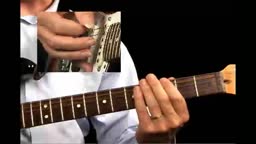
A Clear and well paced delivery with good explanations and close-ups.
Some harmonic theory, if thats your thing (not mine)
Good bite-size lessons.
L
Loophole
Verified buyer
06/13/23
Everything You Wanted to Know about Jump Blues
This is a very extensive, detailed presentation of blues and jump blues.
It contains an incredible amount of detailed information on the topic of jump blues, well organized, with plenty of examples.