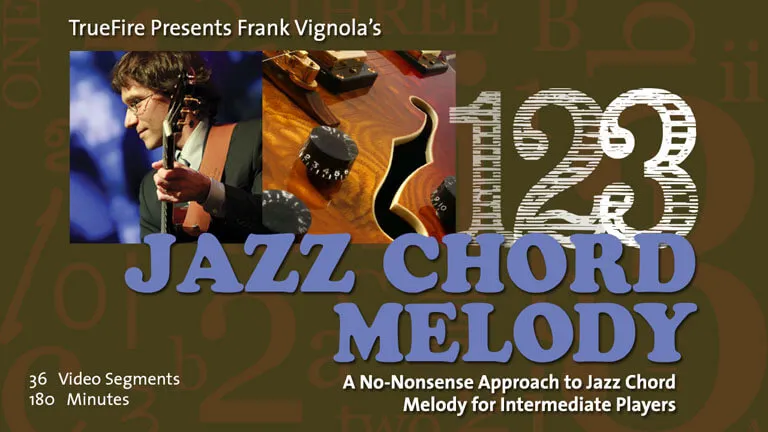
1-2-3 Jazz Chord Melody

A no-nonsense approach to jazz chord melody guitar for intermediate players.

Marty FriedmanTommy EmmanuelSteve VaiEric GalesEric Johnson

Get this course and 1,000+ more with All Access

Try 14 days free. Cancel any time.

Purchase Individual Course for $24.99
1-2-3 Jazz Chord Melody

About this course

Chord melody may very well be the most daunting rite of passage for jazz guitarists. Learning how to comp, jazz up melody lines and improvise solos is challenging enough but doing all of that simultaneously is seemingly an impossible task. Especially if you’re a fan of jazz chord melody masters like Joe Pass, Barney Kessel and Bucky Pizzarelli. Meanwhile, you can’t pick up your jazz guitarist credentials without passing that chord melody class.

So where do you start? How do you get up and running as quickly as possible? And who will guide you on this learning journey? All three answers can be found inside Frank Vignola’s 1-2-3 Jazz Chord Melody.
"Frank Vignola is one of the best Jazz teachers that I have encountered. His delivery and concise and methodical manner make his teaching style extremely easy to follow, understand, and digest. I was blown away not only by the quality of this course but the depth and breadth of chord melody that Frank covers in these treaties. Frank's "system" for building an INSTANT library of major, minor and dominant chords for use in developing your own chord melody solos is outstanding (along with his own chord vocabulary and melody work). I recommend this course for any aspiring jazzer looking for a chordal breakthrough." - Simon C., TrueFire Student
Frank showed you the ropes with 1-2-3 Jazz and Next Steps Jazz, he jazzed up your blues lines with Jazz Up Your Blues, he stoked your improvisational prowess with Vamps, Jams & Improvisations, and he expanded your single line and chord vocabularies with 50 Jazz Licks You MUST Know and Inversion Excursion. And now he’s got your back with 1-2-3 Jazz Chord Melody.

1-2-3 Jazz Chord Melody is not a beginner’s course. And it’s not a repertoire-building course. It’s an accelerated, systemized approach for crafting chord melody arrangements for intermediate to late intermediate jazz players. If you have fundamental rhythm skills and can identify the notes in a piece of sheet music or even in just a tab, Frank will have you playing chord melody arrangements of your favorite tunes in less than a month’s worth of practice sessions.

Frank organized 1-2-3 Jazz Chord Melody curriculum into 3 sections. In the first section, you’ll learn 36 moveable chord forms: 12 major, 12 minor and 12 dominant. Using just these 36 moveable chord forms you'll be able to play hundreds of jazz chord melody arrangements in all 12 keys.

In the second section, Frank shows you the simple, practical 3-step system that he himself learned from his own jazz mentors, who in turn learned from their jazz teachers. No tedious theory. No boring exercises. No voluminous harmony manuals to struggle through.

Just 36 moveable chords and three simple steps to follow. No kidding.

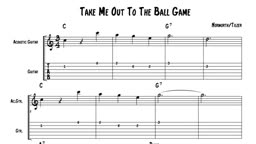
In the third and final section, Frank shows you how to put those 36 chords and that 3-step formula to work crafting three jazz chord melody arrangements for Take Me Out to the Ballgame, Peg O' My Heart, and the Gershwin classic, Lady Be Good (the three arrangements are also tabbed and notated for your reference). During this process, Frank will also share what he considers to be six of the most useful creative options for chord melody arrangements and performances.

Once you have a grip on the 36 moveable chords, 3-step formula and 6 creative options you’ll be able to craft chord melody arrangements from virtually any jazz standard or pop tune. To make that process even easier, Frank includes a Chord Melody Reference Guide with all 36 moveable chords, in all 12 keys, mapped out to every possible melody note commonly found in those 12 keys.

Passing that Jazz Chord Melody class is now as easy as 1, 2, 3.

What you'll learn

  • Execute clean chord melody playing with clear melodic lines
  • Apply chord vocabulary reference system to create chord melody arrangements
  • Apply the downbeat chord rule for smoother arrangements
  • Arrange and play a complete chord melody version of 'Peg O' My Heart'
  • Understand when to use single notes instead of full chords in chord melody
Release date: 06/04/2014 • 2h 59m runtime
Start Course
Sample lessons
Major Chords
Major Chords
Overview
Major Chords: C
Major Chords: C
Playalong
Chord Melody Formula
SECTION 2: Overview
Step 1: Identify the Prevailing Chord
Overview

What's included

36 lessons • 24 charts

1-2-3 Jazz Chord Melody
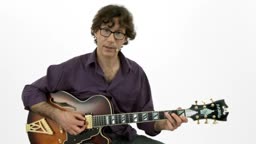
Hi, I'm Frank Vignola. Welcome to 123 Jazz Chord Melody. If you've ever heard players like Joe Pass, Barney Kessel or Bucky Pizzarelli play chord melodies, you've probably not only shook your head in amazement, but also said to yourself "I'll never be able to do that! Learn all those chords, all of those harmonizations, all of those techniques." Yes, it will take years to develop the chops and the stylings of these great masters, but you can get in the chord melody game quickly and easily if you follow this system that I lay out for you in 123 Jazz Chord Melody. This is not a repertoire building course, it's not about learning my jazz chord melody arrangements, rather I'm going to show you how to craft your own chord melody arrangements, and here's how.

I've organized 123 Jazz Chord Melody into 3 sections. Of course you have to have a chord vocabulary to play jazz chord melody arrangements.

In the first section I teach you 36 moveable chord forms, 12 major, 12 minor, 12 dominant. Using these 36 moveable chord forms you'll be able to play hundreds of jazz chord melody arrangements in all 12 keys.

In section number two I'll show you a very easy to use, simple 123 formula that I've been using for years, my mentors have been using for years, and their mentors have been using for years on how to craft chord melody arrangements.

In the third and final sections we'll take our chord vocabulary and the simple, easy to use 123 formula, and put it to work learning three jazz standards. Everything is tabbed and notated, plus you get lead sheets and charts, and a 432 chord reference guide which includes the 36 moveable chord forms, the 12 major, 12 minor, and 12 dominant in all 12 keys. Let's get started!
Moveable Chord Forms
In section number 1 we're going to build a chord vocabulary. This will serve as your foundation to craft your own chord melody arrangements. We're going to learn 36 moveable chord forms, 12 major, 12 minor, and 12 dominant. Learning this chord vocabulary, these 36 moveable chord forms, will allow you to play hundreds of jazz standards in all 12 keys, crafting your own chord melody arrangements. Let's get started.
Major Chords
Let's discuss the chord forms we'll be using for major. These are moveable, major chord forms. We're going to be working with the C scale. Let me demonstrate the C scale we'll be using.

Now you may have noticed that I went beyond the one octave. That's because most melodies are within a 12th of each other, from the root up to the 12th, so that is the reason why we're expanding beyond one octave, because most melodies do.

Now let's go over the moveable chord forms we're going to use for the major. A C, the root. Once again, the C on top is the root, this is the chord form. For the D, which is the second or the 9th, we're going to use this chord form, a C 6/9. Once again, D is on top, you have an A and an E barring your first finger and your second finger on the C note. That gives us the root, the second. For the E note, the third, we use a Cmaj7. Some of you might already know this chord form. So one succession so far. Starting to sound like a chord melody now! For the F note, the suspended or the 4th, we're going to use the Cmaj7 and just extend our pinky up to the F note. To the F... The suspended sound, like you're suspended in mid-air, usually resolved with that 3rd. So one succession...Now we move up to the G note, or the 5th. We're going to use a Cmaj7. Most of you probably know this chord grip. C, B, E, and a G. Always make sure these chords are nice and clean, that each note is sounding. Okay, so in succession... Okay, the next note is A on the first string, a C6, a simple bar on the first finger. Again make sure each note is nice and clean. So in succession... The next note in the scale is Bmaj7. You can use your 3rd or 4th finger, and it's the bar with the B note on top. In succession...And then the next note is the C, the octave. In succession... Now we're going to continue with the high D note, or the 9th. Here's the note. We go from the C and just add your pinky. Let's go in succession. And now up to the high E on the 12th fret, Cmaj7, bar your third finger, add in the C note with your first finger. Let's go up to that point now. On the high F, again that's the suspended, we'll use the same Cmaj7 and add the pinky on the F note. Let's go in succession…Finally, to the high G, a 12th away from our original starting point. On the 15th fret, 6/9 chord. Barring. So let's take it from the beginning and go all the way up to the high G. And now let's go the other way. These are the major moveable chord forms we'll be working with in this course. You can take these moveable major chord forms and use them with any piece of sheet music in any key and be able to play chord melody.
Major Chords: C
Now let's play these moveable major chord forms we just went over along with a metronome, as if we were playing a chord melody. So we'll use all of the moveable chord forms we went over in the key of C along with the click track as if we were playing a chord melody. Remember to make each chord clean, visualize the next chord you're going to play as you're playing the chord you're on. You need to look ahead to the next chord in your mind so you get a nice clean transformation from one chord to another. Let's get the click track going and we'll play this through.
Major Chords: E
As I mentioned, this is a moveable major chord form. So now, let's move these major chord forms up to the key of E. You might notice when we get really up high, going up to the high B note, a 12th away from the E, that it might get a little tight up there if you don't have a cutaway, just move your hands the best you can to get up there. If you do have a cutaway, then you're in great shape, just keep your hands nice and close together, and keep the chords clean. Let's get the metronome going and we'll do these major moveable chord forms in the key of E.
Major Chords: A
Now let's move the moveable major chord forms to the key of A. We're going to start in the open A position with the maj7 using the 3rd on top, because if we started on the root note, on the A, there's no way we can get all the way up there, that's not practical. So the reason why I chose the key of A is to show you that we're going to use practical ranges, and in all the charts and all 12 keys that you'll reference in your chord charts you'll notice that we use practical ranges, basically up to the 15th or 17th fret.

In this particular case we'll start on the Amaj7, with the 3rd on top. You might notice this is an open position. If we take our Cmaj7, a chord that most people know, you get your open position. That's why it may look a little funny compared to the other one. We're going to take this and go up to the 12th fret.

Let's get the metronome going, remember to visualize the next chord to get a nice clean transition between chords, and cleanliness is very important to playing chord melody, so please keep that in mind. Here we go.
Minor Chords
Now let's move on to moveable minor chord forms. We're going to use the Cmin chord forms and we're going to build these chords using the Cmin scale. Let me demonstrate the Cmin scale. We're going to go up all the way to the 15th fret, or the high G. Let's do that again. And once again, the reason why we're going all the way up to the high G is because most melodies go beyond one octave, so we're going to go up 12 instead of 8 to expand on the scale.

Now let's add the moveable minor chords to the Cmin scale. The first is the C on top, you're going to use a Cmin7, which is 3rd finger, 1st finger, 4th finger, and 1st finger. Make sure your chords are clean. Now we move up to the D note, going to make a Cmin9. So Cmin7 in succession, Cmin9. Now we go up to Eb, the 3rd, Cmin7. In succession...Now for the F note, the 4th, we simply add our pinky to the Cmin7. In succession...Now we go to the G, the 5th. Cmin7. In succession...Now to the 6th, or the A note, Cmin6: G, C, Eb, and A. In succession...Now up to the Bb, or the 7th. Same as the min6, but we're moving our pinky up to the 7th. In succession...And up to the high C, bar form, Cmin7. In succession... Or with your first finger. Then we go up to the high D, the 9th, and it's the same as the Cmin7, except we're adding the D note with our 3rd or 4th finger, whichever is more comfortable. In succession...Up to the Eb, the high Eb, Cmin7. Now you can either bend your 2nd finger to get these two strings or use your 2nd and 3rd fingers, either one is acceptable. I prefer bending, but either one will work. In succession... For the high F just add your pinky. And that's why I prefer to just bend, because you can just add your pinky. Instead of moving your fingers around, but either way works. That's the high F. In succession...And then up to the high G, so Cmin7, bar your 1st finger, 3rd finger, and pinky. In succession...And descending... These are moveable minor chords using the Cmin scale, and these are the forms we're going to use to create many chord melodies.

+ 29 more lessons

Start Course

Reviews

23 results

Atom289

04/16/25

Great course

This was my first Vignola course and won’t be my last. I really liked how he broke down the simple chords forms. Next step for me is to start composing my own melodies and be able to play the chords instead of single notes. I would LOVE a course on playing chord melodies and progressions improv on the fly.

bandontherun

Verified buyer

11/15/22

Definitely recommended

Great course for building up your knowledge of chords across the fretboard. Worth putting in a good chunk of time with this course - it will pay off.

Estudiozinho

Verified buyer

09/12/22

Very good system of developing chord melody

Very clear presentation. A very easy to follow method that will enable you to harmonize a melody. Although it is called 1-2-3 doesn't mean it is a beginner's course. You should already know how to play (at least some) chords. You are presented with a practical library of chords, major, minor, and dominant. you should practice them and then, you apply those chords to craft you harmonised melodies. The videos are top notch. The tabs are great and you can follow along viewing the videos. It is all you need to be a jazz guitarist? No, i think it made me a better musician. I have no doubts about it. It worked for me!

Vernon

06/30/22

123 Jazz Chord Melody

This is the companion course to 1,2,3 Jazz. Frank Vignola is one of the most prolific performers and instructors around. This course is a theory free primer on 36 movable chord forms used to create simple chord melodies. I always thought playing chord melody was beyond my ability, but this course makes it immediately accessible. The practical applications are as fun as they are instructive. Even though I'm an all access student, I bought both of these courses to have permanently.; they are that good.

rhmeyers

Verified buyer

03/08/22

I have found the course very helpful in getting a lot more satisfaction out of playing guitar. I will be revisiting the course time and again to get more of the information into my playing.

Stop searching. Start improving with All Access.

Try 14 days free. Cancel any time.