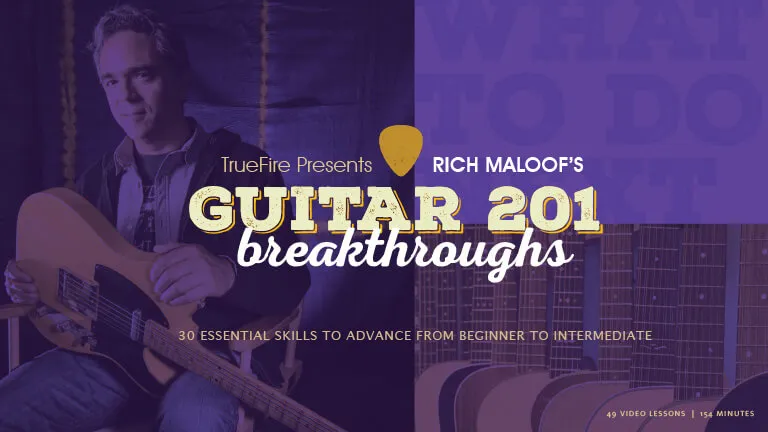
Guitar 201: Breakthroughs

30 essential skills to advance from beginner to intermediate

Marty FriedmanTommy EmmanuelSteve VaiEric GalesEric Johnson

Get this course and 1,000+ more with All Access

Try 14 days free. Cancel any time.

Purchase Individual Course for $5.00
Guitar 201: Breakthroughs

About this course

YES, you’re in the right place! How do we know that? Because the very fact that you’re reading this course description says a a lot about you…

You’ve always wanted to play guitar and so you bought one or received one as a gift. You picked up a couple of beginner’s courses or had a friend give you a few tips. You put in the time to learn a few chords and a strum or two. But you still can't play your favorite songs or jam with your buds. You’re frustrated because you’re still a beginner, and not yet a player.

Statistically, only 7% of the people who set out to learn guitar have the conviction to get as far as you have (the vast majority quit before they even learn three chords). So, congrats to you! Now, the only thing keeping you from graduating from beginner to guitar player is desire (we know you have that!) and the right course of study.

Rich Maloof’s GUITAR 201 is the bridge between beginner and guitar player. The curriculum is specifically designed to teach beginners how to play entire songs smoothly, add personality to their sound, and play with other musicians confidently.
"This course may be made for beginners, but you don't have to be a beginner to learn from it. I see some things in here that I need to pick up in order to fill some of the gaps in my own playing and I have been playing a long time." - Ron H., TrueFire Student
Building on the fundamentals that Rich presented in his ACOUSTIC GUITAR FOR BEGINNERS course, GUITAR 201 is the perfect course for electric and acoustic guitarists alike who want to take their skills to the next level and start making music.

“GUITAR 201 will get you unstuck. Using very little music theory, we'll work with open-position chords and basic major/minor barre chords to expand the possibilities and rocket you to the next level. I’ll clear up those troubling little things that are keeping you from getting through the songs you want to play. GUITAR 201 will take your skill set to the next level — all with a very minimal amount of music theory and tech talk. We're also going to do a lot of troubleshooting and work through the problems that a lot of people run into during the early stages of playing.”

Rich will present and demonstrate the specific key concepts and techniques that will take you playing to the next level: Chord Flow, How to Practice, Strum Patterns, Slash Chords, Barre Chord Tips, Left-Hand Mutes, Right-Hand Mutes, Sus Chords, Picked Arpeggios, Chord Vocabulary, Riffs, Drop D, Making Tabs Sound Good, Power Chord Do's and Don’ts, Capos, Intro to Lead Lines, Chord Tones, Expressivity, Building on a Melody, Playing Well With Others, Be Tight with the Drummer and Thoughts on Gear.

No tedious theory of boring exercises here; you will play your way through the course so that you can put each new concept and technique to work in a musical context immediately. Rich also includes charts, tabs and a variety of practice rhythm tracks for you to reference and work with throughout the course.

You’re just a click away from leaving those beginner blues behind and learning how to really play. Grab your guitar and lets get busy!

What you'll learn

  • Create melodic riffs that combine chords and single notes
  • Apply vocal and horn player concepts to guitar
  • Control dynamics and attack for musical expression
  • Understand that melody is about expression, not just correct notes
  • Develop vocabulary of expressive techniques for solos
Release date: 12/03/2014 • 2h 34m runtime
Start Course
Sample lessons
Chord Flow 1
Chord Flow 1
Concept
All Along the Strum Patterns
Demonstration
Left Hand Mutes
Left Hand Mutes
Concept
Picked Arpeggios
Picked Arpeggios
Overview and Demo

What's included

49 lessons • 38 charts • 23 Jam Tracks

Guitar 201: Breakthroughs
Why Guitar 201? We hear from a lot of people who are really excited when they first get started on guitar, but then get bogged down. We took our cues from talented friends and TrueFire beginning students who have some beginning skills but get frustrated with things that keep them from progressing.

We're going to get you over the hump. We also want to clear up misunderstandings about troubling little things that can keep you from getting through songs you want to play or playing well with other people. We're going to take your skill set to the next level — all with a very minimal amount of music theory and tech talk. We're also going to do a lot of troubleshooting and work through the problems a lot of people run into in the early stages of playing.

This is your sophomore year — and by the end of it, you'll be getting through songs more fluently, playing with other people confidentally, and having a great time exploring new possibilities on the instrument.
Building on Basics
Players with some grasp of beginning-level guitar playing will be comfortable making their way through Guitar 201. If you’re unsure about anything we cover, don’t worry — we'll never leave you hanging. There will be plenty of charts, diagrams and TAB notations to help you review. So, you can always practice with the materials provided and keep up with the course at your own pace. Our first few charts include refreshers on the names of the guitar strings and several common chord shapes.

You can also check out starter courses at TrueFire like Rich Maloof’s Acoustic Guitar for Beginners, Susan Mazer’s Hands-On Guitar, and Brad Carlton’s Beginner Chords Vol. 1.
Chord Flow 1
Probably the most conspicuous hallmark of the new player: Taking time between chord changes. And it makes you feel bad about yourself, but it’s really not a mortal sin — unless you're losing the beat. So let's look at how to start making smooth transitions.

#1 Visualize — Think ahead. Know when the next change coming, and plan for it.

#2 Economy of Motion — Which fingers have to move? Can you pivot on some fingers? Can a whole shape or part of a shape be moved to the next chord in the progression?

#3 Cheat! — Try the “zero chord” technique. Other options are to play a simple “power chord” or just sit on the root note (the note that has the name of the chord, like G or D). When all else fails, just keep the rhythm going with muted strums until you can grab a chord.
Chord Flow 2
This first example uses just two chords so we can get used to the idea of anticipating an upcoming change. Feel where the change happens in the rhythm so that you can get it into your head and into your hands. We want to start getting our chords and our timing together really tightly. Your chords have to be clear and your timing has to be on.
Chord Flow 3: How to Practice
Changing chords smoothly is really all about practice, so that things can come more naturally. Thoughts on how to practice chord flow:

1) Keep time with drum loop or metronome. Play slowly at first, and only increase tempo after you can get through the changes without a mistake. If you miss, keep going. Think of it like a dress rehearsal: The show goes on even if your pants come down.

2) Don’t look. You can even play while you're watching TV. Just have the guitar around all the time, and load up your muscle memory.

3) Remember your cheats, like the zero chord, root notes, power chords, and muted strums.

4) Look for shape similarities between chords.

5) Consider different fingerings for your chords, and use the most comfortable ones.

6) You have to sell it. Practice assertively. Make loud mistakes.
All Along the Strum Patterns
Our chords are the same throughout this example (Bm – A – G) but the feel shifts when we change the strum pattern. When you find a strumming feel you like, whether it's one of these or something different, try it with different chord progressions. This will add to your rhythm vocabulary and also support what we've covered earlier about chord flow.
Thumbthing 1
This basic “claw” technique is based on using the thumb to catch the bass notes and pulling on upper strings with the remaining fingers. You might want to start with the thumb plus your first three fingers and then bring in the pinky in if you're comfortable. Just make sure you’re plucking notes appropriate to the chord you want to hear. Play in steady time and you’ll find that your hand naturally falls to the strings with a little slap that’s right in time, too. In the next clip we'll put this technique to work on a progression.

+ 42 more lessons

Start Course

Reviews

10 results

duncsboyd

08/09/21

Great for effective playing

This course is probably better suited to advanced beginner / intermediate as it dives in assuming you've got the basics covered. Initially I was lost but I keep coming back to this course now as it really stimulates with alternative / more effective strategies to playing. It is not a simple "do as I do" course but more "think about playing guitar differently". A great course, with simple instruction and some cool riffs / songs thrown into the mix too.

kvasanthkumar

Verified buyer

02/17/21

Very good course

I enjoy it.

STripepi

07/27/20

Fills the Gap

This 'late beginner' course by Rich Maloof should have a place in every new guitar player's library. It will certainly fill the gap between absolute beginner and "Hey, I know a bunch of chords!". This guitar course covers a lot of ground and introduces subjects that give the beginner a little more polish and confidence. Overall, I liked Rich's teaching style and the structure of this course. I would recommend Rich Maloof's Guitar 201: Breakthroughs to beginners looking for a good followup course.

Hoffman46

Verified buyer

06/07/20

Well thought out. Plus the layout of the course is awesome.

megaglyph

Verified buyer

05/31/20

Just what I needed

This was the kick in the backside I needed to get me back into playing. Rally loved the topic covered and Rich is one of the best instructors.

Stop searching. Start improving with All Access.

Try 14 days free. Cancel any time.