Solid rhythm chops gets you the gig but its your lead chops that gets you the spotlight and gives you a chance to stand out front and mesmerize an audience with your musicality.
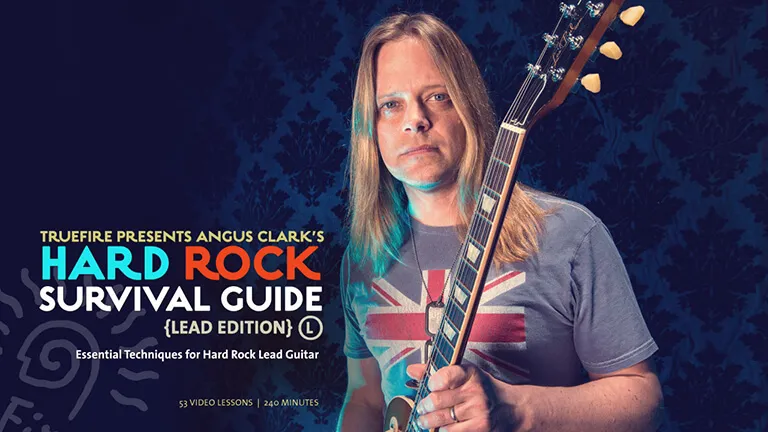
Rock audiences are tired of the same old same old. It’s not about blazing technique and fretboard pyrotechnics anymore. Today, you have to have that something extra-special, and ‘extra-special’ is Angus Clark’s middle name.
Angus walks the walk and talks the talk. He’s toured the world and has owned that spotlight thousands of times playing to more than a million people on five continents. He’s been a featured soloist on numerous Grammy-nominated and platinum-selling albums. He loves, lives, eats and breathes Hard Rock.
Angus also loves to teach and he’s very, very good at it. His Hard Rock Survival Guide: Rhythm course went platinum with a bullet and he’s back now with the Lead edition, which will help develop your own extra-special and ‘lead’ you directly to the spotlight.
Angus organized this Lead edition into two main sections. In the first section, Angus guides you through 25 key concepts and techniques. In the second section, you’ll play your way through 12 Performance Studies covering a wide variety of Hard Rock grooves, tempos and keys.
The 25 key concepts and techniques that Angus will focus on include: The Minor Pentatonic & Blues Scale, Bending, Hammer-ons and Pull-offs, Pentatonic Licks, Minor and Major Scales, Major Pentatonic Scale, Pentatonic/Diatonic Licks, Open Up the Neck Pents, Sliding Pentatonic Licks, Open up the Neck Diatonic, Shredding the Diatonic, Using Scales in Licks, Triad Arpeggios, 7th Chord Arpeggios, Arpeggio-Based Licks, Using Effects Concept, Modes Shmodes, Mixing the Modes, Exotic Scales, Sweeping, Tapping, Mixed Bag Licks, Make it Fit, Go For Broke, and Mapping Out The Solo. Consider these 25 key concepts and techniques as the palette of colors that you will paint your Hard Rock solos with.
You will learn how to paint with that palette of harmonic and technical colors in the second section, where Angus leads you through the 12 performance studies: A Page From Zep, Blazing Iommi, American Thighs, Running Stone Cold, Burnin’ Up the Rhoads, Burnin’ Up the Rhoads, Down at Dino’s, Forgotten Son, Exotica, The Epic, Breaking Melodic, After School and Deep Smoke.
Angus demonstrates all of the leads over rhythm tracks and then breaks them down measure-by-measure, technique-by-technique. You’ll first learn the parts as performed by playing along with Angus and referencing the tab and notation. When your ready, you’ll work with the rhythm tracks on your own and craft your own lead parts using all the ‘extra-special’ that Angus passed on throughout the course.
All of the key demonstrations, performances and examples are tabbed and notated for your practice, reference and study purposes. You’ll also get Guitar Pro files so that you can loop and/or slow any section down as you work through the lessons. Plus, Angus generously includes all of the rhythm tracks for you to work with on your own.
Hard rock influences practically every other rock genre and so, whatever style of rock you play; classic, grunge, metal, alternative, indy, grind core, stoner, psychedelic, blues-rock, power pop, folk rock …. you’ll extract enough firepower from this Lead edition of the Survival Guide to whip your lead chops into serious jaw-dropping shape.
Click now and the spotlight is yours!
What you'll learn
Navigate between pentatonic positions using slides
Execute unison bends with rhythmic precision
Apply harmonic minor scale over grooves that don't explicitly imply it
Create tension by resolving to the 'wrong' note in a progression
My name is Angus Clark, I have been a professional touring and recording guitarist for over 20 years. I have played in front of over a million people on five different continents. I have been fortunate enough to be a featured soloist on numerous Grammy-Nominated and Platinum-Selling albums. Whether on stage or in the studio, my goal is always the same: Create music people will enjoy listening to. I love Hard Rock. It is the music that shaped me as a teenager and it is still the music that I am most comfortable with. Please allow me to show you around.
This course is a Survival Guide, and is meant to help you develop all the necessary skills needed to play lead guitar in the Hard Rock genre. It is divided into two sections, concepts and solo studies. The concepts are explanations and exercises, and sometimes licks, that can be practiced with a metronome. The solo studies are demonstrations of applications of the concepts, and feature 12 complete solos played over backing tracks, along with a detailed breakdown explaining the the licks and techniques involved.
I highly recommend watching each concept at least once, even if it is on a subject you already feel well in control of. If there is a concept lesson that is entirely new material for you, you should spend some real time with it and practice the material presented with a metronome. As the survival guide format doesn't allow for each topic to be covered at length, you may want to pursue a topic with your private teacher or find additional lessons on the subject via the TrueFire site. Where the video lesson touches on a topic, there may be additional exercises covering that topic in the tablature, so definitely check it out. Where a concept involves basic neck knowledge, I strongly encourage you to practice the exercises in all twelve keys.
I highly recommend watching each concept at least once, even if it is on a subject you already feel well in control of. If there is a concept lesson that is entirely new material for you, you should spend some real time with it and practice the material presented with a metronome. As the survival guide format doesn't allow for each topic to be covered at length, you may want to pursue a topic with your private teacher or find additional lessons on the subject via the TrueFire site. Where the video lesson touches on a topic, there may be additional exercises covering that topic in the tablature, so definitely check it out. Where a concept involves basic neck knowledge, I strongly encourage you to practice the exercises in all twelve keys.
The minor, or blues, pentatonic scale is the home base for any blues-based music played on the guitar, so that is where we are going to start. While covering this basic fingering I am also reviewing fundamentals of hand position, picking, and hand synchronization. These are the fundamentals of creating sound on the guitar and everything else hinges on your control of these elements. If this is all new material for you, you're getting two lessons in one, if you already know the scale, you should still take the time to review these fundamentals.
One of the single most emotionally powerful techniques you can employ in playing the guitar is bending the strings. I am introducing this concept early on because it is integral to playing this style and you will need the not only finger strength but also a strong sense of pitch in order to execute these bends accurately. I play through a series of simple whole-step bends from notes on the pentatonic scale covered in Concept one. Make sure that your bends are in tune. You can even play your guitar through a tuner to check yourself. If you play both Fender and Gibson scale guitars, practice on both, as the scale length affects the bending enormously. As we move through the course, you will see numerous examples of different kinds of bends: half-step, minor third, major third, and so on. The longer bends will require even more strength in order to control them and accurately hit the pitch. So start practicing now. These demonstrations are done on a Gibson scale guitar with strings gauge .011-.049.
Hammer-ons and pull-offs are another pair of techniques that create a different sort of articulation from the string. Here again, finger strength is paramount, but instead of pitch being so much of an issue as with bending, your sense of rhythm is now at play. When you hammer on and pull off you are creating a rhythm with your left hand instead of with your pick. So practice hammers and pulls with the metronome. In order to develop your ability to hammer on or pull from from any finger to any other finger, look at the exercises in the tab. Typically we are stronger when working between fingers 1 and 2 rather than 3 and 4 or 2 and 3, etc. These exercises will help you even out the volume differential between your picked notes and your hammered or pulled notes.
Licks are very short phrases that you will develop your own library of over time. They are meant to be embellished and mutated in order to make them more your own. Here are four short and simple pentatonic licks that can be used on their own or in combination. They all use some version of bending, and hammer-ons or pull-offs. Practice them with the metronome and in different keys, etc. Play along with the video if you can.
Now that I've enticed you into this course with some very approachable and very rock n roll stuff, I'm going to take advantage of your enthusiasm by dropping mad science on you with a few lessons about playing scales. You'll be all the better for it. As with concept one, this is also an opportunity to work on your picking and metronome synchronization. These are skills that develop over time by practicing consistently on a regular basis. They also require maintenance, even veteran performers and players run their scales to stay "in shape" on the instrument. So get used to it, and while it's ok to do it in front of the tv sometimes, definitely listen to what you're playing more of the time. Play them as slowly as you need to to play them absolutely perfectly before starting to speed them up.
Once you start speeding up the metronome, if you really want to get the most out of it, pay attention to things like your breathing and if you have tension in your hands, shoulders or jaw, etc. I find that remembering to breath normally and remembering to smile help relax tension and improves my performance. And that's a hot tip.
If any of the terminology confuses you, just take a minute and wrap your head around it: There are seven notes in a diatonic scale. I refer to them by the number of the scale degree, I use Root and "1" interchangeably. Jazzbos like to refer to the 2, 4, and 6 as the 9, 11, and 13, cause they like having their own exclusionary language. I use that terminology sometimes, but I don't consider myself a jazzbo, so there. Anyway, truth be told I really see the neck as notes, like A, C#, Eb, etc. The numbers game is effective in teaching because I am encouraging you to practice these exercises in all twelve keys, so do that. What I do not see are fret numbers. I can't read tab and that's never lost me a gig. I can read standard notation and that has gotten me gigs, so you can glean from that whatever you want. Moving on.
I spent many hours with it and (as I always do) also scrolled back and forth a bit, so I didn't just play everything in order. It's really worth listening to it. Angus has a lot of experience and he puts his finger on the crucial points. I had heard a lot of it before, but in a different context, so I was able to learn a lot.
I can absolutely recommend the course. Not for the complete beginner, but for anyone who already has some background and is familiar with scales. The course includes many good tips and exercises.
What I don't like—and this isn't a criticism of this course specifically, but of Truefire in general—is that I would like a page where all the sheet music is available for download, so you don't have to select, download, and rename each PDF separately within the course. Other online courses offer PDF download pages with all the content, all with sensible names.
But as I said, Angus's course is great, no complaints there.
M
mastrocm
Verified buyer
11/13/25
Awesome playing!!!
D
Deathyak
Verified buyer
09/20/25
Worth it.
A solid course. Lots to learn. Great instructor.
P
ProudProwser49
Verified buyer
11/28/24
Though I am not Done Yet. . .
Angus' jams are awesome. However, I find myself listening to the solo study content too much. That's good, though because I'm cutting my mind in as I'm getting ahead of things. I especially like his solo performance of his take on Randy Rhodes. Obviously, he can do this in his sleep, and judging by the black bags under his eyes, he is going out of his way to do this video content. I am a beginner lead player in some ways and I really do want to buckle down on this video content and get it under my fingers. I especially like Angus' one foot in front of the other developmental approach. I think he's teaching average stuff. Aside from a few micro blems, such as him laughing with the camera person, this video is a very good way to learn and practice essential lead guitar. Angus is being Angus, to boot. I own a few different courses he does. Like Andy Timmons, he has to slow down his production pace here and there. He did a good job. 👍
M
MyTrufire44
Verified buyer
11/21/23
Très bonne leçon, comme toujours avec Angus Clark !
Une large gamme d'exercices et d'exemples à des niveaux différents. Le challenge pour moi c'est de "boucler" toute la leçon en réussissant tous les exercices. Pour vérifier que c'est acquis il suffit de jouer les exercices proposés avec le playback. Un vrai plaisir.