Quintus Horatius Flaccus, known as Horace by his English-speaking friends, offered friendly, entertaining advice for fellow poets in the form of a poem titled Ars Poetica. Written somewhere around 8 BC, Ars Poetica inspired the art of poetry for many hundreds of years to come.
Amongst the 30 maxims in Ars Poetica, Horace advises that a poem demands unity, harmony and proportion, which should be balanced with meter and style, and crafted around a theme or character. Horace also professes "ut pictura poesis," or, "as is painting so is poetry.”
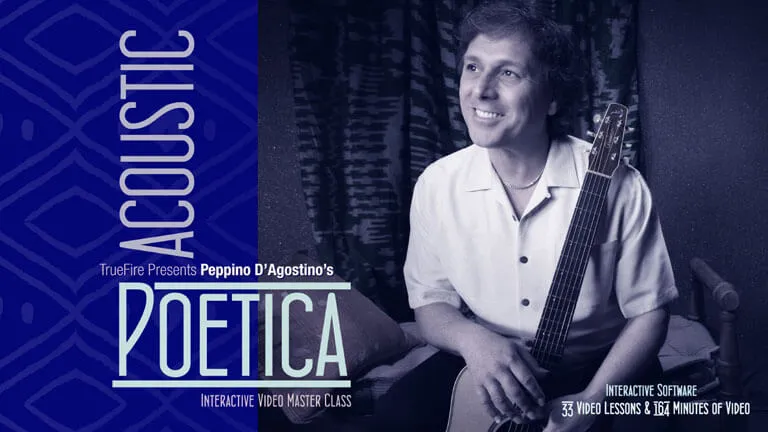
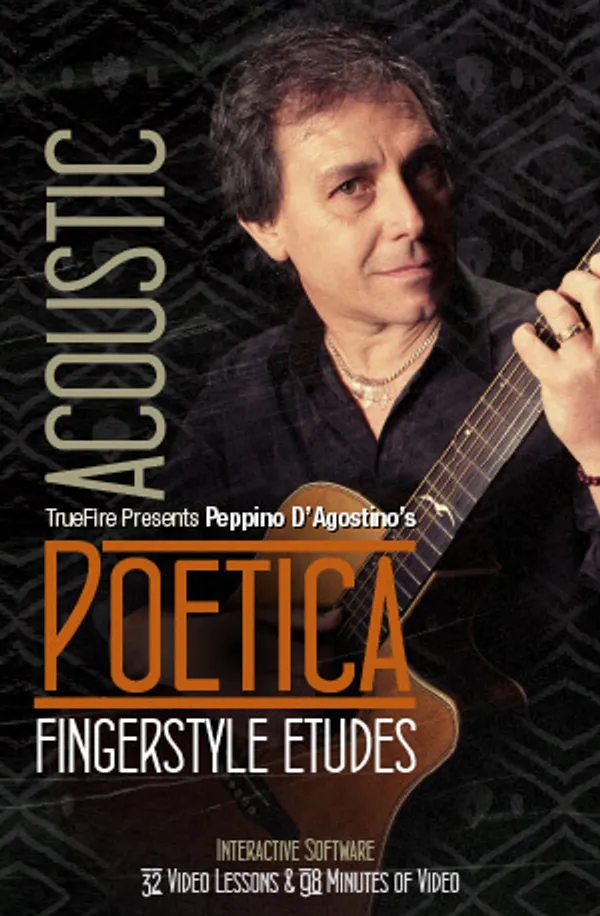
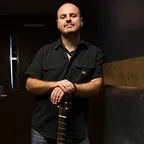
Quintus Horatius Flaccus and celebrated composer, prolific recording artist and virtuoso guitarist Peppino D’Agostino have very much in common. TrueFire is proud to welcome Peppino to the TrueFire family and introduce his Acoustic Poetica to our entire student community.
“Acoustic Poetica is a very appropriate title because composing music on my guitar is very much like writing poetry. There are rhythms in the rhymes of a poem and there are rhythms in musical phrases. Both art forms capture the essence of an experience or emotion and express it in a visceral way to connect me to my audience.
My musical compositions are very similar to paintings. For example, in a landscape, you might see the silhouette of a tree being closer than the mountain range in the background. In the same fashion, when you compose a piece, you may want the melody to be upfront and the chords in the background.”
Whatever style of music you play, the inspirational value of Peppino’s Acoustic Poetica demands a spot in your library. Just watching this master perform and break down the four featured performance studies, is worth the price of admission alone. Peppino also presents ten key creative concepts and technical approaches with detailed explanations and demonstrations — these are priceless maxims for any and every acoustic guitarist.
Acoustic Poetica is organized into two sections. The first section focuses on what Peppino considers to be essential techniques and creative approaches: Open Tunings, Melody in Open Tunings, Harmony in Open Tunings, Lower Register Melodies, Harmonizing a Melody, Left Hand Only, Palm and Finger Percussion, Muted Percussive Finger Strum, Thumb Slap and Using Harmonics.
The second section puts all of the first section’s creative approaches and techniques to work across four featured full-length, original composition performance studies (2 in standard tuning and 2 in very evocative open tunings): The Blue Ocean (76 measures - Tuning: DADEAE), Barefoot in Rio (111 measures - Standard Tuning), Nine White Kites (79 measures - Tuning: C#G#EF#BD#) and Street Pulse (65 measures - Standard Tuning).
All of the performance studies (and many of the previous section’s examples and demonstrations) are tabbed and notated, plus you’ll get Guitar Pro files as well (Windows & Mac compatible).
Peppino’s Acoustic Poetica is a magical, enlightening learning experience that will be a treat for your eyes and ears and inspire your imagination and creative prowess.
As is painting so is music.
What you'll learn
Execute partial barre chords with index, middle, and ring fingers
Play an original fingerstyle composition in DADGAE tuning
Apply classical right-hand fingerpicking approach to contemporary music
Integrate strumming techniques within fingerstyle patterns
Understand how to create depth and layers in solo guitar arrangements
Since the mid 60s, when I discovered the guitar through an Italian cousin of mine, this wonderful instrument has being a big part of my life. I have always loved to compose pieces for the guitar and I believe that my very first composition was written when I was 10 years old. "Acoustic Poetica" is a very appropriate title for my guitar course because composing music on my guitar is very much like writing poetry on a notepad. There are rhythms in the rhymes of a poem and there are rhythms in musical phrases. Both art forms can capture the essence of an experience, an emotion and express it in a visceral way which connects me to my audience.
A musical composition could also be very similar to a painting of a landscape. In a painting you may see the silhouette of a tree being closer than the mountain range in the background. In the same fashion, when you play a piece, you may want the melody to be upfront and louder than the chords in the background.
Sometimes people ask me to describe my guitar style and the risk in that is to limit myself. I love Melodies, Harmony, Rhythm so I try to put these elements together plus a percussive sound here and there. What's my style? I have no idea, but if you press me from now on I'll call it "Acoustic Poetica"!
If I have to describe my guitar style, I will start by saying that most musicians have a way to approach music. It could be Melody, Harmony or Rhythm. You've got to get to everything eventually! Melodies are certainly a very important element for me, followed by Rhythm and then Harmony. I do write music in a variety of styles from Pop ballads, to more Classical and World music influenced, to Brazilian and Italian traditional.
The guitar it's like a mini orchestra of sounds, the perfect instrument for me to write my melodies, my musical ideas and especially express my emotions.
In this course I will show you the elements that define me as a musician.
I hope that by studying my compositions you'll gain confidence in your own playing and refine your skills as a composer. Enjoy it!
I discovered open Tunings in the mid 70' thanks to guitarists such as Leo Kottke. Dave Evans, John Renbourn and Davey Graham. I began experimenting with them and developed my own unusual open tunings. One of the reasons I love open tuning so much is that all the familiar chord shapes, scales, right and left hand patterns are obsolete. You're in strange territories that you can't recognize and it can be a little unnerving at first. The guitar becomes almost a new instrument and that factor can be actually really inspiring. The guitar itself will suggest melodies you would not play and chord voicings you wouldn't ordinarily think about. When I use open tunings, I basically follow my fingers, my musical instinct and let my intuition dictate what happens next. Unlike the violin, the cello or wind instruments, the guitar doesn't have a long sustain and the notes tend to die away almost as soon as they are plucked. For this reason open strings played either as a melody or over a melody can give the illusion of a sustain. In this course we'll be looking at two unusual open tunings, DADEAE and C#G#EF#BD#, but in my future courses we'll explore more of them, so stay tuned.
In this segment you will hear and see the difference between a melody in the upper register and chords played in standard tuning and the same musical phrase played using an open tuning. The open tuning is: C#G#EF#BD# and is the same one that I use on my original composition "Nine White Kites" which I'll perform later in the course. Having lowered the sixth and fifth string respectively to C# and G# adds harmonic richness to the bass arpeggio and a different flavor due to new chord voicings.
The open tuning that I'm using in this segment is the following: D A D E A E.
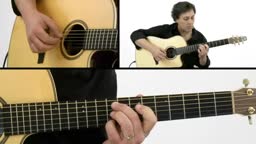
Building chord progressions in open tunings can be challenging and exciting. In this segment you will learn how to build the very well known I- V-vi-IV chord progression used in so many musical genres. Using open ringing strings will make your chords more interesting and rich. Check the chord diagrams and pay attention to the fingering that I'm using.
Typically melodies on the guitar are played on the first, second and third string. I actually find it very interesting to create melodies in the lower register of the instrument. In this video I will show you a melody played exclusively on the fifth string and intertwined with a bass line on the six string with a chord on the third and fourth strings. Initially it is kind of difficult to coordinate all these syncopated movements and understand all these different rhythms so practice slowly and make sure that you understand the bass, the melody and the chords separately first and then put them together. Pay close attention to the right-hand fingering. This is an excerpt from my composition "Nine White Kites". In this passage the rhythm is clearly syncopated and influenced heavily by South American music.
Here I explain how I harmonize a simple melody moving between three different keys: G Major, Db and F. The fingering of your left hand is a little bit tricky especially on the Db chord when you have to move the index on the ninth fret of the second string. In these 18 measures I am using essentially major seventh chords over the melody played on the first and second strings.
This is the very beginning of my tune entitled Barefoot in Rio, which I'll be playing in its entirety later in the course.
I'm a rock and blues fellow, but am liking Peppino's course - inspiration comes from many places and this is worth exploring - beautiful music and insights!