Developing the requisite technical skills, mastering key expressive techniques, and learning how to perform songs are the rites of passage that every guitarist must travel through on their path to becoming a great fingerstyle player.
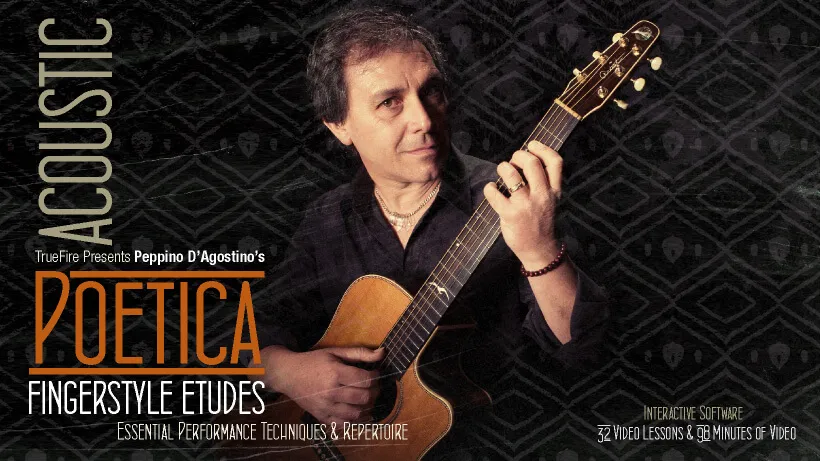
If you’re ready to embark on your own rite of passage, you couldn’t ask for a better guide than master fingerstyle artist, Peppino D’Agostino who presents this Etudes edition of Acoustic Poetica for early intermediate players.
Creating this Etudes edition of Acoustic Poetica was a journey in my musical past that brought back the excitement which sparked my undiminished and constant love for our beautiful instrument. The main challenge in preparing this course was composing cohesive and simple guitar etudes containing the musical and technical elements that students first need to master in order to perform more complex compositions.
I hope that the dedicated beginner and intermediate fingerstyle player will find these etudes helpful and will manage, in time, to incorporate and use these techniques and creative approaches in their daily practice routines and as tools for their own compositions.”
Each of Peppino’s 10 etudes focus on a particular technique and creative approach. You’ll start out working on your left and right hand coordination along with the steady-bass technique. You’ll then focus on sliding techniques, strengthening your fretting hand, right hand percussion techniques and also explore melodic approaches for playing up and down the neck. You’ll also learn how to develop your arpeggios with various creative approaches, build on your technique for playing harmonics, and also b introduced to performing a piece in an open tuning.
Peppino demonstrates all of the following 10 etudes and then breaks them down, stepping you through the key concepts, techniques and creative approaches used in the etude.
Coordination Nation - ”This exercise is designed to improve the coordination of both hands working together. Make sure to use the right and left hand fingering indicated in the standard notation even if it seems difficult or awkward at first. Let the bass notes ring throughout the measures and sustain them as long as possible. Use your thumb to strike the 6th, 5th, and 4th string, your index finger to strike the 3rd string, the middle finger to strike the 2nd string, and the ring finger to strike the 1st string.”
Basso Ostinato - ”In this exercise, we'll be learning how to play a constant bass with the thumb, switching from the 6th to the 5th string. Learn this etude by first playing the bass notes and then add the additional notes on the 1st, 2nd, 3rd, and 4th strings. Use a metronome at low speed (50 BPM) to practice playing the bass. The 6th and 5th strings are played with the thumb, while the 1st string is played with the ring finger. The 2nd string is played with the middle finger, and the 1st string is played with the index finger.”
Sliding Sweetness - ”Sliding from one fret to the next can hurt your fingertips, especially if you've never done it before. The good news is that if you keep on practicing you'll slowly build calluses and everything will become much easier! In this etude, you'll be sliding essentially from the 5th to the 7th fret of the 2nd string with your ring finger. The only exception is on measure 14, where you'll be sliding from the 5th to the 3rd fret of the 1st string with your index finger. The bass notes are keeping a straight 3/4 waltz tempo. ”
Around The Bend - ”All the bent notes in this etude are done on the 2nd and 1st strings using either the index or the middle finger. It requires strength and precision to execute this etude properly. It's extremely important to pay attention to intonation and to reach the proper pitch as you bend these notes. You’ll see in the video that the notes are either bent in an upward or downward motion. It's important to choose one or the other in order to simultaneously play the proper bass notes.”
Percussion Introduction - ”At the very beginning of this etude, we're already in A minor position and the very first percussion (shown with X letters) is done with the tip of your index, middle, and ring finger landing on the 4th, 3rd, and 2nd string, creating a sound reminiscent of maracas. Immediately after the percussion, you pluck the 4th, 3rd, and 2nd string playing the A minor chord.”
Traversing The Neck - ”In this etude, it's particularly important to follow the fingering described in the standard notation. With the exception of measure 4 and 12, you'll find out that the very last note of each measure is an open string. Please take advantage of this open string to shift quickly to the next position. It will be particularly challenging to shift between measures 7 and 8 and measures 11 and 12.”
Arpeggiated Voyage - ”The melody of this etude is played on the 5th and 4th strings while the higher strings are in charge of arpeggiating the chords around it. Measure 11, 12, 13, and 14 requires big stretch of your hand. Practice these measures slowly and pay particular attention to the fingering suggested on the standard notation.”
Harmonically Speaking - ”This etude focuses on harmonics, which present a series of difficulties. When a harmonic is played together with a bass note, it's important to pluck the harmonic close to the bridge with precision and power so that both notes can be heard. Measure 5 can be challenging as well, with a jump from the 9th to the 2nd position of your guitar.”
Rhythmic Slap - ”I've created this exercise to incorporate percussion into a simple chord progression. In this etude you'll find three different kinds of percussion sounds. The 1st one is created with the flesh of your index finger against the top of the guitar above the sound hole. The 2nd one is with the index nail against the top side of your guitar.”
Open & Melodic - ”This is quite an unusual open tuning that I learned a while ago from one of my students. In this etude, the melody is carried out by the 1st and 2nd string. It's very important to play the bass/accompaniment notes softly so that the melody can be in the forefront. For students that are not very used to open tunings, it will feel strange at first to play this etude, because the notes that they hear would be situated in different locations if they were playing in standard tuning.”
All of the performances are tabbed and notated for your practice, reference and study purposes. You’ll also get Guitar Pro files so that you can play, loop and/or slow down the tab and notation as you work through the lessons.
Grab your acoustic guitar and let’s get Poetica with Peppino D’Agostino!
Hi, I'm Peppino D'Agostino, and welcome to the Fingerstyle Etudes edition of Acoustic Poetica.
When TrueFire asked me to work on a second instructional video, I was excited and slightly nervous about it. I was tasked with preparing 10 etudes, approx. 12 measures in length, all for the early intermediate and intermediate player. My anxiety was due to the fact that I had to come up with original material for guitarists at their early stage of musical knowledge! The main challenge was to create cohesive, simple, short guitar etudes for beginners containing the musical elements that I've been using for years in my more complex compositions. To achieve this result, I had to go back in time (to my teens years) and recall what I had to do in order to master and internalize certain guitar techniques. Creating this course was a journey in my musical past and brought back the adolescent excitement which sparked my undiminished and constant love for our beautiful instrument.
Each etude will focus on a particular technique you'll need to master on your journey to becoming a great fingerstyle player. I hope that the dedicated beginners and intermediate students will find these etudes helpful and will manage, in time, to incorporate and use these musical examples in their daily practice and as tools for their own compositions. I'll perform each piece for you and then I'll break it down, pointing out each technique you need to know. And of course, you'll also have all the standard notation and tab to work with as well. Ready? Grab your guitar, and let’s get started!
This exercise is designed to improve the coordination of both hands working together. Make sure to use the right and left hand fingering indicated in the standard notation even if it seems difficult or awkward at first. Let the bass notes ring throughout the measures and sustain them as long as possible. Use your thumb to strike the 6th, 5th, and 4th string, your index finger to strike the 3rd string, the middle finger to strike the 2nd string, and the ring finger to strike the 1st string.
This exercise is designed to improve the coordination of both hands working together. Make sure to use the right and left hand fingering indicated in the standard notation even if it seems difficult or awkward at first. Let the bass notes ring throughout the measures and sustain them as long as possible. Use your thumb to strike the 6th, 5th, and 4th string, your index finger to strike the 3rd string, the middle finger to strike the 2nd string, and the ring finger to strike the 1st string.
This exercise is designed to improve the coordination of both hands working together. Make sure to use the right and left hand fingering indicated in the standard notation even if it seems difficult or awkward at first. Let the bass notes ring throughout the measures and sustain them as long as possible. Use your thumb to strike the 6th, 5th, and 4th string, your index finger to strike the 3rd string, the middle finger to strike the 2nd string, and the ring finger to strike the 1st string.
In this exercise, we'll be learning how to play a constant bass with the thumb, switching from the 6th to the 5th string. Learn this etude by first playing the bass notes and then add the additional notes on the 1st, 2nd, 3rd, and 4th strings. Use a metronome at low speed (50 BPM) to practice playing the bass. The 6th and 5th strings are played with the thumb, while the 1st string is played with the ring finger. The 2nd string is played with the middle finger, and the 1st string is played with the index finger. Please note that on the 1st beat of measure 9, the E note played on the 2nd fret of the 4th string is played with the index finger in conjunction with the thumb playing the 3rd fret of the 5th string. It's the same fingering with the D# played on the 1st fret of the 4th string in conjunction with the thumb playing the 2nd fret of the 5th string (1st beat of measure 10).
In this exercise, we'll be learning how to play a constant bass with the thumb, switching from the 6th to the 5th string. Learn this etude by first playing the bass notes and then add the additional notes on the 1st, 2nd, 3rd, and 4th strings. Use a metronome at low speed (50 BPM) to practice playing the bass. The 6th and 5th strings are played with the thumb, while the 1st string is played with the ring finger. The 2nd string is played with the middle finger, and the 1st string is played with the index finger. Please note that on the 1st beat of measure 9, the E note played on the 2nd fret of the 4th string is played with the index finger in conjunction with the thumb playing the 3rd fret of the 5th string. It's the same fingering with the D# played on the 1st fret of the 4th string in conjunction with the thumb playing the 2nd fret of the 5th string (1st beat of measure 10).
In this exercise, we'll be learning how to play a constant bass with the thumb, switching from the 6th to the 5th string. Learn this etude by first playing the bass notes and then add the additional notes on the 1st, 2nd, 3rd, and 4th strings. Use a metronome at low speed (50 BPM) to practice playing the bass. The 6th and 5th strings are played with the thumb, while the 1st string is played with the ring finger. The 2nd string is played with the middle finger, and the 1st string is played with the index finger. Please note that on the 1st beat of measure 9, the E note played on the 2nd fret of the 4th string is played with the index finger in conjunction with the thumb playing the 3rd fret of the 5th string. It's the same fingering with the D# played on the 1st fret of the 4th string in conjunction with the thumb playing the 2nd fret of the 5th string (1st beat of measure 10).
I have owned a Peppino signature guitar for several years. This course allows me to get closer to his style. He is a great artist.
T
tompedersen
Verified buyer
09/16/21
Awesome Etudes
I was never so motivated to learn an Etude! These are beautiful pieces and the learning objectives are appealing and clear.
N
nuno69
Verified buyer
03/06/21
I'm really happy with this course, Peppino is a great teacher and musician. The etudes are small, poetic pieces of music which are fun to play and at the same time are not very hard to play. Thank you.
L
Lummkanda
Verified buyer
08/30/20
Peppino d'Agostino is an exceptional musician. His music is hallucinating with calm and beauty.Due to his video lessons he reveals to us his musical universe. Interesting but complex!
To start well, it is better to start first with your "Fingerstyle Studies" lessons!
A treasure !!
M
Mandru0615
Verified buyer
08/17/20
Acoustic Poetica Etudes
So far this course has been very beneficial to me. I'm finding these etudes, while short, are very helpful in helping the fingerstyle guitarist to acquire and strengthen various techniques. I'm confident this course will help me to broaden my skills and also prove valuable when learning fingerstyle pieces from other artisits.