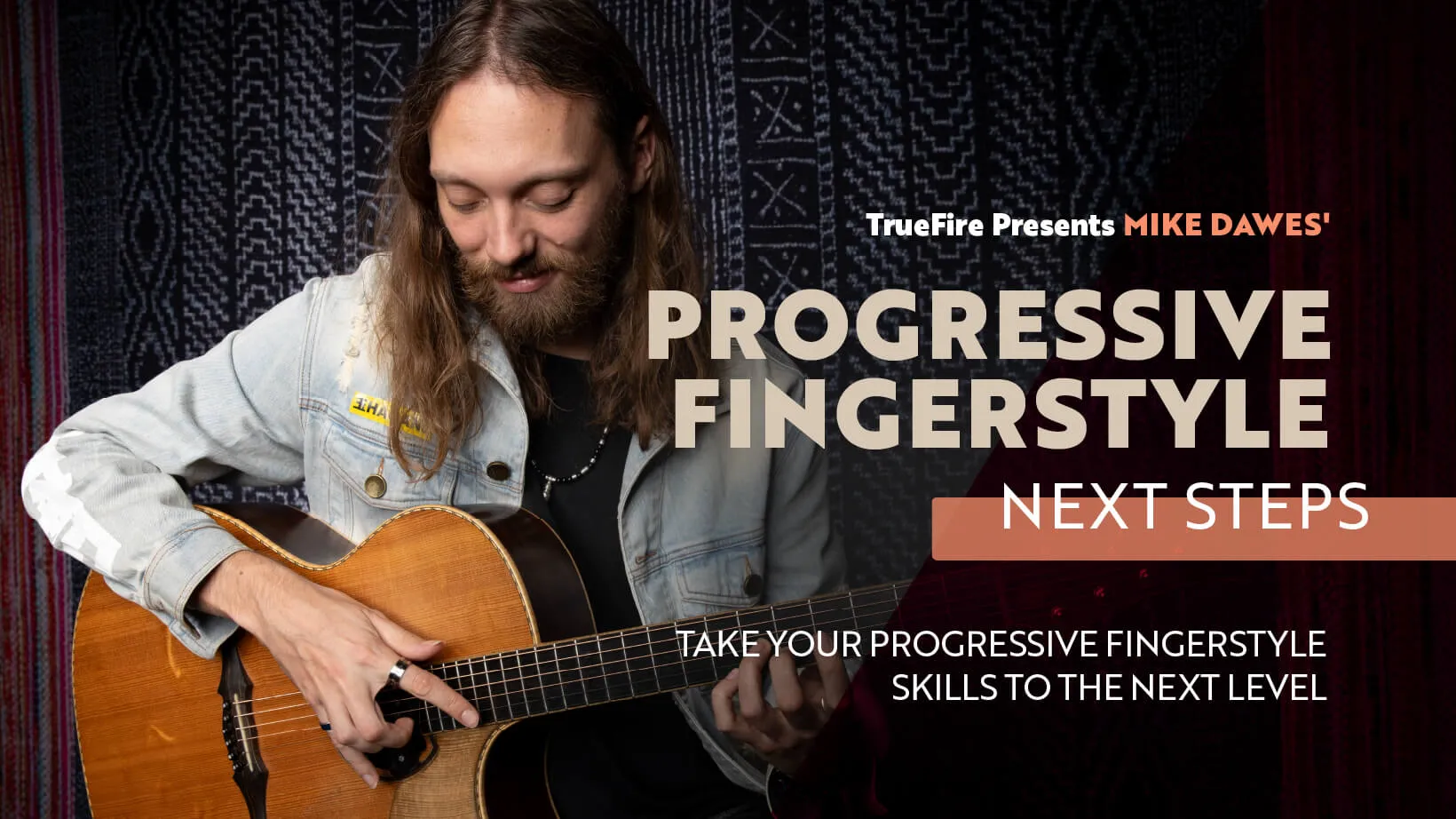
Progressive Fingerstyle: Next Steps

Take Your Progressive Fingerstyle Skills To The Next Level

Marty FriedmanTommy EmmanuelSteve VaiEric GalesEric Johnson

Get this course and 1,000+ more with All Access

Try 14 days free. Cancel any time.

Purchase Individual Course for $19.99
Progressive Fingerstyle: Next Steps

About this course

In Mike Dawes' “First Steps” edition of his Progressive Fingerstyle Series, you learned how to ditch the pick and expand your instrument’s potential using essential right hand techniques, alternate tunings, harmonics, and some simple body percussion.

In this “Next Steps” edition, Mike will expand your progressive fingerstyle toolkit with alternate right hand techniques, harmony studies, slap bass, polymeters, syncopation, a broader range of percussive techniques, and much more.

”We’ll focus on the why as well as the how. You’ll not only learn these techniques through a series of sixteen skill specific etudes, but you’ll gain a better understanding of how to apply them to your original songs, create your own arrangements, and build your repertoire more efficiently.

I invite guitar players of all abilities to try something new and join me as we continue this progressive fingerstyle journey. Everything is tabbed and synced to the video. You can slow down or loop any of the video lessons to learn at your own pace.”


Named ‘Best Acoustic Guitarist in the World’ two years in a row by Total Guitar Magazine/MusicRadar reader polls, Mike Dawes’ ability to seamlessly combine melody, bass, harmony, and percussion leaves audiences absolutely stunned with his original music and massively popular covers.

In this “Next Steps” edition you will learn: Index Finger Swipe Techniques, Swipe with Articulation, Using Harmony for Self Accompaniment, Expressive Neck Bend Vibrato, Harmony in Open Tunings, DADGAD Harmony, Horizontal Movement, Slap Bass Inspired Techniques, Syncopation: The One Man Band Hack, Polymetric Playing, Waterfall Harmonics, Snare Drum Technique, Percussive Rudiments, Fills, Putting Your Skills to Work, and Expanding Your Creativity and Repertoire.

Mike will thoroughly explain and demonstrate all of the essential progressive fingerstyle guitar techniques and concepts as play your way through the course.

You’ll get standard notation and tabs for all key examples and performance studies. Plus, you’ll be able to use TrueFire’s learning tools to sync the tab and notation to all the video lessons. You can also loop or slow down the videos to work with the lessons at your own pace.

Grab your guitar, ‘ditch the pick” and let’s take those “next steps” with Mike Dawes!

What you'll learn

  • Navigate chord changes while maintaining independent rhythmic patterns
  • Apply polymetric concepts to composition and arrangement
  • Integrate melody notes on top of polyrhythmic fingerstyle patterns
  • Coordinate thumb harmonics with independent melody notes
  • Develop the ability to hear and feel different time signatures simultaneously
Release date: 09/19/2023 • 2h 42m runtime
Start Course
Sample lessons
Index Finger Swipe Technique
Concept & Demo
Swipe Etude with Travis Picking
Overview
Swipe Etude with Travis Picking
Performance
Swipe Etude with Travis Picking
Breakdown

What's included

67 lessons • 25 charts

Progressive Fingerstyle: NEXT Steps
Hi, I’m Mike Dawes and welcome to Progressive Fingerstyle, Next Steps.

In our “First Steps” edition of this series we explored how to ditch the pick and expand your instrument’s potential using essential right hand techniques, alternate tunings, harmonics, and some simple body percussion.

Here in “Next Steps”, we’ll elaborate on some of those same techniques and expand your progressive fingerstyle toolkit with alternate right hand technique, harmony studies, slap bass, polymeters, syncopation, a broader range of percussive techniques and much more.

In this edition we’ll focus on the why as well as the how. You’ll not only learn these techniques through a series of sixteen skill specific etudes, but you’ll gain a better understanding of how to apply them to your original songs, create your own arrangements, and build your repertoire more efficiently.

Everything is tabbed and synced to the video. You can slow down or loop any of the video lessons to learn at your own pace.

I invite guitar players of all abilities to try something new and join me as we continue this progressive fingerstyle journey. Let’s jump into it!
First Steps Review
Welcome, folks, to "Progressive Fingerstyle: Next Steps." In our first course, "First Steps," we covered the basics of the modern fingerstyle genre. We discussed how to choose a guitar, introduced different tunings, and went over fundamental exercises for techniques such as tapping, harmonics, percussion, and many introductory licks and tricks.

In this course, as the name suggests, we're aiming to take things further, diving into the beginner to intermediate range. We'll focus on more techniques, more riffs, and delve into more complex aspects, especially concerning the right hand. We'll also cover topics you might not have encountered before. Additionally, we'll discuss the reasoning behind certain musical decisions. Through my journey of trial and error, I'll share why I chose to shift my focus in certain areas when composing and arranging music.

I hope this course will help streamline your learning process. While "First Steps" pairs well with this course, "Next Steps" can also serve as a standalone. However, I'd recommend going through "First Steps" since we won't delve as deeply into some of the subjects discussed there.

Join me in this continuation of our journey. Let's dive in and pick up where we left off.
SECTION 1: Right Hand Evolution
In this initial section of the course, we'll elevate the right hand techniques. While we've covered Travis picking and other methods in the "First Steps" course, we'll now explore unique techniques such as finger swiping. Drawing inspiration from masters like Chet Atkins, Tommy Emmanuel, and techniques I personally employ, our aim is to assist you in refining your fingerstyle skills. By integrating these with techniques you're already familiar with, you can achieve a more distinctive sound. Let's delve deeper into the right hand techniques.
Index Finger Swipe Technique
In this section, we will explore the intricate technique of Travis Picking, pioneered by Merle Travis, which emphasizes an independent thumb and finger pattern on the guitar. This method creates the illusion of a one-man band by having the thumb alternate on the lower strings of a chord, while the fingers play individual notes. Building on this foundation, we'll delve into a widely-used approach seen in works by artists like Paul McCartney and Chet Atkins. This approach combines the consistent 4 4 thumb pattern with strumming to fill in the gaps, primarily using the index finger in a down-up motion. By integrating hammer-ons and pull-offs, this technique produces richer patterns, offering a fuller sound with chord strikes, reminiscent of a bass and snare effect. The session will culminate with an etude that refines thumb-finger separation, enhancing finger-picking skills.
Four Chord Swipe Etude
In this etude, we'll work with four chords: D major, E minor, B minor, and G. We'll focus on the right hand pattern, where the thumb alternates between the first and third beats. The index finger, using the back of the nail, will strike down on beat two and come up on the 'and' of beat two. We'll maintain a consistent pattern to help you establish a rhythm. The selected chords offer a diverse mix of four-string, five-string, and six-string configurations. This exercise aims to familiarize you with a fresh approach to guitar picking. Let's delve into it.
Four Chord Swipe Etude
In this etude, we'll work with four chords: D major, E minor, B minor, and G. We'll focus on the right hand pattern, where the thumb alternates between the first and third beats. The index finger, using the back of the nail, will strike down on beat two and come up on the 'and' of beat two. We'll maintain a consistent pattern to help you establish a rhythm. The selected chords offer a diverse mix of four-string, five-string, and six-string configurations. This exercise aims to familiarize you with a fresh approach to guitar picking. Let's delve into it.
Four Chord Swipe Etude
In this lesson, we will explore the intricacies of Travis picking in combination with strumming. While traditional Travis picking often involves a stationary hand with a pinky anchor, introducing strumming adds a unique dynamic where the arm exhibits a subtle bobbing motion, imitating the rhythm of a strum. We'll delve into the technique's application across various chords, starting with the D major, where the focus is on the D-ring and G-string. As we progress to the E minor chord, the emphasis shifts between the bottom string and the D string. Finally, with the 5-string B minor chord, we'll utilize an A-shaped bar chord, jumping between the A string and the D string. This lesson aims to merge the precision of Travis picking with the fluidity of strumming to enhance your fingerstyle guitar techniques.

+ 60 more lessons

Start Course

Reviews

6 results

rarchee

Verified buyer

11/18/25

Great course by a great teacher.

This is an excellent guitar course. Worth every penny.
wojtop6

Verified buyer

12/10/24

Great!!!

GuitarPeppe

Verified buyer

12/09/24

Great course and great player

Tuckashreds

08/02/24

An Impressive Set of Lessons - Tough And Satisfying

This is a great set of lessons if you are looking to progress beyond Mike's first lesson pack. Very tough but also very satisfying. Can't wait to start the Essential Riffs pack.

Habehabe

Verified buyer

02/15/24

Great lessons to advance your playing, provided you practice

I bought this “Next Steps” course as I am interested to add modern fingerstyles techniques in my playing of the acoustic guitar. Less for flashy effects but for potentially enhancing the musical content of my fingerstyle repertoire. After Mike Dawes reviews briefly the key concepts of his “1st Steps” course he presents etudes on finger swipes in combination with Travis picking. He explains added harmonies on the middle strings to melody and bass lines and neck bendings before he moves to harmonies and open tuning (DADGAD). For me, the less familiar territory starts with section 3 to apply slaps, pops combined with muting using a funky riff section to train the coordination of these techniques. It sounds really cool once you get it sorted out. The challenging parts for me are the following applications of syncopation and then polymetric playing, i.e. playing simultaneously in different time signatures, and the usage of percussive elements. I will have to reserve quite a few hours in the shed before it may become second nature and before I will attempt the final two cool sounding etudes (at least if played by Mike). But I think it is really worth it. In any case, it certainly helps to be familiar with “1st Steps” as well as Mike refers to it regularly. Thanks, Mike, for the very interesting content and the relaxed presentation! Well done!

Stop searching. Start improving with All Access.

Try 14 days free. Cancel any time.