You simply can’t listen, study or play Gypsy Jazz guitar without thinking or musically referencing Django Reinhardt. The artist and the style are absolutely synonymous, which in itself is unprecedented. Dig deeper and you’ll discover that Django, the son of gypsy parents in Belgium, never attended a day of school and could barely write his own name. He also lost the use of two fingers on his left hand in a fire at the age of 18. Yet, Django went on to become one of history’s most influential jazz guitarists and improvisers before his untimely passing in 1953.
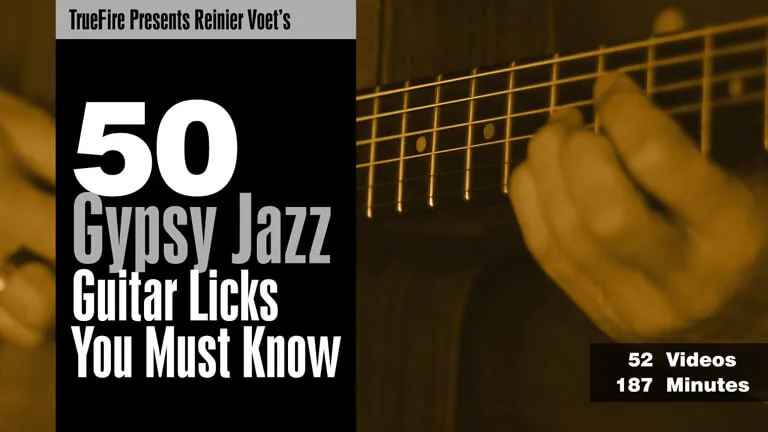
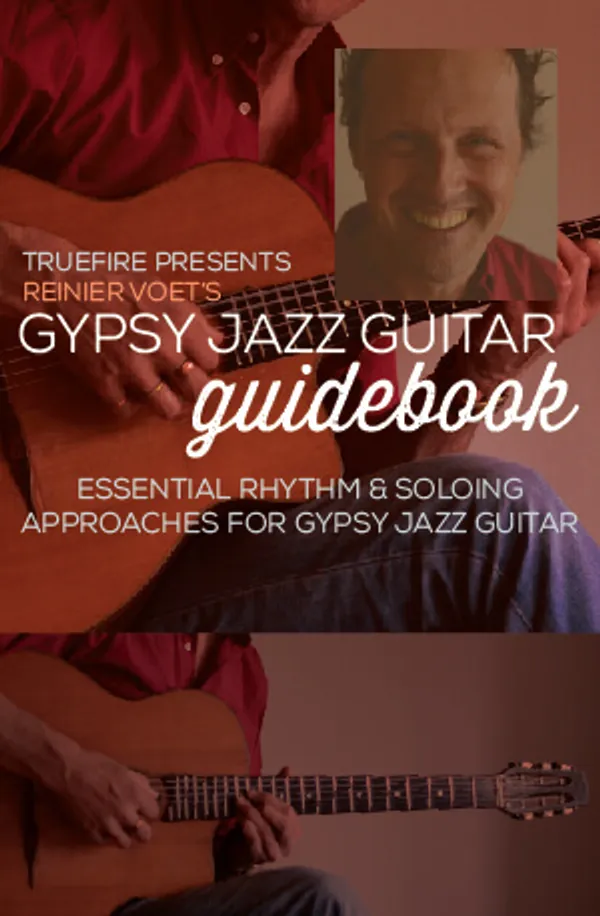
Reinier Voet’s 50 Gypsy Jazz Licks You MUST Know is so much more than a hand-picked collection of versatile and essential gypsy jazz lines and phrases — its also a an homage to the man who innovated a timeless vocabulary that guitar players will still be quoting a thousand years from today.
Gypsy Jazz is very much alive today. Stochelo Rosenberg, Jimmy Rosenberg, Fapy Lafertin, Biréli Lagrène, Boulou Ferré, Häns’che Weiss, Angelo Debarre, Wawau Adler, Joscho Stephan, John Jorgenson, Frank Vignola and many, many other giants of guitar perform and celebrate gypsy jazz to the delight of their audiences.
In the traditional gypsy culture, the musical skills and knowledge were handed down from master to student face-to-face. The master plays and the student emulates what he hears and sees. Joe Pass, Rene Tomas, Les Paul, Philippe Catherine, Charlie Christian, Jim Hall and so many other players will readily fess up to copping more than a few licks from the great Django. In similar fashion (but with the aid of tab, notation and interactive video), Reinier will pass on the rhythms, lines and techniques that he himself learned from the masters that he has studied over the years.
While most of the phrases in this collection reference Django’s influence directly, there are also phrases inspired by other gypsy jazz masters such as Matelot Ferret, Häns’che Weiss and Boulou Ferré to name a few.
All of the licks are presented over a rhythm track so that you can hear and practice them in a musical context. Each performance is then followed by a detailed breakdown of the line along with the techniques being employed to perform it. Everything is tabbed and notated, plus you get all of the rhythm tracks used in the performances to practice the lines with on your own.
Reinier Voet’s 50 Gypsy Jazz Licks You MUST Know will load your bag with enough gypsy jazz firepower to get you squarely in the game. Click now, shed heavily and join the gypsy jazz revival!
What you'll learn
Create flexible diminished lines that can start and end on different chord tones
Execute the lick using proper downward pick strokes
Apply Django Reinhardt's approach to introducing solos with diminished phrases
Use connecting lines to give solos musical meaning and power
Understand how diminished arpeggios resolve to target chords
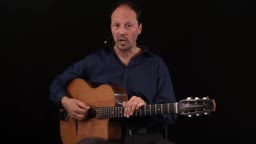
I'm Reinier Voet, welcome to 50 Gypsy Jazz Licks You MUST know. Gypsy Jazz is a unique dialect of jazz that has its roots in the American jazz and its Gypsy interpreters in France. This specific style was in fact invented by guitarist Django Reinhardt in the 1930's. Django was a Gypsy and travelled through northwest Europe with his family, consisting of professional musicians and dancers. In the 1930's Django’s family lived in France where Django discovered jazz by hearing Louis Armstrong and guitarist Eddie Lang with violinist Joe Venuti.
Django mixed this new music from the USA with the music he used to play in that time: French chansons and valse musette / accordion music.
He started his Quintette of the Hot Club De France and shaped Gypsy Jazz into a popular and exciting new style, with a prominant role for the acoustic guitar.
In the last 15 years we've seen a phenomenal revival of Gypsy Jazz with players like Stochelo Rosenberg, Jimmy Rosenberg, Fapy Lafertin, Biréli Lagrène, Boulou Ferré, Häns’che Weiss, Angelo Debarre, Wawau Adler, John Jorgenson and Frank Vignola among others.
In these 50 Gypsy Jazz licks we'll look at all the basic elements that create the Gypsy Jazz sound.
Gypsy Jazz guitar can be played on ANY acoustic guitar, whether it has a pickup or not. But electric jazz players can also season their solos with these intensely flavored licks and their romantic tone.
Gypsy Jazz has had a lasting influence on other jazz guitar players, like Joe Pass, Rene Tomas, Les Paul, Philippe Catherine and Jim Hall - who even named his dog after Django. And they say that even Charlie Christian copied Django's solos.
Within the Gypsy Culture musical skills and knowledge are handed down from Master to Student in direct contact. The Master plays and the student sits across from him and emulates what he hears and sees. Theoretical knowledge is limited and there are no Gypsy Guitar schools.
You learn by doing and by copying.
This style of learning is very labor intensive but extremely musical. Your ears and eyes will tell you what sounds good. And what sounds good, IS good.
What we'll do in this course is similar, but with the help of modern techniques. For efficiency reasons I will play these Gypsy Jazz licks for you AND explain some of the theory and techniques behind them.
But the main goal remains to make music with your ears and eyes. Use these licks as a jump board to create your own solos and improvise with with all these Gypsy Jazz elements. Let yourself be inspired by Gypsy Jazz, like I was inspired myself.
Lets start swingin'.
In gypsy jazz the rhythm guitar is one of the recognizable components. In this section we'll discuss ‘LA POMPE’, playing rhythm guitar in a gypsy jazz group.
Sometimes a bit of variation in your accompaniment is nice to hear and nice to play. But don’t exaggerate! Here is an example in the key of G major.
This one is for the rhythm player. It is also possible to add extra chords in tunes in a minor key. In gypsy jazz there are many tunes in a minor mode!
Although Django himself didn’t record any Gypsy bossa at all, it is a quite popular rhythm that is often played in Gypsy jazz guitar land.
There really is only one tune in Gypsy jazz that uses a bolero rhythm; the Troublant Bolero, a standard in Gypsy jazz.
Because Gypsy jazz is mostly played on an acoustic guitar, you have to make your own tone and your own volume. In this section we'll discuss the plectrum: our indispensable picking tool!
From chord shapes, to picking techniques, an array of arpeggios that gives you that gypsy jazz vibe. Very well structured course
A
Addahia
Verified buyer
01/17/25
Pure gypsy sounds
Grate course, grate teacher and a must if you have done his other introductory courses to gypsy jazz. Also, this licks can be very helpful if you are also studying BeBop.
V
vcmvcm
Verified buyer
11/28/22
A new world of leads
The have really help broadened my lead and melody playing.