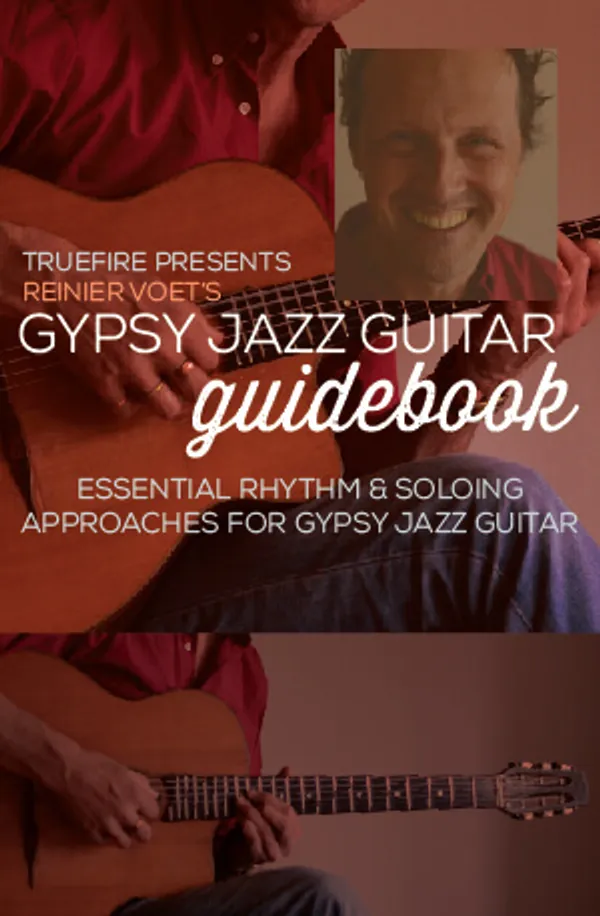

Gypsy Jazz Melodic Soloing Guidebook

Create Compelling, Melodic Gypsy Jazz Guitar Solos

Marty FriedmanTommy EmmanuelSteve VaiEric GalesEric Johnson

Get this course and 1,000+ more with All Access

Try 14 days free. Cancel any time.

Purchase Individual Course for $14.99
Gypsy Jazz Melodic Soloing Guidebook

About this course

Building a strong melodic solo is one of the most important skills an improviser needs, especially when soloing in the Gypsy Jazz style. You need to use solid building blocks to structure and present your solo into a seamless, engaging story that your audience will want to listen to.

Master Gypsy Jazz guitarist, Reinier Voet will focus on this essential skill here in the Melodic Soloing In Gypsy Jazz Guidebook Reinier will demonstrate how to use the melody of the tune as an inspiration and then embellish it with a variety of improvisational tools and techniques. You’ll learn how to spice melodic solos up with minor6th arpeggios, chromatic runs, tritone substitutes, diminished runs, and much more.

”I'll show you some standard melodies and offer you several ways to construct a strong melodic solo. These solo performance studies will give you a solid grip on all the key concepts and you’ll learn how to be more creative and flexible in your solos. And, they're all great technical guitar etudes and you’ll find them a lot of fun to play!”

For each of the five performance studies, Reinier will focus on and demonstrate key Gypsy Jazz guitar techniques and concepts and then perform a solo applying those techniques and approaches in play.


Reinier will explain and demonstrate all of the key concepts and approaches along the way.  You’ll get standard notation and tabs for all of the performance studies. Plus, Reinier includes all of the rhythm tracks for you to work with on your own. In addition, you’ll be able to loop or slow down any of the videos so that you can work with the lessons at your own pace.

Grab your guitar and let’s get gypsy with Reinier Voet!

What you'll learn

  • Navigate the fretboard using chord shape visualization
  • Apply chord substitution concepts to create lick variations
  • Combine melody, arpeggios, and licks into cohesive improvisations
  • Create thematic solos using repeated intervallic patterns
  • Extract melodic motifs from original melodies and use them as improvisation material
Release date: 09/21/2018 • 1h 34m runtime
Start Course
Sample lessons
Swinging Minor
Swinging Minor
Concept: m6 Arpeggios
Georgia in Town
Georgia in Town
Concept: Tritones
This Thing!
This Thing!
Concept: Diminished
Clouds
Clouds
Concept: Arpeggios

What's included

20 lessons • 19 charts • 19 Jam Tracks

Melodic Soloing In Gypsy Jazz Guidebook
Hi, I'm Reinier Voet, and welcome to Gypsy Jazz Melodic Soloing Guidebook. Building a strong melodic solo is one of the most important skills an improviser needs, especially in jazz and its European brother gypsy jazz. In this course, we'll work on developing solid building blocks to structure your solo into a story that people will want to listen to. We'll look at concepts like using the melody of the tune as an inspiration and add your improv tools and techniques to spice it up. You can also embellish the melody with minor 6th arpeggios, add chromatic runs, use tritone substitute and diminished runs, apply standard licks or solo with chord tones. These are techniques that you can use in almost any song.

I'll show you some standard melodies and offer you several ways to construct a strong melodic solo. These example solos will get you a solid grip on all those concepts: Instead of running on automatic, you'll learn to become more creative and flexible in your solos. And, they're great technical guitar exercises and fun tunes to play.

As always, this course comes with tabs, backing tracks and extra information. Let's get busy!
Swinging Minor
When you're able to find and play the most common minor 6th arpeggios and their fingering, it will give you a lot of possibilities for soloing over minor progressions. As mentioned before, minor 6 arpeggios give you that "gypsy jazz guitar" sound. So, any place where a "normal" minor chord is played, use a minor 6 arpeggio in your solo.

Another interesting application of the minor sixth is as a substitute for a dominant 7th chord. For example, play a B6 arpeggio over an E7 chord, which results in a E7/9 sound. The similarity between the Bm6 chord and the E7/9 chord is quite clear. Just look at the chords!
Swinging Minor
Because the tune "Minor Swing" consists of just a few chords, with each chord lasting two bars, it's relatively simple to apply some chromatic lines to.

I'll demonstrate variations on this concept in the following example solo. I start with some lines over one chord, for example, A minor. But, I also use chromatic movement from a chord note going to a note of the next chord - for example, A minor to D minor.
Swinging Minor
Another way to play over "Minor Swing" is to use tritone substitutions. First of all, you need to know how the tritone works. I'll give a detailed description of tritone theory later in the course in the "Sweet Georgia Brown" example. Make sure you listen to this as well in order to really understand how to apply this concept.

Let's keep it very simple: The tritone is a substitute for a dominant 7 chord, and the function of a dominant 7 chord is, normally, to resolve to the next chord. To increase that tension, making the "wanting to resolve" sensation even bigger, you can replace the original dominant 7 chord for it's tritone. The tritone is a flat 5th lower (or higher) than the original dom. 7 chord.

For example: Instead of E7, you can use Bb7 to go to A minor, or to resolve to D minor, you can use the tritone Eb7 instead of the A7. Even if the rhythm section doesn't play an A7 chord, you could "imply" it for 2, 3 or even 4 beats. This will make the resolution towards D minor even more clear. Just try it. Don't be afraid of anticipating a chord that is coming up in the next bar. It will make your lines even more interesting. Most of the jazz greats use this throughout their solos.
Georgia in Town
In this solo example, using only the first half of the chorus, I will start by playing the original melody. But, since there is enough space left for some improvisation, why not fill the remaining two bars with some arpeggios to illustrate the harmonies?

Have a listen first, play the example, and last but not least, have a look at your fretboard so you can start recognizing the arpeggio patterns. This will also make it clear where the melody is placed within the changing chords, but knowing this will allow you to play more melodically of course!

As you will notice, playing the melody and embellishing with some arpeggio lines already makes it kind of a solo. Or rather, a variation on the song "Sweet Georgia Brown". It does NOT sound like you're playing chord/scale patterns spelling out the harmonies of the piece. It is much more musical, and that's the whole idea!
Georgia in Town
Just like dominant 7 chords, diminished chords are made for resolving. "Sweet Georgia Brown" is full of 7th chords, so here we go!

First have a listen to the sample, and you will immediately recognize the gypsy jazz guitar sound. I will explain later on how it works.
Georgia in Town
The use of the tritones gives you a sound which is distínctly "jazzy". It's an easy way to alter dominant 7 chords, making them sound hip and a bit dissonant. Have a look at the explanation about the tritone in the section about "Minor Swing".

In this example, I apply the tritone concept in the same way. Of course it sounds different, because it's another piece. But, the same principles are being used. Have a listen to my example.

+ 13 more lessons

Start Course

Reviews

21 results

Frank U.

02/12/26

Great Course!

Love it. So much "stuff" to get your teeth - or plec - into. Well, done
jmillerc2

Verified buyer

05/02/25

Highly recommended

Cool course. Good review of minor 6 arpeggios, diminished arpeggios and more. Teacher is clear and an inspiration.

iruelafr

Verified buyer

01/14/25

Great teacher, great lessons in the french style of playing Gypsy Jazz

Reiner Voet, is an excellent teacher with great tips and examples that are very helpful for internalizing the true feel and attitude of this magical genre of music. What I love about all these Gypsy Jazzers is their respect and acknowledgement of the master of masters: Django Reinhardt

normalized

Verified buyer

09/16/24

Good overall intro

Good deliberate coverage of the gypsy jazz style. Examples given of topics like arpeggios, Tritons sub, diminished runs, etc. straightforward and usable examples. This is very much an intermediate to intermediate advanced level course. You need a fair overall good survey of gypsy jazz soloing concepts.

tguyfr

Verified buyer

01/08/22

Excellent course about this particular style of jazz. Bravo !

Stop searching. Start improving with All Access.

Try 14 days free. Cancel any time.