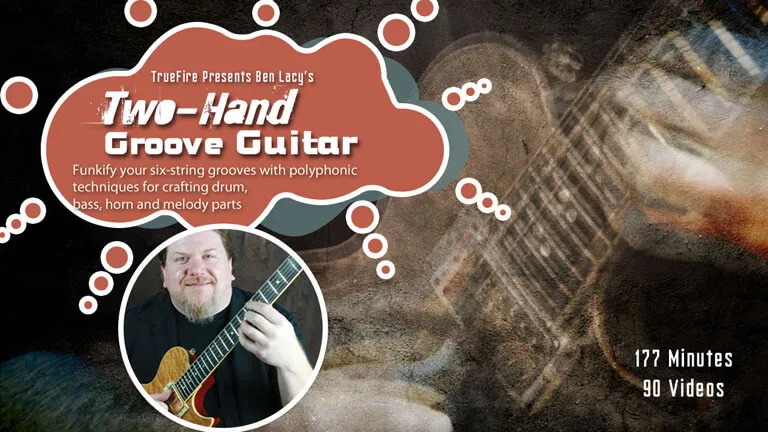
Two-Hand Groove Guitar

Funkify your six-string grooves with polyphonic techniques

Marty FriedmanTommy EmmanuelSteve VaiEric GalesEric Johnson

Get this course and 1,000+ more with All Access

Try 14 days free. Cancel any time.

Purchase Individual Course for $9.99
Two-Hand Groove Guitar

About this course

Hire a bass player for the gig: $150. Hire a drummer: $150. Hire a horn section: $75 a man. Play all of the band parts yourself: Priceless.

No, we're not talking about one of those evil little midi-crap machines that cats are using instead of real players 'cause gigs just don't pay what they used to. We're talking going solo on guitar and funkifying your six-string grooves with polyphonic techniques for crafting drum, bass, and horn parts a la Ben Lacy and his Two-Hand Groove Guitar technique.

If you're familiar with Ben Lacy, we probably had you at 'hello' and you're already downloading the course. For the rest of you, let's put it this way -- go to the big NAMM show or any major guitar festival; look for the biggest crowd of people; fight your way to the front of that crowd, and you'll find Ben Lacy playing his extraterrestrial you-know-what off. You won't believe your eyes and ears.

"Lacy's technique is so mind-boggling it really needs to be seen to be believed. He is a one-man band, providing his own bass and percussive parts while simultaneously laying down rhythmic chords and melodies."

Indeed, Lacy does things on guitar that no other living thing on this planet even comes close to pulling off. In fact, we couldn't come up with a technique category to even classify what he does. So, to be straight up about it, we can't promise you that Two-Hand Groove Guitar will impart everything you need to know to play like Ben Lacy. Nothing short of a mind-meld will accomplish that.

We can however promise that you'll learn to incorporate some of Ben's techniques into your own playing with powerful results. You'll also learn to craft and maintain majorly funky groove in any tune that you apply these techniques to. Plus, Ben gives you a peek under the hood of several of his signature tunes and arrangements.

Ben starts you off with right and left-hand techniques for working drum parts into your playing. You’ll learn how to make snare, kick, hi-hat and various drum fill sounds using just your fingers, strings and fretboard. Once you have the basic techniques down, Lacy shows you how to integrate triplets, quads, polyrhythms and 8-stroke rolls for maximum groove.

To fill out the rhythm section, Ben then shows you left-hand techniques for playing bass lines with hammer-ons on the lower strings. You'll get a grip on this pretty quickly but the challenging part is playing those bass lines along with the drum sounds -- no worries, this too will come relatively quickly once you get comfortable synchronizing the two techniques. You'll find a million ways to spice up your tunes, arrangements and solos with these moves and this alone is worth the price of admission. But there's more.

What better way to funk up a groove than to add a horn section? Lacy drills down on right and left-hand techniques for fingering, plucking, smacking and brushing chords on the high strings to emulate a horn section. Pulling this off while playing the drum and bass parts is a crazy multi-tasking finger-twisting feat but this is still within the realm of possibility for we mere mortals.

So what's the rub? Melody and soloing on top of all of the above. Fortunately, Ben spares us this seemingly impossible task in Two-Hand Groove Guitar. His attitude, which we wholeheartedly support, is that students should first focus on getting their groove on by working the drum, bass and horn techniques until that muscle memory becomes automatic. Once that happens, the melody and soloing will emerge with practice. OK, years and years of practice.

Need a good reason to pick up Two-Hand Groove Guitar?

1. Just to look behind the curtain and see how Ben does it.
2. To incorporate amazing sonic qualities in your own playing.
3. To prove us wrong and learn how to play just like Ben.

What you'll learn

  • Develop pocket and groove in a play-along context
  • Build coordination between different guitar techniques
  • Build muscle memory through slow repetition
  • Develop patience and discipline in slow practice
  • Develop ability to practice complex rhythms at slow tempos
Release date: 03/24/2012 • 2h 57m runtime
Start Course
Sample lessons
Section 1: Drum Sounds
Overview
Finding Snare Sounds
Basic Drums Sounds
Basic Beat Play-along #2
Basic Drums Sounds
Rosanna Groove Intro
Basic Drums Sounds

What's included

90 lessons • 4 charts

Two-Hand Groove Guitar
Welcome to Two-Hand Groove Guitar. I'm Ben Lacy, and I'm going to show you a style I've developed I call Two-Hand Groove Guitar. I've been playing since I was 7 and I've always been moved by a good groove. My style incorporates ALL of the elements of great groove: drums, bass, guitar, horns.

I'm the kind of guy who when he hears something great, I just gotta learn to play it. So at different times I found myself thinking like a drummer, then like a bass player, keyboard player, horn player - and I bring all that together on one guitar. I'll be showing you the techniques I use to get these sounds, from hammer-on and pull-offs to slapping, brushing and plucking the strings and even ringing keyboard-like pads and horn stabs..

First I'll show you how to emulate an entire drum kit with your guitar. Then we're going to add some great baselines, and then spice it up with some tasty chords. So get your guitar and get ready to get your groove on. We're going to have a lot of fun.

Section 1: Drum Sounds
Let's start off with percussion. I'll show you how to find a great bass drum sound, then snare, hi-hat, and tom-toms - even sound like you're going across them!

I want to get you thinking like a drummer and even think of your guitar as a drum kit. I'll show you my techniques, and then we'll have some play-alongs so you can try them with me. They'll be at friendly tempos so don't worry.

Finding Kick Drum Sounds
I begin by showing you how to find a cool kick drum sound, using either hand. First, mute the strings with your left hand index finger. Drape your finger where you don't hear a harmonic. Hit the strings with your left hand middle finger, or your right hand thumb.

Be sure to hit the string strong enough to get a good sound, but not too hard. Don't kill it! If you use your thumb, don't lift it too far from the string.

Finding Snare Sounds
Now the snare. We usually hear it on beats 2 and 4, the backbeat. Mute the strings with your left index finger, then snap a string.

I get that snap by grabbing the string underneath and pulling up then letting it snap back. Don't pull too hard, because you might pull the string right off your guitar! Just enough to get that snap sound but not too soft.

The D string is my favorite sound, but try the other strings too.

Basic Beat Play-along #1
Play along with me using the basic beat. Bass drum on 1 and 3, snare on 2 and 4.

We'll use both right and left hands for the bass drum. Just follow me. Remember to dial up some reverb for a good sound.

Basic Beat Play-along #2
Here I up the ante on the kick drum pattern. It's a bit more challenging for you, a chance to get groovin' a little bit.

Remember to try both left and right hands on the kick. Notice the different tone each hand gives it. Experiment with this!

Adding the Hi-Hat
Here's some finesse for your drumming. Excellent drummers use the hi-hat well. Use less volume than with your kick and snare. It's a subtle thing.

I use an alternating down-up stroke with my thumb on the A string to fill in between the kick and snare hits. Use the "meat" of the thumb.

+ 83 more lessons

Start Course

Reviews

9 results

ninor

Verified buyer

08/19/20

New ways

Two Hand ,very good structured lessons.Supergroovy and very much fun to learn.Thank you
JBarnes01

Verified buyer

07/19/20

An easy to use series of tutorials on a part of playing rarely touched by other instructional products. A must-have for any Ben Lacy fan or guitarist in general

Lairdey

12/19/19

A One Man Loop Machine

I could probably spend a lifetime trying to cultivate the knowledge of a musician like Ben Lacy. Ben is a stellar guitarist, but he's more than that. He's a musician's musician. This is demonstrated by the fact that he has clearly spent quite a bit of time paying attention to the framework of the songs he plays. He has a very disciplined attention to detailing, arrangement, and composition. To this day, I've never heard anyone quite like him. If you want to stretch your ears and broaden your horizons, check this one out. You won't regret it!

sm5574

10/31/18

So much to learn!

"Late intermediate"??? LOL! This is the pinnacle of solo electric guitar. Acoustic guitarists have long enjoyed the ability to use their instrument as a cajon, but electric players had to be content with throwing in an independent bass line or so. The idea of adding significant levels of percussion was simply not realistic. Until now. Ben Lacey's technique is nothing short of jaw-dropping. This course covers the basics of how he gets his sounds, but I would say that you need to be a pretty advanced solo guitarist already to be able to take any of this beyond the bedroom and into a public gig. This is NOT easy stuff AT ALL. I can only imagine the time Ben put in to get to where he is. I would also caution that certain guitar setups will not work well with this approach. You need to be able to slap a finger against your strings without the strings hitting any frets. If you have super-low action, you may be frustrated that you can't get beyond the first lesson. I have two electric guitars, and only one works well for this course. So if you have seen Ben do his thing and realize that's where you want to be, this course is the path to get you there. Ben's ready; are you?

pa

10/22/18

R-evolution

afteer seeing him on youtube decided also to buy this course on truefire it's a revolution, pretty challengin' also for the expert, but it's a way to play and thinking to guitar (classical, electric and acoustic) in a different way. PS If you love funky this help)))

Stop searching. Start improving with All Access.

Try 14 days free. Cancel any time.