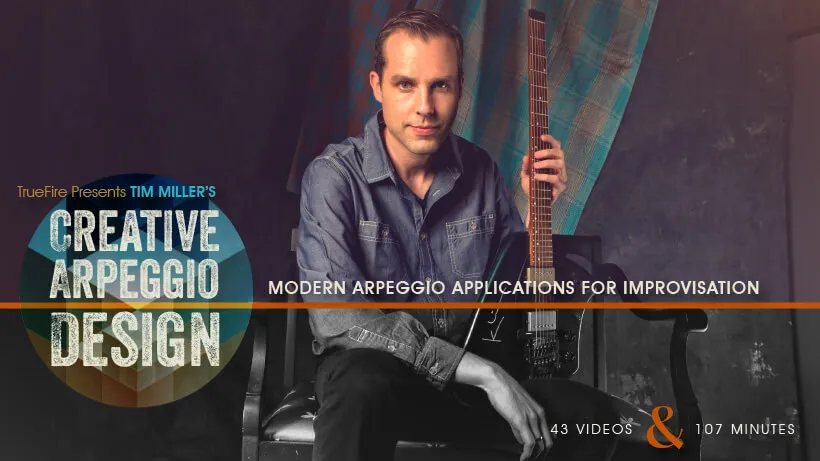
Everyone learning improvisation is correctly advised to start by mastering their scales and arpeggios. Of course, the challenge is learning how to improvise without sounding like you’re just running those scales and arpeggios up and down the fretboard. That can be a very time consuming and frustrating process without a clear and accessible approach. Tim Miller’s Creative Arpeggio Design system is a proven, extraordinarily easy solution developed specifically for guitar players.
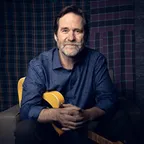
Tim is currently a Professor of guitar at Berklee College of Music. Guitar Player magazine characterized his playing as “pure melody consciousness with remarkable control, and a breathy, violiny tone.” Tim is also a gifted player who has performed and recorded with Dweezil Zappa, Randy Brecker, Mick Goodrick, Mike Stern, Gary Burton, Eddie Gomez, David Liebman, George Duke, and many other world-class artists.
We’re very proud to welcome Tim to the family with his first TrueFire course, Creative Arpeggio Design. ”In this Creative Arpeggio Design course, I’ll show you three new arpeggio fingering templates -- all of them structured with 2-1-2-1 fingering patterns, which not only make the patterns super easy to learn, they’ll enable you to play them with great speed.
I’ll show you how to easily modify those patterns to fit any chord, in any key, anywhere on the fretboard. Once you become fully familiar with these fingering templates, you’ll be able to craft endless creative variations to power your improvisations with.”
Tim organized the course into three main sections. In the first section, The Foundation, Tim steps you through six lessons, which reveal the fundamentals of his Creative Arpeggio Design system: Origins Of The System, Three Arpeggio Shapes, Fingering Tips & Options, Applying The Shapes to Scales, Hybrid Picking Approaches and Your Ears & Creativity.
In the second section, Scale Examples, Tim shows you how to adapt the three arpeggio shapes that you learned in the first section to eight of the most useful scales to craft creative arpeggios for your improvisations.
Tim presents an Overview, an Improvisational Performance Example, and then a Creative Approach Breakdown for: Minor Pentatonic Arpeggios, Major Scale Arpeggios, Dorian Scale Arpeggios, Phrygian Scale Arpeggios, Lydian Scale, Mixolydian Scale Arpeggios, Aeolian Scale Arpeggios and Locrian Scale Arpeggios.
In the third and final section, you’ll work through four Application Etudes: 2 5 1: C Etude, 2 5 1: Two Keys Etude, Modal Progression Etude, and a Jazz Blues Etude. Tim overviews each Etude and then demonstrates the application with a performance over rhythm tracks. The Etudes are designed to help you learn how to apply the arpeggios and approaches from the system when improvising over real world progressions.
All of the Etudes are tabbed and notated for your practice, reference and study purposes. You’ll also get Guitar Pro files so that you can play, loop and/or slow down the tab and notation as you work through the lessons. Plus, Tim generously includes all of the rhythm tracks for you to work with on your own.
Grab your guitar and let's spark up some creative improvisations with Tim Miller!
What you'll learn
Apply 2-1-2-1 arpeggio fingering patterns
Improvise over Aeolian mode using arpeggios
Improvise using Phrygian arpeggios over a modal vamp
Extract intervals from arpeggios for creative improvisation
Transform arpeggios into flexible note groups rather than rigid patterns
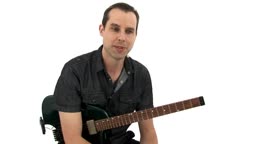
Hi everybody, I'm Tim Miller and welcome to Creative Arpeggio Design, a unique concept and technique that I have developed for playing and creating my own arpeggio shapes on guitar. This course will help you to break out of the traditional shapes and techniques for playing arpeggios. By using my 212121 arpeggio templates combined with hybrid picking, you'll be able to craft your own unique arpeggios all over the fretboard.
The goal is to play arpeggios anywhere on the guitar effortlessly, at any tempo, with any combination of notes that you can imagine. Using a combination of picked notes and hammer-ons & pull-offs, you'll be able to play unique arpeggios for any harmonic situation. Alright, grab your guitar and let's get started!
In this section, we're going to talk about the three fundamental 212121 arpeggio shapes that will serve as the basis for this entire course. I'll show you the shapes, then demonstrate how to apply these shapes to scales to design your own creative arpeggios. We'll also learn a unique hybrid picking technique that will allow you to play the arpeggio shapes with great speed and accuracy.
The origin of this technique came out of my desire to play like piano players. I would hear these percussive, yet smooth arpeggio sounds from my favorite players, but was unable to play with the same speed and articulation on guitar. Through experimentation and a desire to create this sound, I created my own technique for designing and playing arpeggios.
Here are the three basic shapes. I'll discuss each shape, then demonstrate how to play each one at a nice, slow tempo. Start slowly with these, then gradually increase the tempo. Spend some time working with this section before moving on, as the concepts presented here are the basis for the entire course.
Here are some ideas on fingering 212121 arpeggios. Specifically on the fingering #2 shape, here are some ideas on playing cleanly and clearly without rolling the fingers on your fretting hand.
Let's look at how to apply the 212121 shapes to any scale. When you apply a 212121 shape to a scale using a creative approach, you can design your own unique arpeggio shapes:
1. Choose a scale. 2. Apply any of the three fingerings to the scale. 3. change the notes to fit the 212121 shape.
In this section, I'm using an A Lydian scale to design 3 new arpeggios.
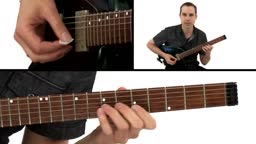
I use hybrid picking to achieve speed and clarity with 212121 arpeggios. Here's a detailed demonstration of my picking technique.
This course is awesome! The arpeggios sound modern, not neoclassical, and as Tim puts it, "It's a great sound!"
R
romeley
Verified buyer
04/18/26
Great for improving arpeggio and overall fretboard skills.
A really good course. Techniques are well explained and offered in a context that made sense (to me) and thus helped in them “sticking” and becoming part of my evolving skill-set and style.
Tim has a great, engaging style which keeps the lessons fresh.
E
ericbsoriano
Verified buyer
12/24/24
Fresh approach for playing arpeggios
This course offers a fresh approach to playing arpeggios. Tim Miller's teaching style is very clear. The course shows a practical approach to playing fast or melodic arpeggios. Spice up your playing with this course.