Guitar Player Wanted: Vocals A Plus

Vocal instruction for guitar players and other musicians

Marty FriedmanTommy EmmanuelSteve VaiEric GalesEric Johnson

Get this course and 1,000+ more with All Access

Try 14 days free. Cancel any time.

Purchase Individual Course for $19.99
Guitar Player Wanted: Vocals A Plus

About this course

Close your eyes and imagine being in a happy place. Breathe deeply and slowly. Feel yourself sinking down, shutting down. You’re resting comfortably in a deep peaceful state of sleep. Now, go back to your early childhood. You loved to sing. Remember what fun that was and how natural that felt? You sang your heart out those first few years. Unabashed, unbridled song all day and all night.

Then that creep in the playground made fun of you in front of your friends, everybody had a good laugh, and it all shut down. Not another note was sung. Your confidence cracked in that moment of self-consciousness. You accepted that you just weren't cut out for singing. Perhaps even tone-deaf. Wrong! Erase that playground incident from your head. Wake up now -- You CAN sing!

Of course you can sing. You couldn’t play guitar if you were truly tone deaf. You just haven't learned how to control and ‘tune’ your voice like you would any other instrument. According to researchers, the vast majority of people who claim they can’t sing, simply don’t sing because someone in their past either made fun of them or told them they couldn’t sing.

According to research conducted for the Acoustical Society of America, 90% of people can indeed hold a tune and 100% can nail the timing of a given melody. Yes, you can sing -- you just haven’t developed your natural ability to do so.

Karan Andrea’s Guitar Player Wanted: VOCALS A PLUS is a fast-track singing course designed specifically for guitar players, or any musician who already understands the principles of music. The lessons and vocal exercises presented in the course will set straight whatever misconceptions you might have about singing and get you up and running quickly. Yes, you can sing.

Guitar players in particular enjoy big benefits if they can bring vocals to the table along with their fretboard prowess. Any bandleader will choose the player who can also sing over a player who can’t -- even if the non-singing player has stronger chops. It just makes more sense to have a band member who can sing back-up and maybe even lead a tune or two. So, if you gig or plan to gig, spending time in the shed with this course is a real no-brainer.

While working pros will certainly reap financial benefits from also being able to sing, have you ever met a non-singing guitar player who didn’t wish he could sing a bit at the jams or with the buds or even just alone on the front porch or even?! We ALL want to sing -- its in our blood.

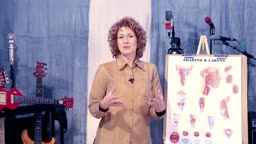
Karan organized Guitar Player Wanted: VOCALS A PLUS into six sections. Section 1 covers the ‘anatomy of the voice’ to provide you with a clear understanding of what makes the instrument work. Not unlike the strings, fretboard and tuning pegs on your guitar, you’ll learn how the larynx, vocal cords, pharynx and other components interact to create sound.

In Section 2, Karan explains the differences and qualities of your Chest, Head and Mixed Voice and how these different voices combine to craft song. Section 3 focuses on breath control and Section 4 on Larynx position.

The fun begins in Section 5 with 22 of Karan’s vocal exercises covering a broad range of essentials: breathing, warm-ups, a cappella, scales, consonant enunciation, vowel enunciation, lip trills and much more. Think of these as a series of workouts to help train your voice, in the same way you would run scales or technique exercises on the fretboard.

Section 6 concludes the course withy answers to 24 of the most common questions that students have about singing and the learning process.

All of the lessons are presented with video PLUS three sets of audio exercises are also included for absolute beginners to more experienced singers, to help develop muscle memory, improve tone, intonation and range.

Yes, you can sing.

What you'll learn

  • Learn proper volume levels for effective vocal practice
  • Understand how chronic sinus problems affect vocal tone
  • Understand the connection between body irritants and mucus production
  • Learn practical solutions like humidifiers and vaporizers
  • Develop vocal range through the 'So So So' exercise
Release date: 06/05/2013 • 1h 40m runtime
Start Course
Sample lessons
The "Zipper"
The "Zipper"
Anatomy of The Voice: 3
Mixed Voice
Mixed Voice
Understanding Your Voice: 4
The Column of Air
The Column of Air
Breath Control: 2
The "Tee Dee Tee Dee"
Vocal Exercises: 11

What's included

68 lessons • 1 charts • 22 Jam Tracks

Guitar Player Wanted: Vocals A Plus!
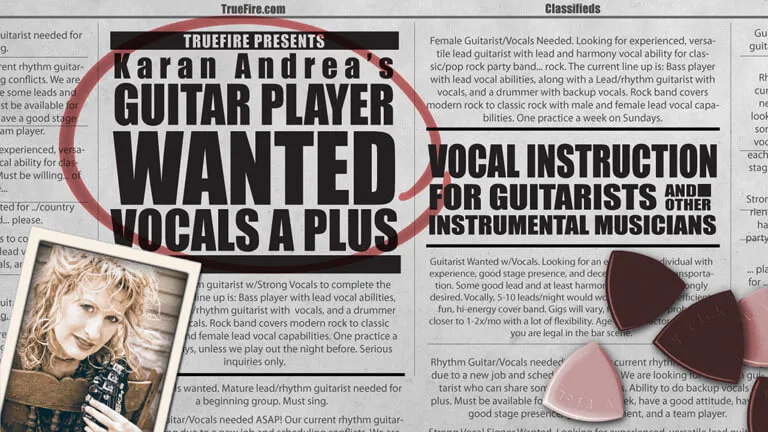
So you've dedicated all your time to mastering your instrument, and then you see ads like these. They make you realize that you aren't that comfortable singing - or are downright terrified. Or worse, you have been told "don't sing - stick to guitar." For most of you, singing is secondary, but to get good gigs, you find that you have to at least be able to sing harmonies, or do some lead vocals, and you aren't sure of yourself. When you step up to the mic, you aren't certain of what is going to come out of your mouth.

This training course is for players who just want the basics. You may be a seasoned player who needs to develop some vocal chops, or you may be a beginning musician who wants to start out with a solid foundation. You will be surprised to learn that the basics are less about singing scales, and more about understanding your voice as an instrument that you can control. If you think about it, you realize that your voice is a fretless instrument that you cannot see. It couldn't get much tougher, could it?

What makes it seem worse is that there is some sort of mysticism surrounding great singers, which certainly isn't encouraging for the rest of us. In actuality, learning to sing correctly is simply a matter of learning to coordinate the muscles involved, and it doesn't mean that you are going to sound like an opera singer. Not at all. You can sing in your own voice, in your own style, with great technique, and sound natural. So we can take the mystery out of it, really.

If your goal is just to become a better background singer, with the odd lead vocal, you do not need intense, formal training, and you don't have to dedicate endless hours to practice. This is not to say that you will never have to practice - you will - but you will not have to invest lots of time to get positive results.

As a guitar player, you have quite a few advantages over non-players who sing. You understand basic music theory and structure. You understand keys, chords, melody, harmony, intervals, keeping time - all those things that a performing musician must know. You can communicate both musically and verbally with other instrumental musicians. For someone not playing an instrument, it is easy to get a little lost in a song during extended jams, or even simple solos, but you always know where you are in the song, and where the vocals should be placed.

You have already done at the very least, passive ear training. In fact, in my experience, guitar players often have much better pitch and pitch recognition than singers do. As an added bonus, you are always holding your pitch reference in your hands. You understand tone, timbre, pitch and resonance as it applies to your primary instrument - the guitar.

All of these are skills that you pick up as you learn to play an instrument. If you are a seasoned player, you will have a great musical foundation to build upon, and you have a better technical foundation than most singers - even trained singers. Why? Because these are not skills that singers pick up even if they have some formal vocal training.

For example, many pop singers have no idea what key they are singing in, or how to communicate musical ideas to their band mates. I use the term "pop" as a catch-all for "popular music" - all the various genres that have splintered out of blues and country of the early 1900s. So when I use that term, understand that I include all the styles you might be working in. Speaking of style, this program is not about singing style; rather, it covers the basics of how to sing. You are going to put the style into it. A song is just a melody, meter, chords and lyrics until you put it into a genre. I encourage you to listen to all styles of music and all styles of singers, and be open to hearing them.

I always loved to sing, but when I started playing guitar and writing songs, I started hearing things in my head that I wanted to do vocally, but I didn't have the chops. This put me on a quest to learn how to sing the things I wanted to hear in my songs. I started with some basic training materials and ended up working with my current voice coach, who has helped me find my own way.

With her guidance, not only has my technique and ability improved, but my understanding of what specifically is going on with my 'instrument' has made it more consistently reliable. This has given me the ability to work through difficult situations, pulling off vocals that I never thought I could. What I have done with this course is distill the concepts and exercises that are the most effective and most beneficial to give you a basic foundation from which to work.

You are a guitar player - you know that instrument. You know how to control its pitch, tone, timbre and resonance consistently. I am going to teach you how to get that same control over your voice, which I encourage you to think of as an instrument just like your guitar - although it requires different care and feeding.

First, I'll explain the basic anatomy or structure of your voice, and the anatomy of the breath. I will cover the basics of breath control. Next, I will explain in more detail the importance of your larynx position with regard to singing.

I realize that these first two parts may seem a little tedious, but trust me. Once you get these concepts, you will know more than most singers do. Then I will explain the exercises I have included on the companion CD. They are in three groups, so you can break them down and work on one section at a time.

SECTION 1
If you understand the anatomy of the voice, you will see that the working components are a set of muscles that you must learn to coordinate. They are essentially the same muscles you use to speak, but you must develop them to a much higher degree for singing. The rest of the components are the breath itself, and the spaces and surfaces in your body and head. These enhance the resonance and influence the tone and timbre of your voice.
The Larynx
Your larynx houses your vocal cords. In men, it is visible as your Adam's apple. In women, it is not. The larynx is at the top of your trachea, or 'wind pipe.' It is important to know that the larynx can move up and down vertically to a slight degree.
The Vocal Cords
Your vocal cords are simply folds of tissue that sit horizontally across the opening of your larynx. It is very important to understand that their movement is to open and close horizontally from the back to the front of your larynx. Almost every untrained singer instinctively reaches 'up' for high notes, when in fact, there is NO vertical movement in your cords at all for high or low notes - it's all horizontal back to front, front to back. Therefore, the note you are singing is determined by how far open (or closed) your vocal cords are, and the tension you create across them. This combination of position and tension is very much like fretting a note on your guitar, except that your voice is "fretless."
The "Zipper"
There is a terrific book by Roger Love called Set Your Voice Free, in which he describes the vocal cord movement as a zipper. This is a pretty good analogy. When you are taking a breath, your cords are completely open, and appear hinged at one end. When you are speaking or singing, the cords are "zipped" together until they are parallel.

The air passing through your cords makes them vibrate, which creates sound. When you are singing low notes, your cords are slightly further apart, and are not pulled as taut. This creates the lower pitches. As you sing higher up the scale, your cords pull closer together, although they are still parallel, and as you sing higher and higher, they stretch to create more tension for your highest notes. So this is the true action of the cords, but Roger Love's zipper concept is a bit easier to visualize.

Think of the lowest notes happening when the zipper is mostly open, and as you sing up the scale, you are zipping your vocal cords almost closed. This gives you a smooth image of your voice sliding up and down scales with no hitches. It is very helpful to visualize this zipper action when you are doing your vocal exercises, and when you are singing. Eventually, as you get more coordinated with the exercises, you will actually feel a sort of zipper action in your cords. When you get to this point, you will begin to have the control you need to sing well.
The Pharynx & Other Components
PHARYNX: This is the passageway of muscle and tissue that provides the connection between your larynx, your mouth and your nasal passages. Its major contribution to your vocal instrument is its resonance.

RESONATING CHAMBERS: Just like an acoustic or chambered guitar, you have resonating chambers in your body and head that shape your tone and pitch. Your throat and mouth (or pharynx as I just described), your nose and sinus cavities, all contribute to your sound.

You also have surfaces that act like soundboards (like the wood top of an acoustic guitar) in your hard palate, nose cartilage and bone structure of your face. As you learn to use these, you will learn to shape your tone much like you do with your guitar and amp.

HARD PALATE: This is bony cartilage that makes up the forward part of the roof of your mouth.
The Soft Palate
Your soft palate is just behind the hard palate. You can feel it if you run your tongue back over the roof of your mouth. Where the hard portion ends, the soft palate begins, and the uvula (which looks like a little speed bag) is at the end of your soft palate.

Your soft palate does move, and you can learn how to raise and lower it voluntarily. This is important, particularly as you sing higher in your range. If you don't raise your soft palate, you can sound flat, even if the notes you are singing are on pitch as they leave your cords. This happens when the soft palate is in the way and affects the timbre of your voice. Another unpleasant effect of not raising that soft palate, is that it can place the sound directly into your nose, and make your tone sound very pinched and nasally. Once you understand the motion and the muscles involved, practice raising your soft palate until you can control its movement both up and down. This won't take too long, but these very small movements give you huge results.

Get in the habit of raising your palate and dropping your jaw simultaneously as you sing higher and higher in your exercises. This will give the tone more space to resonate in. Think about how sound bounces so beautifully in the vaulted ceiling of a cathedral. You are creating that same sort of space in miniature just by dropping your jaw and raising your palate. Remember that its effect on your tone and timbre is quite radical.

+ 61 more lessons

Start Course

Reviews

10 results

tclak

05/28/26

So much gold

This course is fantastic for us guitar players learning to sing. So many useful tips and tricks. Great tutor!

brenANDnoodle

Verified buyer

05/23/25

Great course

Great set of vocal exercises that starts with a comprehensive set of lessons on how our body produces our voice. I’ve been using them for a few weeks and I’ve already seen improvement in the ease of producing good tone quality and intonation.

jfdazas

01/25/22

Exceed my expectations

IMO I have a odd voice, however, however, by doing these exercises on a daily basis, I was able to expand my vocal range and make significant improvements in my vocal technique.

LuigiD

Verified buyer

11/19/20

Exellent! Good course with good exercises to increase singing skills. I think it will be beautiful if there will be more courses like this!

red52

10/31/20

To the point

Here's a neat little course on singing techniques. I like that all the lessons are in very small segments that concentrate on one small objective at a time. Karan Andrea teaches you all the fundamentals to and physiology necessary to improve your voice and singing technique. Karan introduces mic technique and approaches to sound checks. She expands the information to mic feedback and plosives. A solid foundation if you want to learn how to sing.

Stop searching. Start improving with All Access.

Try 14 days free. Cancel any time.