
Essentials: Chord Tone Soloing

Ramp up your improvisational skills with chord tone soloing essentials

Marty FriedmanTommy EmmanuelSteve VaiEric GalesEric Johnson

Get this course and 1,000+ more with All Access

Try 14 days free. Cancel any time.

Purchase Individual Course for $24.99
Essentials: Chord Tone Soloing

About this course

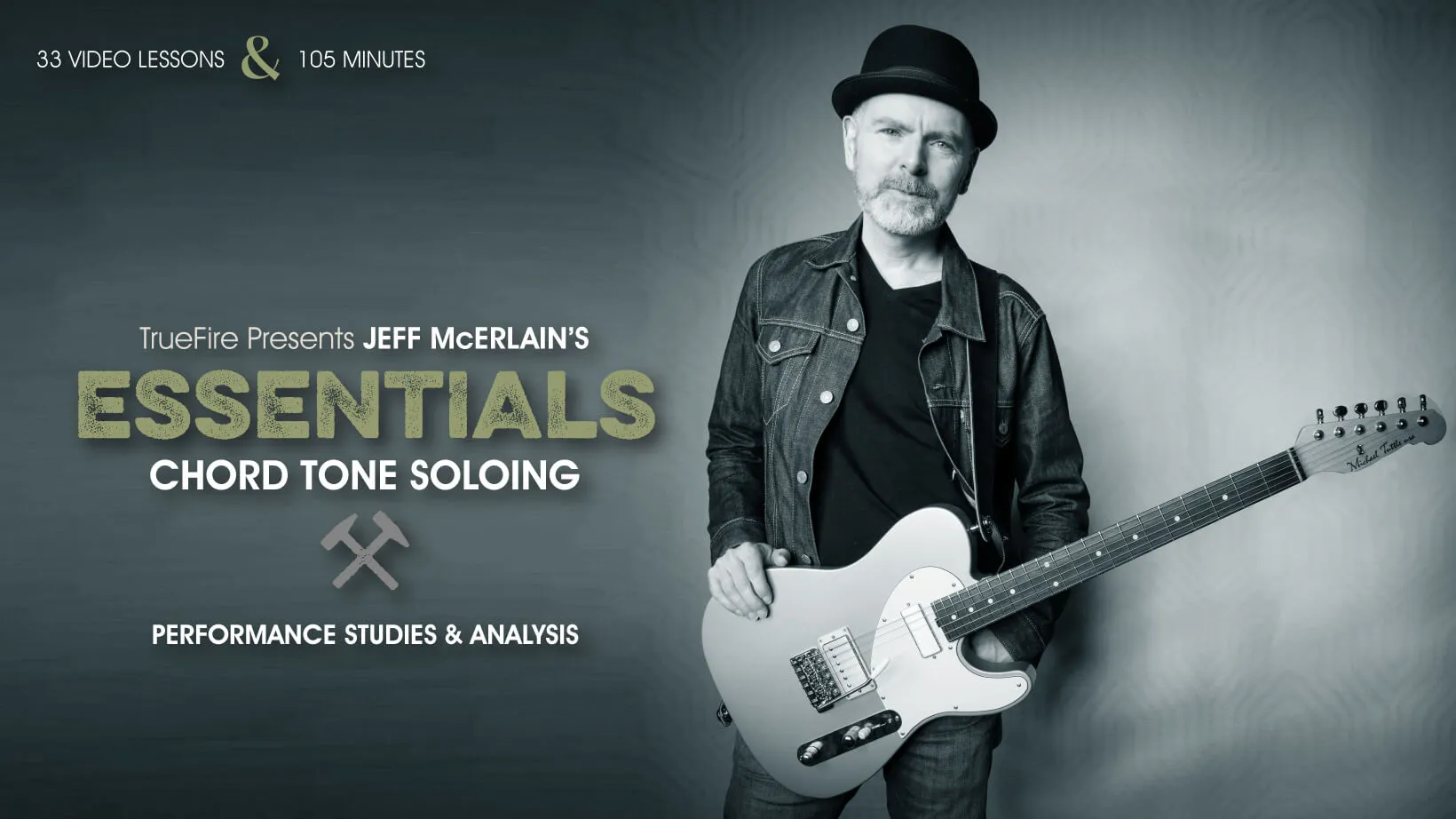
One of the most important improvisational skills is learning how to play over chord changes. This can be very confusing and frustrating for guitarists because there are so many different approaches, some of which are very technical and theoretical. Even some simple three chord songs can be challenging to solo over melodically. One of the easiest ways to overcome this challenge is revealed here in this Chord Tone Soloing edition of Essentials from Jeff McErlain.
"This is probably the best course ever on TrueFire. Love the way Jeff shares his very own "ah-ha" moments." - Ken Keyes, TrueFire Student
”What is chord tone soloing? The simplest definition I can give you is playing the notes of a chord while you're on that chord. As guitar players, we often play "over" the chords, meaning we're playing the proper scale for the progression, but we're not considering each chord as it goes by. Chord tone soloing is the opposite, as we're playing "on" the chord changes. We can treat each chord as its own thing requiring us to play or resolve to the specific notes of that chord.”

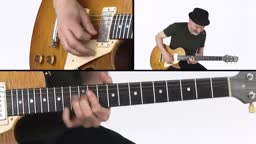
For each of the 10 Chord Tone Soloing studies featured in this course, Jeff will first perform the solo over the jam track in its entirety, and then break it down for you note-by-note emphasizing the essential techniques and concepts in play. All of the solos were constructed using the chord tone soloing approach, and all are played over commonly encountered rock, pop, soul and blues progressions in a variety of keys and styles.

All of the performances are tabbed and notated for your practice, reference and study purposes. You’ll also get Guitar Pro files so that you can play, loop and/or slow down the tab and notation as you work through the lessons. Plus, Jeff generously includes all of the backing tracks for you to work with on your own.

Grab your guitar and let’s build up our chord tone soloing chops with Jeff McErlain!

Jeff McErlain's Preferred Gear

Below is a list of Jeff McErlain's preferred gear including guitars, amps, pedals, accessories, and more. What you see in Jeff's lessons may or may not be this actual gear, but if you are trying to capture Jeff's sound and tone, the gear listed below is recommended by Jeff and it's a great place to start!

Guitars

Amps

Pedals

Accessories & More

What you'll learn

  • Use pentatonic scales for blues soloing
  • Create more intentional melodic solos
  • Learn to target chord tones outside of pentatonic scale
  • Understand how to solo over a minor blues progression
  • Develop skills in blues improvisation techniques
Release date: 03/29/2017 • 1h 43m runtime
Start Course
Sample lessons
Bird Out
Bird Out
Overview
Bird Out
Bird Out
Performance
Bird Out
Bird Out
Breakdown
Highway Key
Highway Key
Performance

What's included

33 lessons • 10 charts • 10 Jam Tracks

Essentials: Chord Tone Soloing
Hi, I'm Jeff McErlain, and welcome to Essentials: Chord Tone Soloing. We've all been soloing over a song and end up hitting a wrong note and wonder why that note, although in the scale, sounds sour or weak. Why is that?

The answer is simple: we're soloing over chords, and those chords each have a collection of notes that form those chords. Usually the best sounding note to resolve to on any given chord is a note contained within that chord, which we call chord tones.

In this course, I'll help you learn how to navigate playing through simple through more advanced chord changes by thinking chord tones as opposed to scales. Of course, scales are important and should be practiced every day, but they're not the be-all and end-all of improvisation. I can honestly say that I've gotten more out of learning my triads and thinking about chord tones when soloing then I have thinking about scales.

I would recommend working through the course sequentially, as it's the way I've designed it. First, we'll learn how to target chord tones on a simple two chord progression can ramp it up from there. I'll perform each piece and then break it down for you, pointing at the chord changes, chord tones, and how to approach soloing with them. Of course, you'll also have all the standard notation, tabs, and rhythm tracks to work with on your own. So, let's get started!
Chord Tone Soloing
What is chord tone soloing? The simplest definition I can give you is playing the notes of a chord while you're on that chord. Pretty simple in theory, but it does require some practice, and don't worry, it's well worth it.

As guitar players, we often play "over" the chords, meaning we're playing the proper scale for the progression, but we're not considering each chord as it goes by. Chord tone soloing is the opposite, as we're playing "on" the chord changes. We can treat each chord as its own thing requiring us to play or resolve to the specific notes of that chord. My first piece of advice is to learn as many chord voicings as you can, because as you'll see, that's what I'm thinking about first. It's important that you know the fingerboard and the notes of each chord, but that takes time. With this method, you can get started on chord tone soloing right away.

This course is in loose difficulty order, but the final tune is by far the most challenging. Have fun and please be patient with yourself, as this way of thinking requires some mental work, but it's worth every synapse you're creating!
Try Sometimes
Let's start with a basic two chord progression similar to The Rolling Stones song "You Can't Always Get What You Want". I've played this tune on many gigs, and it's fun to solo over. The chords are C7 to F, so we're technically in C Mixolydian. Whaaa? Don't sweat it!

Let's start with a C major pentatonic scale, which is C-D-E-G-A, and get comfortable with that. C major is spelled C-E-G and F major is spelled F-A-C. As we can see, all the notes of these chords are in the pentatonic scale except for the F. First concentrate on being comfortable using the C major pentatonic scale.
Try Sometimes
Now that you've messed around using the major pentatonic and feel comfortable with that as a scale over the chord progression, start to think about playing chord tones on each chord while on that chord. Always look for common tones between the two chords, C and F in this case, with the C note in common between both.

It's fairly obvious the song is in the key C, so the next thing you want to look for are the notes that are in the scale and in the chords. For example, the F major chord has the note A in it. A is not a great choice over the C chord, but works beautifully on the F chord. Why? Because it's in the chord! I know that sounds silly, but I didn't think about that for many years. Kind of embarrassing, actually.

So, a simple way to practice this concept is to choose one note from each chord and concentrate on hitting that note on the change. Be very conscious in this effort and don't worry about it sounding musical or not. We're trying to introduce a new concept. It's important when practicing to realize that this may not sound all that musical at first. That's fine. Continue to do this with the other chord tones contained in the pentatonic scale.
Try Sometimes
If we dig a little deeper, now we see that we've still not used the F note on our chord. This will be a particularly strong note, as it's the root of the chord, and it's also outside of our pentatonic scale. Just like you did in the previous section, practice incorporating this note slowly into your playing. Remember, it doesn't have to be musical at first, just get that note into you're playing and under your fingers.

Now let's take it one more step and look at the C chord as a C7 chord. C7 is spelled C-E-G-Bb, so now we can think about adding in the Bb over the changes. If we were to take the notes of these two chords and lay them out alphabetically, we would get a C Mixolydian scale, C-D-E-F-G-A-Bb-C. That's a lot to think about and can often sound very "scaley" when soloing. This is a perfect time to think about chord tone soloing. Repeat this process through all the songs in this course.
Bird Song
Here's a really fun chord progression based off of the Leon Russell tune "Hummingbird". BB King also recorded it, and John Mayer did as well. It's a great tune as it's not quite the blues, but certainly bluesy, and this will allow me to dig a little deeper into chord tone soloing as one scale doesn't really fit all in this case.

Actually, as we move through this course, we'll see that thinking just scales doesn't really do a progression justice. If we look at the melody of a song, I can bet you it's primarily chord tone based. It's very difficult to sing a note over a chord that's not a chord tone.
Bird Song
With this and every tune we approach, I suggest playing through the chord progression using as many different chord voicings as you can. In this performance, I'm very often just outlining those shapes. By familiarizing yourself with those shapes, it's very easy to start thinking about chord tones.

Of course, at some point you want to make sure you know what all those notes are, but as we know, that takes a lot of work. However, we can start right away by thinking shapes. The overall pentatonic scale we can use on this song is in D minor, but as we can see, this doesn't cover all the chords. The second chord in the song is Bb7, so right there we have some great options. For that chord, I'm just outlining the chord by playing its root, Bb. Another song that's fun to jam over is Jeff Beck's "Come Dancing" that just repeats these two chords.

+ 26 more lessons

Start Course

Reviews

47 results

usshermgt

Verified buyer

02/23/26

Great course, clear instruction and aimed at a reasonable level
jeanvanwambeke

Verified buyer

05/06/25

Incontournable !

It is always a pleasure to play and learns some tricks with Jeff McErlains. Thanks to him to improve my play and my library of licks. I am fan !

6v6power

Verified buyer

12/29/24

Great approach and easy to follow!

Dusty11

Verified buyer

12/25/23

Like the way he explains, Essential chord tones is a must buy, Jeff is really a great teather, have a few of his courses. Will definitely get all of them.

Riffster59

Verified buyer

12/23/23

Worth every penny.

The usual from Jeff. Well explained with great presentation.

Stop searching. Start improving with All Access.

Try 14 days free. Cancel any time.