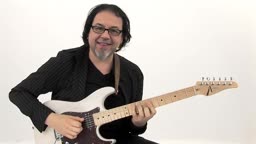
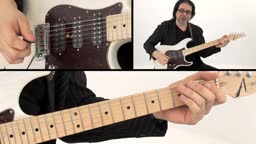
Chord Navigator: CAGED Triads

Instantly Find & Play Triads Anywhere on the Fretboard

Marty FriedmanTommy EmmanuelSteve VaiEric GalesEric Johnson

Get this course and 1,000+ more with All Access

Try 14 days free. Cancel any time.

Purchase Individual Course for $19.99
Chord Navigator: CAGED Triads

About this course

Guitar players spend 90% of their time playing rhythm guitar and yet, we tend to stick to the chord shapes that we’re most familiar with. Of course, this greatly limits our sound palette and stunts our creativity. There are dozens of ways to play any chord, anywhere on the neck, IF you understand how they’re constructed and IF you know how to navigate the fretboard to find and play them.

Rob Garland’s Chord Navigator: CAGED Triads will show you how to quickly and easily construct and play major, minor, suspended, diminished and augmented triads, in any key, anywhere on the fretboard.
"After watching the free videos, I almost made the mistake of passing on this course on the assumption it would not have added much to what I already knew. Boy, was I glad to be wrong! The course is terrific, and I'm only halfway through because I'm taking my time to practice and enjoy each new tool that I acquire. If you have ever thought, 'I know the chords, I know more or less my way around some scales, but I just don't have the fluidity that makes it sound interesting' this is the course for you." - Michael McIlwrath, TrueFire Student
”Not every musician wants a chord chart on their bedroom wall. Yet, how do you make the leap from grasping open chords and one or two barre chord forms to easily memorizing and utilizing other chord shapes? With Chord Navigator: CAGED Triads, you'll quickly understand the theory and application behind creating triads and be able to play your own chord voicings over a wide variety of popular stylized song forms.”

Rob organized the course into three sections: Section 1 examines how to build major triads and covers topics such as learning the notes on the neck, building chords from the major scale, finding major triads throughout the five open CAGED chords shapes, and understanding and creating smaller hip inversions and utilizing them in songs.

Lessons in this section include: String & Note Names, Note Name Exercise, The Major Scale: Key of C, Building Major Chord Triads, The CAGED System: C Triads, C Triad Inversions & CAGED, C Triad Inversions Application, Major Scale & Triad: Key of G, The CAGED System: G Triads, G Triad Inversions & CAGED and Using Triads to Play Changes.

Section 2 takes an in-depth look at minor chords and enables you to play minor triads all over the neck in both large and small voicings. In this section of the course, you’ll learn how three note minor chords (triads) are created and how, by applying the C-A-G-E-D chord system, you'll be able to play minor chords all over the neck.

Lessons in this section include: Building Minor Chord Triads, The CAGED System: C Minor Triads, C Minor Triad Inversions & Application, The CAGED System: G Minor Triads, G Minor Triad Inversions & Application, Using Minor Triads to Play Changes and Combining Major & Minor Triads

Section 3 examines other chord forms such as diminished, augmented, and suspended chords. In this section of the course, you’ll learn how diminished, augmented, and suspended triads are created and how, by applying the C-A-G-E-D chord system, you'll be able to play these chord shapes all over the neck.

Lessons in this section include: Building Diminished Chord Triads, Using Dim & Aug Over Changes, Building Suspended Chord Triads, Suspended Triads Over Changes

Each section explains how to create and apply chord voicings that will enhance the way you play songs and also inspire compositional ideas. The performance examples, within each section, are played over rhythm tracks so that you can hear the chords you create and apply them rhythmically in the context of songs.

All of the performances are tabbed and notated for your practice, reference and study purposes. You’ll also get Guitar Pro files so that you can play, loop and/or slow down the tab and notation as you work through the lessons. Plus, Rob generously includes all of the rhythm tracks for you to work with on your own.

Grab your guitar and let’s navigate our fretboards with Rob Garland!

What you'll learn

  • Navigate fretboard using CAGED system
  • Apply chromatic movement knowledge to navigate the fretboard
  • Use visual reference points to find notes quickly
  • Build minor triads from scales
  • Build a systematic practice routine for fretboard memorization
Release date: 04/18/2016 • 1h 52m runtime
Start Course
Sample lessons
Note Name Exercise
Note Name Exercise
Demonstration
The CAGED System: C Triads
Playalong Session
Using Triads to Play Changes: 1
Playalong Session
The CAGED System: G Minor Triads
Playalong Session

What's included

40 lessons • 28 charts • 6 Jam Tracks

Chord Navigator: CAGED Triads
Not every musician wants a chord chart on their bedroom wall. Yet, how do you make the leap from grasping open chords and one or two barre chord forms to easily memorizing and utilizing other chord shapes? With Chord Navigator: CAGED Triads, you'll quickly understand the theory and application behind creating triads and be able to play your own chord voicings over a wide variety of popular stylized song forms.

The course is broken up into three sections: Section 1 examines how to build major triads and covers topics such as learning the notes on the neck, building chords from the major scale, finding major triads throughout the five open CAGED chords shapes, and understanding and creating smaller hip inversions and utilizing them in songs. Section 2 takes an in-depth look at minor chords and enables you to play minor triads all over the neck in both large and small voicings. Section 3 examines other chord forms such as diminished, augmented, and suspended chords. Each section explains how to create and apply chord voicings that will enhance the way you play songs and also inspire compositional ideas. Examples within each section contain standard notation and tab as well as charts and rhythm tracks so you can hear the chords you create and apply them rhythmically in the context of songs.

Guitarists play rhythm guitar 90% of the time, so break free of limitations and embrace the world of chords. By understanding chord creation and visualizing voicings on the neck, your lead playing will also take on a new lease of life. Whether you're playing in a band, recording rhythm parts in a studio, or just jamming at home, spice up your chord knowledge and eliminate the need to ever again reach for that oversized chord book.
SECTION 1: Major Triads
The major scale contains all the ingredients you need to build chords. In this section of the course we'll learn how three note chords (triads) are created, and by applying the C-A-G-E-D chord system you'll be able to play major chords all over the neck.
String & Note Names
Learning the notes on the neck will help you find and create chords, write songs, and also improve your improvisation skills. Once you are able to find the notes that are used to create chords, you'll have no problem finding your way around the neck and will be able to play all the chords you'll ever need.

You probably know the names of the strings - by using a shortcut such as chord bass-note roadmaps you can visually connect the notes on the neck. For example, look at a C major chord. The bass note 3rd fret on the A string is the root of the chord (C), so if you want to know what note the 5th fret A string is, it must be a whole step up from C, meaning it's a D note. Look for octave patterns, 2 frets over and down from the low E and A strings, and the note will be the same. Move up a fret when looking for your octave using the D or G strings.
Note Name Exercise
Play the same note on all six strings but do not use open strings. Choose random notes. For example: Begin with Bb, then play E, then G#, then D, and so on. You could use a metronome to to fire up that muscle memory and force you to reach for the note. Set it at 80 BPM. Do this every time you pick up your guitar and you'll have the notes down in no time.
The Major Scale: Key of C
Where do chords come from? We'll use the major scale as the basis for finding chords that are diatonic to the key, meaning all the notes in the chords come from that key and therefore that one scale. Example: In the key of C, begin on a C note and play C-D-E-F-G-A-B-C.
Building Major Chord Triads
Major chords are built from the root, 3rd, and 5th of the major scale. If you take the note C as your root note, the 3rd note of the scale is an E and the 5th is a G. Play these three notes together and you have a C major triad. Note that when you play an open C chord you're stacking several of the same notes.
The CAGED System: C Triads
By moving the open chord shapes for C-A-G-E-D up the neck, the same chord can be played in different positions. I'll demonstrate by playing a C chord in the five C-A-G-E-D positions.

+ 33 more lessons

Start Course

Reviews

16 results

BlueFox213

Verified buyer

10/05/25

AWESOME course to learn fundamental triad theory.

After many lazy attempts at trying to learn triads the right way, this was the course that got me to enjoy it and learn it right. Hands down one of the best courses I have purchased on TrueFire (and I have many). Rob is a great teacher!

natdixon

Verified buyer

09/16/25

Spot on!

Exactly what I needed - the overarching map of the fretboard filled a lot of holes in my knowledge. Awesome course!

Nikos V.

02/23/25

An unexpectedly great course!

Great stuff, great teacher, and fun to play exercises! I was supposed to know more of the stuff around CAGED, only to realize how much easier this would have been for me, if I had this teacher some years ago. Thank you :)

magictalong

Verified buyer

07/25/24

Great

Teacher is great, clear and concise. I was able to understand the triads and open app my fretboard knowledge. I also like the application across the fretboard

Domdege

Verified buyer

02/22/23

Great course easy to follow and fun. It opened up the fretboard for me.

Stop searching. Start improving with All Access.

Try 14 days free. Cancel any time.