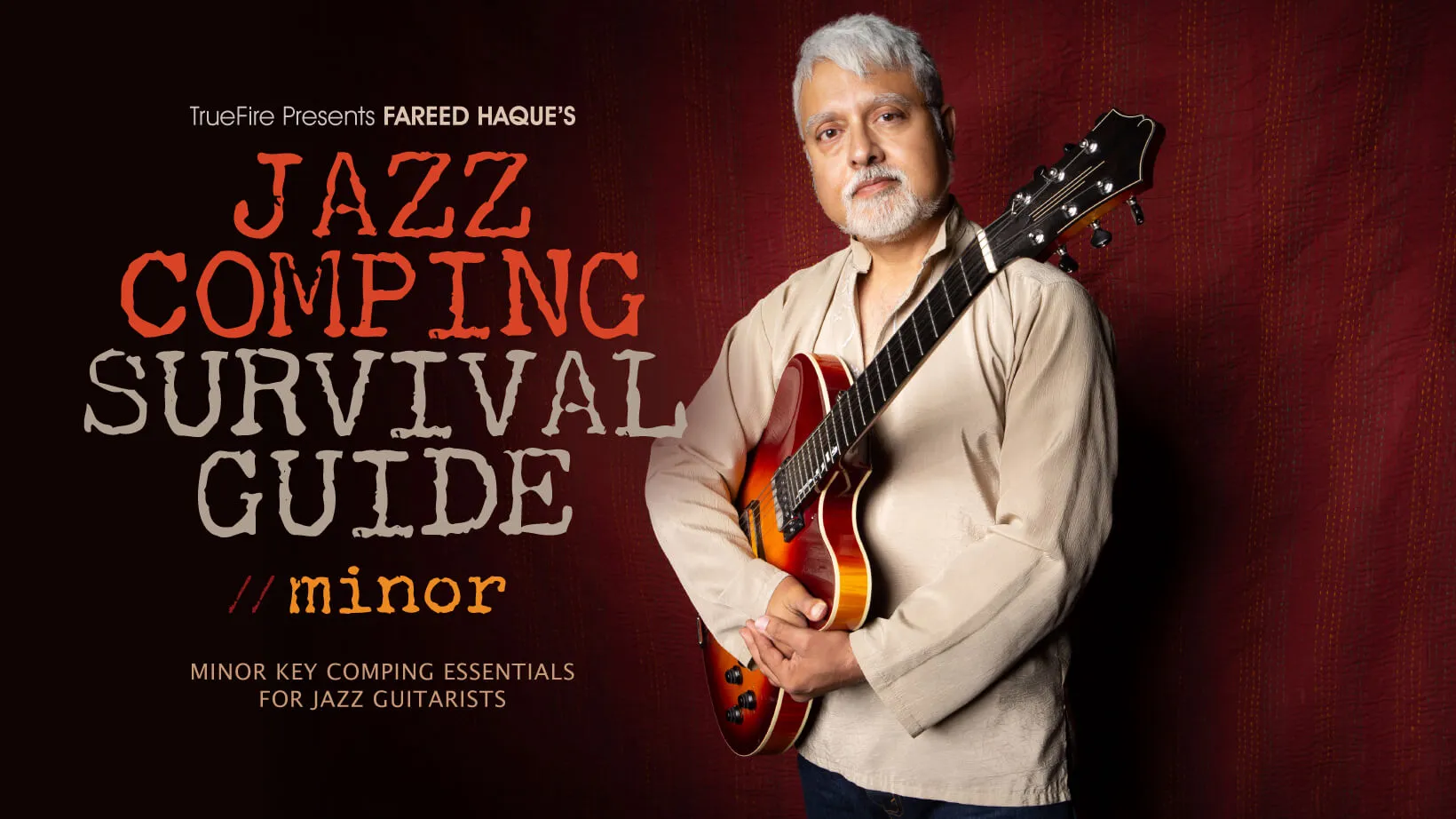
Jazz Comping Survival Guide: Minor

Minor Key Comping Essentials for Guitarists

Marty FriedmanTommy EmmanuelSteve VaiEric GalesEric Johnson

Get this course and 1,000+ more with All Access

Try 14 days free. Cancel any time.

Purchase Individual Course for $14.99
Jazz Comping Survival Guide: Minor

About this course

In the first edition of Fareed Haque’s Jazz Comping Survival Guide, the focus was Major Keys and Dominant Blues. In this Minor edition, Fareed focuses on minor blues, minor turnarounds, and jazz standards in minor keys.

”We’ll work on essential minor key voicings and progressions, then apply those to the most common minor jazz form - minor blues. We'll play these in multiple keys just to make sure you get plenty of practice before heading to the jam session. Finally, we'll use all of the approaches and principles covered in this edition and apply them to a slow minor blues, two medium minor blues, and one beautiful jazz ballad, Angel Eyes. This classic is sung by many jazz singers and is very useful on that coffee house gig, or jazz jamboree.”

Fareed will explain and demonstrate all of the key concepts and approaches along the way. You’ll get standard notation and tabs for all of the key playing examples. Plus, you’ll be able to use TrueFire’s learning tool to sync the tab and notation to the video.

Fareed also includes all of the backing tracks for you to work with on your own. In addition, you’ll be able to loop or slow down any of the videos so that you can work with the lessons at your own pace.

Grab your guitar and let’s comp with Fareed Haque!

What you'll learn

  • Execute tritone substitutions on dominant chords
  • Navigate complex bebop and post-bop chord progressions
  • Create smooth voice leading in chord progressions
  • Apply multiple harmonic principles simultaneously in a turnaround
  • Maintain a melodic top voice while comping
Release date: 09/09/2019 • 1h 59m runtime
Start Course
Sample lessons
The "Granddaddy" Chord Progression
Demonstration
The Core: Guide Tones
Demonstration
"One Chord" Voicing Options
Demonstration
"One Chord" Voicing Application
Playalong

What's included

42 lessons • 18 charts • 8 Jam Tracks

Jazz Comping Survival Guide: Minor
Hi, I'm Fareed Haque, and welcome to Jazz Comping Survival Guide: Minor.

First off, let's clarify that this course is essentially the second volume of the Jazz Comping Survival Guide. Part 1 covers comping in major keys and on the blues, so if you don't have that course, you should probably get it and go through it. But, the main principles are going to be covered here as well, so this course does stand alone. But, get them both to make sure that you can comp in major and minor keys!

In this part of the Jazz Comping Survival Guide, first we will work on essential minor key voicings and progressions, then apply those to the most common minor jazz form - minor blues. We'll play these in multiple keys just to make sure you get plenty of practice before heading to the jam session. Finally, we'll use all we've learned and apply this to one beautiful jazz ballad, "Angel Eyes", a 1946 popular song composed by Matt Dennis, with lyrics by Earl Brent. This classic is sung by many jazz singers and useful on that coffee house gig, or jazz jamboree.

All of the key examples and performances are tabbed and notated, plus you'll get all of the backing tracks to work with on your own. You can loop or slow down any of the videos so you can work with the lessons at your own pace.

Grab your guitar and let’s dig in!
SECTION 1: Minor Keys Primer
In this section, let's review the types of minor scales, and the most basic theory, just so we have a little background on minor keys. We build chords on each degree of a scale, and then create chord progressions by moving from degree to degree of a scale, or scales. So, for example: If we built a chords on the 2nd, 5th and 1st degree of a scale, we can play those chords one after the other and we'd have a 2-5-1 progression (usually notated as II-V-I, note: we use lower case Roman numerals for "minor-ish" chords and major Roman numerals for "major-ish" sounding chords).
Minor Scale Exploration
We COULD get into a lot of fancy theory here, and I'd love to do JUST THAT (just stop by with a bottle of something yummy and a couple of pizzas and we'll have at it), but you DON'T need to know what it is to use it and to play great. Just remember the main bits, and once you have these down then explore the alternative options. Just remember, in minor keys it's all about what you do with the 6's and 7's.

Melodic Minor is the most essential and basic minor scale:
1,2,b3,4,5, Major 6th, Major 7th, 1 or C, D, Eb, F, G, A, B, C
Harmonic Minor
1,2,b3,4,5, minor 6th, Major 7th, 1 or C, D, Eb, F, G, Ab, B, C
Jazz Minor (Dorian mode of major scale)
1,2,b3,4,5, Major 6th, minor 7th, 1 or C, D, Eb, F, G, A, Bb, C
Natural minor (Aeolian mode of major scale) is often associated with classical music and often with heavy metal:
1,2,b3,4,5, minor 6th, minor 7th, 1 or C, D, Eb, F, G, Ab, Bb, C

Practice tip: To get the sound of these scales in your ears and under your fingertips - JAM!! Use each scale and jam on each one until you start to hear 'em...
Building Chords from Minor Scales
OK, this is a little confusing so hang in there.

All chords IN THEORY are built by stacking of thirds (play on a keyboard 1, 3, 5, 7, 9, 11, 13 of any scale and let them sound together.... really, a chord is just a scale spelled out with every other note). We can build a chord on each degree of any scale, so we can build a chord on the 1st, 2nd, 3rd, 4th, 5th, 6th and 7th degree of any minor scale. OK? Still with me???

NOW, in practice we choose the notes we like, and stack them so that they A) sound good and B) are playable.

This is called voicing your chords. We will spend most of this course working on simple, playable and historically useful guitar voicings. But, it's good to know which notes we have to choose from...

So, since every chord is built by stacking of thirds in a scale, and there are 4 minor scale types, IN THEORY there are 4 versions of each of the 7 chords - one from each type of minor scale, with 6th and 7th corresponding to the minor scale type.

So, for example, you could build a Gm "one chord" from the:

1) Natural minor scale: G, Bb, D, F, A, C, Eb (contains minor 6th and minor 7th)
2) Melodic minor scale: G, Bb, D, F#, A, C, E (contains minor 6 and major 7)
3) Dorian minor: G, Bb, D, F, A, C, E (has major 6 and minor 7)
4) Gm from the harmonic minor scale: G, Bb, D, F#, A, C, Eb (contains minor 6 and major 7)

You can do the same for all 7 chords from each of the seven notes in each of the 4 minor scales in all 12 keys: 4 scales x 7 chords = 28 different types of chords in minor x all 12 keys = 336 different chords to learn how to use!!!! ARGH!!!!

The good news for your practice time is that many many of those THEORETICALLY correct chords sound pretty AWFUL. Some are in fact HORRIBLE (as I said, grown men have often ripped their own heads off rather than hear some of the bizarre chords produced in minor keys. I can't even mention what happens to the players...brrrr). So...we stick to the pretty ones:

Commonly used chords in minor keys:

The I chord (1, b3, 5, etc.) in minor keys is usually a minor 7th or minor 6th with added 9th or 11th. Once in while, especially if the melody has a major 7th in it, we play a minor (major 7th) voicing. If you're not sure if the melody has a major or minor 7th in it, it's always safer to play a minor 6th chord. That's why that's our "go-to" voicing.

The ii chord (2, 4, b6, etc.) is usually a 1/2 diminished chord, though occasionally it can be a minor 7 (2, 4, 6, etc). NOTE: 1/2 diminished chords are notated incorrectly as a minor7b5 throughout this course, due to technical limitations of the scoring/tab program. Sorry!

The III chord (3, 5, b7, etc.) is mostly a major 7 chord with added 6 or 9, but once in a while add in the #5 for a cool mysterious effect (3, 5, 7, etc.).

The iv chord (4, b6, 8, etc.) is usually a minor chord but often it can be IV major if we are building from the melodic minor or jazz minor scales (4, 6, 8, etc.).

The V chord is super important to really get familiar with since there are lots of different versions commonly used. Most often, we play a dominant 7th chord with a b9 and b13 that comes directly from a harmonic minor scale. (5, 7, 9, 11, etc.). Other common V chords are the v minor (5, b7, 9, 11, etc.), often used in 50's/60's rock and folk tunes; another cool one to check out is dom7 13 b9 (5, 7, 9, 11, etc.).

VI chord: There are two "VI chords"; one built on a minor 6th note and one built on a major 6th note. The bVI chord is a major chord (b6, 1, b3, etc.), the VI chord of the key produces a 1/2 diminished 7th chord (6, 1, 3, 5, etc.). This one has a very slick, cool sound while the bVI is more of a pretty, gentle sound.

VII chord: Similarly, there are two "VII chords"; one built on minor 7th note and one built on major 7th note of the key. The bVII chord is sometimes a major/dominant chord (b7, 2, 4, b6, etc.), but the VII chord is a fully diminished Chord (7, 2, 4, 6 - from Harmonic minor).

This is important: The vii chord from harmonic minor is the ONLY diatonic place we can build a diminished chord. OK smarty pants, someone is gonna say, "How about the diminished scale??" And I'll say, "Well, that's not a diatonic scale, is it?? IS IT?? Nope, it's a symmetrical scale!" So, save that one for THE symmetrical scale SG!!!

EXTRA CREDIT! This is SUPER IMPORTANT! The vii chord from melodic minor spells a 1/2 diminished chord (7, 2, 4, b6 etc.), and is super important as it actually spells out a dom. 7 altered chord, which is very common in jazz!!

For example, in the key of C minor the 7 chord from melodic minor (vii chord) is: B, D, F, A, C, Eb, G or 1, b3, b5, b7, b9, b11, b13 - that's alotta flats...

So we build a 1/2 diminished 7 chord w/ flat 9, flat 11 and flat 13. Flat ELEVEN??? b11???? When have you EVER seen or heard about a b11???? Probably never, because if you think this through, a b11 is really just a MAJOR 3rd up an octave. So, re-spelling this mess of notes makes more sense of it all: Let's rename our Eb (b11) as a D# (major 3), then everything else sort of falls into place. B, D, F, A, C, D# instead of Eb, and G = 1, #9, b5, b7, b9, 3, b13 or (shuffling the notes again) 1, 3, b5, #5, b7, b9, #9...this is the complete altered scale/altered chord!!

This is a very useful chord/scale relationship! If you can build B7 altered chord from a C melodic minor scale, then you can PLAY a C melodic minor scale over a B7 altered chord. GET IT??? B7 altered and C melodic minor have THE SAME NOTES!!!!!

The "Granddaddy" Chord Progression
The "Granddaddy" chord progression is just the notes/chords of the scale organized in 4ths instead of steps. So instead of 1-2-3-4-5-6-7 and back to 1 (that's the scale in "steps"), organized in 4ths we'd go: 1-4-7-3-6-2-5-1 . Written in Roman numerals this looks more familiar : I-IV-VII-III-VI-II-V-I .

So you can see that Vi-II-V-I (6-2-5-1) is right in there! This is probably the most common progression in jazz. A typical chord progression in Cm (natural or Aeolian minor, mostly using b6 and b7) would be Cm7-Fm7-Bb7-Ebmaj7-Abmaj7-D 1/2dim7-G7-Cm. This is very much like the first few bars of "All the Things You Are".

Let's also look into the other versions of this chord progression in minor: As above, we can use the chords built using the b6, but we can also mix and match which 6's and 7's we like. So we COULD go Cm-F7-Bbmaj7-Ebmaj7-A 1/2dim7-D 1/2dim7-G7-Cm7. And all of this is still in Cm, though it's more of a C jazz minor sound, since it uses mostly notes from the C jazz minor scale (Cm using A natural and Bb).

Here you have the first few chords of another famous standard, "Autumn Leaves". You'll find many, many tunes "hidden in plain sight" in this chord progression, in both major and minor keys.
SECTION 2: Building Jazz Chords
If you've checked out the Vol. 1 of the Jazz Comping Survival Guide, most of this is review. Long story short, if you really listen to what the great players are ACTUALLY playing on the gig, or on the record, you'll find that most of the time it's guide-tone, 2-note voicings, usually on the D and G strings, sometimes with added bass notes and/or added melody notes on the outer strings, AS NEEDED. This is important. Rather than memorize chords it's more practical if we can build them from the guide-tones out, allowing us the flexibility to choose when we need to add more notes, but keeping the essential elements, the guide-tones, within easy reach.

Keep in mind, especially with another comping instrument like vibes, piano or B3, your job is less to interact with the soloist, but more to lay down the groove with the drums and bass. As such, tight sounding two note guide-tone voicings are perfect. And that's exactly what you'll find Kenny Burrell, Grant Green, George Benson, Pat Martino, Wes Montgomery, Joe Pass, Barney Kessel and so many others playing.
The Core: Guide Tones
Patience young Padawan, patience! Most young players don't have the patience to learn how to really use guide tones. Play through blues, and a bunch of standards using ONLY guide tones. You'll notice that they tend to move in certain patterns. Once you start to see - AND HEAR - those patterns, many chord progressions will become automatic and simple voice leading moves with just the guide-tones. So no leaping from chord to chord, just a few finger slides and you are through the tune smooth and tasty, like biscuits n gravy.

A simple study is to play through the "Granddaddy" (or "Grandmammy"!!) chord progression using guide-tones (GT) only. Notice how the notes move smoothly one-at-a-time down through the key:

Cm - Bb, Eb
Fm - Ab, Eb
Bb7 - Ab, D
Ebmaj7 - G, D
Abmaj7 - G,C
D 1/2 dim - F, C
G7 - F, B
Cm - Eb, Bb

Note that one note moves and one note mostly stays the same. This is good, basic "voice leading" called "oblique motion". After a while you'll start to "hear" the voices move, and won't have to think of a different chord. Rather, you'll "hear" the voices move within the key.

+ 35 more lessons

Start Course

Reviews

19 results

GORDONFRANKS

Verified buyer

06/06/26

Bebop Survival Guide

My super talented guitar teacher Fareed Haque. I was recommended to YOU by REN WRIGHT at Truefire. I purchased almost every product that you have on Truefire. I am so impressed by your patience and indepth teaching method that I must THANK YOU for inspring me to learn Jazz Guitar from Your decades of experience and Jazz Expertise. I am currently studying your Bebop Survival Guide Licks lines phrases. . . . I would appreciate you letting me know when you relase new Jazz Courses with Truefire. Yours Truly GORDON FRANKS South Africa WhatsApp +2782 5441 551 gordonfranks7@gmail.com

olllie

Verified buyer

05/28/25

Getting to grips with Minor

Fareed Haque is an excellent teacher as well as a wonderful musician. Minor lines are changes are demonstrated in a way that gets you exploring sounds. A lot to learn here all of it applies.

SwissDok

Verified buyer

08/01/23

Very helpful approach to comping and building chords

Not only this is a valuable addition to the first comping guide, it teaches you again a very useful approach in general to see and develop chords in a more open way. You will not learn as fixed fingerings, but understand the core of a chord and from there go to different directions depending on context you use it.

Martin A.

01/03/23

Great concepts and teaching, but some quality control issues

The concepts here are broadly the same as the older “Jazz Comping Survival Guide”, but the focus on minor keys and voicings make for some great sounds. Fareed continues to explain things with impressive clarity. Concepts click and make sense and are practically applicable. Unfortunately, he is also tuned sharp throughout the course (I had to set my tuner to A=447hz to get close, when concert pitch is 440hz, but it varies a bit, and I wonder if maybe the issue is the video playback speed because he appears to be in tune with the bass) which makes it harder to play along. Some of the playing examples are also quite long, which is fine - there’s no need to learn them note for note to understand the concepts - but I prefer courses where I feel I can master the content fully rather than pick out the bits I have the time/concentration to learn. In the original Jazz Comping Survival Guide the examples felt more digestible. So definitely worth picking up if you’ve done the the original Survival Guide (or even if you haven’t, he covers the concepts here too), but just be prepared for some slight frustration.

jmsab99

Verified buyer

10/12/22

Great comping course

Farred have made two courses for this subject. One for comping on Major tunes and this one for comping on Minor tunes. Both courses are excellent. The explanations are clear and useful. Farred is an excellent teacher and great player. Everything is presented with good humor and we are sure after working with theses courses the results will be great (better comping).

Stop searching. Start improving with All Access.

Try 14 days free. Cancel any time.