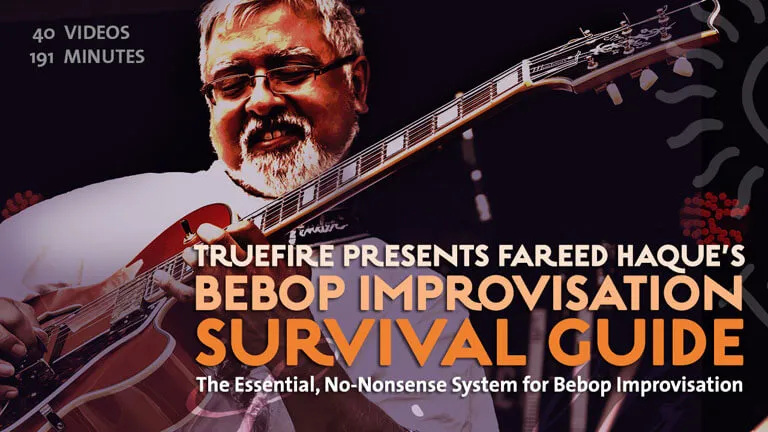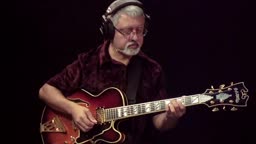
Bebop Improv Survival Guide

The essential, no-nonsense system for bebop improvisation

Marty FriedmanTommy EmmanuelSteve VaiEric GalesEric Johnson

Get this course and 1,000+ more with All Access

Try 14 days free. Cancel any time.

Purchase Individual Course for $14.99
Bebop Improv Survival Guide

About this course

Bird was jamming with guitarist Buddy Fleet in a NYC chili house between 139th and 140th street in December of 1939. That was the night bebop was born, or so the story goes. Bird said he was bored with the straightforward voicings and melodies that were typical in the swing music being played at the time. "I kept thinking there's bound to be something else. I could hear it sometimes but I couldn't play it." That night someone called Cherokee and Bird started playing off the higher intervals, Fleet picked right up on it and the rest is history.

Bebop re-invented popular swing-era tunes with hipper changes, sophisticated melodies and explosive improvisations. Crafting melodies and improvisations by arpeggiating changes that are rich with substitutions and extensions is key to the style. Whatever your preferred style; jazz, rock, pop and especially blues -- if you want to become a skilled improviser, then learning bebop is prerequisite to your success. Ready to start that journey? Put Fareed Haque's Bebop Improv Guide in your back pocket and get busy.

Good news for you. Guitarists already have a bit of an edge when it comes to learning the style because it's arpeggio-based and those arpeggios lie right inside the moveable chords you likely already know. Once you know your 4-note arps, you only need to learn how to integrate three remaining notes in that chord's scale (with a dash of chromatics of course). So, guitarists get a head start.

In the first section of the Bebop Improv Survival Guide, Fareed presents the underlying architecture of bebop demonstrating how bebop lines are built from arpeggios and jazz chords, and also how to create bebop scales and connect them across changes. Fareed's insightful formulas for building ANY chord, ANY arpeggio and/or ANY scale, using the common major scale as the base reference is worth the price of admission alone.

In the second section, you can lay the axe down for a few as Fareed performs some examples to train your ear to recognize the bebop sound and distinguish between early swing-style bebop and the more advanced and sophisticated bebop that it evolved into.

Next up in the third section, a thorough examination of the chord types that comprise the bebop songbook and best practices for crafting the arpeggios and scales needed to play over them.

Grab the box for the fourth section as you work through a series of playalongs. It's here that your bebop prowess starts to take shape as you apply what you've learned over bebop chord changes. Finally in the fifth section, Fareed pulls back the curtain on chord substitution with his enlightening Four Principles of Chord Substitution -- mind-blowing stuff!

True to Fareed's inimitable educational approach, you will not be spending a lot of time studying theory or working through tedious exercises -- you'll be playing your way through the Bebop Improv Survival Guide and bopping with the best of them in no time at all. Long live bop!

P.S. Can't get Milestones out of your head? Check out Fareed Haque's Modal Jazz Survival Guide!

What you'll learn

  • Creating jazz-style arpeggios
  • Creating melodic tension through harmonic substitution
  • Build bebop lines from chord structures
  • Understand bebop improvisation fundamentals
  • Develop organic jazz improvisation approach
Release date: 11/13/2012 • 3h 11m runtime
Start Course
Sample lessons
Turning Arpeggios Into Scales
Overview
Adv. Bebop Soloing Example
Playing 'outside' the changes
Outlining Ab7
Outlining Ab7
Overview
Ebmin7 to Ab7 to Dbmaj7
Slow Playalong

What's included

45 lessons • 18 charts • 13 Jam Tracks

Bebop Improv Survival Guide
Test all your cables and backpacks. Got a flashlight? Trail Mix??? HAND SANITIZER???? 'Cuz This is going to get messy.

Welcome to the BeBop Survival Guide! In this course we are going to BREAK it dowwwwwwn. In my 25 years teaching jazz guitar the tune most played, most butchered, most desecrated has to be Kenny Dorham's beautiful tune Blue Bossa. So we are going to give Kenny some peace, and work our BeBop out thru the changes to Blue Bossa, and hopefully you, me [ and Kenny] will fall in love with that Blue Bossa all over again.
What is Bebop?
Bebop is a style of jazz playing that developed in the early 1950s. Check out Charlie 'Bird' Parker, Dizzy Gillespie, Bud Powell. Early jazz musicians improvised by creating variations on a songs melody [ check out Louis Armsrong] , and later on improvised by building melodies thru arpeggiating or outlining the chords of a given tune [ check out Coleman Hawkins version of Body and Soul].

BeBop musicians took this a step further.

Not only did they play on the chords of a song, they had enough facility with arpegiating chords to arpeggiate more complex chords, and eventually began to add chords to the basic chord progressions, outlining substitute chords extra chords etc etc creating ever more complex and interesting melodic lines, often simply called "lines".

Another characteristic of the Bebop style is the increased use of chromatics to lead to and from chord tones, especially chromatics around 9ths, 11ths and 13ths [called 'Extensions'], and even altered 9ths, 11s or 13ths.
The Architecture of Bebop
There are many benefits to learning to improvise thru the arpeggio approach.

First off, it's historical. You will be learning the same way the jazz 'greats' did. Arpeggios allow you to put together chords and scales based on what your ear tells you…so you will naturally explore, by ear, different musical possibilities that appeal to you. As such you will naturally create your own choices and embark on the path to your own unique and individual style.

Monk chose different notes than Bird did...and so will you! As a guitarist, this approach is also empowering. Make sure you create an arpeggio fingering to go along with every chord grip you know. As you learn more chord grips, you learn more chord arpeggios. Once you have a chord arpeggio you like, fill in the notes in between BY EAR.

An arpeggio is ussually 4 notes 1,3,5,7 ...thats already 4 notes out of the usual 7 note scale! So all you need is to add in BY EAR the remaining 3. You will find different possibilities. They are ALL Correct.

Some will be harsh ["dissonant"], some more sweet ["consonant"], some downright UGLY! Explore! The next step is to start leading to notes in each chord chromatically from above or below.

Once you have many grips and lines you'll start to find that you can add chords thru arpeggios to any progression. C Maj7 goes to Dmin7 to G7 and back to C Maj7. This is a typical I-ii-V-I jazz prgression. We can add chords to this progression. A common example is adding a Dominant chord to lead to another chord. Typical in this case might be to add an A7 to lead to D min and then add a D7 to lead to G7. These chords will clash a bit with the basic chords. That is the desired effect! You are playing 'outside' the chords and leading back 'inside'. That's what makes it cool.
Turn Major Scales Into Chords
Any scale can be turned into chords. Any scale - really!

Since chords in our western musical system are usually built in 3rds, we usually start by building chords on each degree of a scale by 'Stacking Thirds'. Of course we can also build chords by stacking 4ths, 5ths, 6ths, 2nds or any interval you choose...they just aren't that practical tho some are verty beautiful! Once you have a handle on the chords built in 3rds by all means EXPLORE!
Turning Chords Into Arpeggios
Any chord can be turned into an arpeggio.

For now lets start with simple 4 note arpeggios. Once that is comfortable feel free to create arpeggios of 5,6, 7 (or more!) notes. Eventually you want to build arpeggios that LAY on top of your chords and convey the sound of that chord.

For guitarists this is essential. Try to visualize the arpeggio as laying on top of the chord, and eventually the scale as laying on top of the arpeggio. That way chord /arpeggio/scale are all connected visually, physically and eventually musically! {CHART}
Turning Arpeggios Into Scales
As we mentioned earlier, this is one if the great benefits of an arpeggio based approach. No fancy Greek names needed. I see G7, arpeggiate G7, fill in to create multiple G7 scales….all using (and developing) my ear and simultaneously developing my own style.

Check it out! A scale for G7?? Gee , I dunno, how 'bout we call it a 'G7 Scale'. Yea, that oughta impress 'em. A scale for G7#5??? Hmmm, I'm thinking, thinking, thinking...Got it! Let's call it a 'G7#5 scale" Brilliant! Awesome! Total GENIUSNESS!!
Bebop Playing Examples
As our study vehicle, we will examine the the popular Kenny Gorham tune 'Blue Bossa' made famous by the Great Tenor Saxist Joe henderson on his 1963 album Page One.

Please go and LISTEN to the tune a lot! Listening is the heart of learning music. If you dont listen you wont ever really get the hang of this no matter how clearly you think you 'understand it'.

Your mind does not really need to know whats going on...but your EAR DOES!!! So Listen up kids!!

+ 38 more lessons

Start Course

Reviews

17 results

Direkoglu

Verified buyer

05/31/26

Fantastic

Really great I learned a lot
RudyA

Verified buyer

08/11/25

Bebop Survival

Well done! And didactically excellent.

dresserd

Verified buyer

12/21/24

Love Fareed Haque

I love Fareed Haque’s courses. They boil it down to what’s actually important and give you exactly what you need.

Sindibad

04/10/23

Bebop Improv Survival Guide

This is great because it allows for an instinctive approach to Jazz. The pedagogy is clear.

runner09

Verified buyer

07/09/22

Recommended

Fareed gives great easy to understand information and tells it how it is. This has given me some great insights into working on Bebop. A beginner would probably have a hard time with this course. I will say that I wish there was more of a clear path of how to practice this stuff but that may be hard because it would be different for each person. Anyway, definitely recommended for those who already are pretty familiar on the guitar and music theory and wanting to get into jazz and specifically bebop.

Stop searching. Start improving with All Access.

Try 14 days free. Cancel any time.