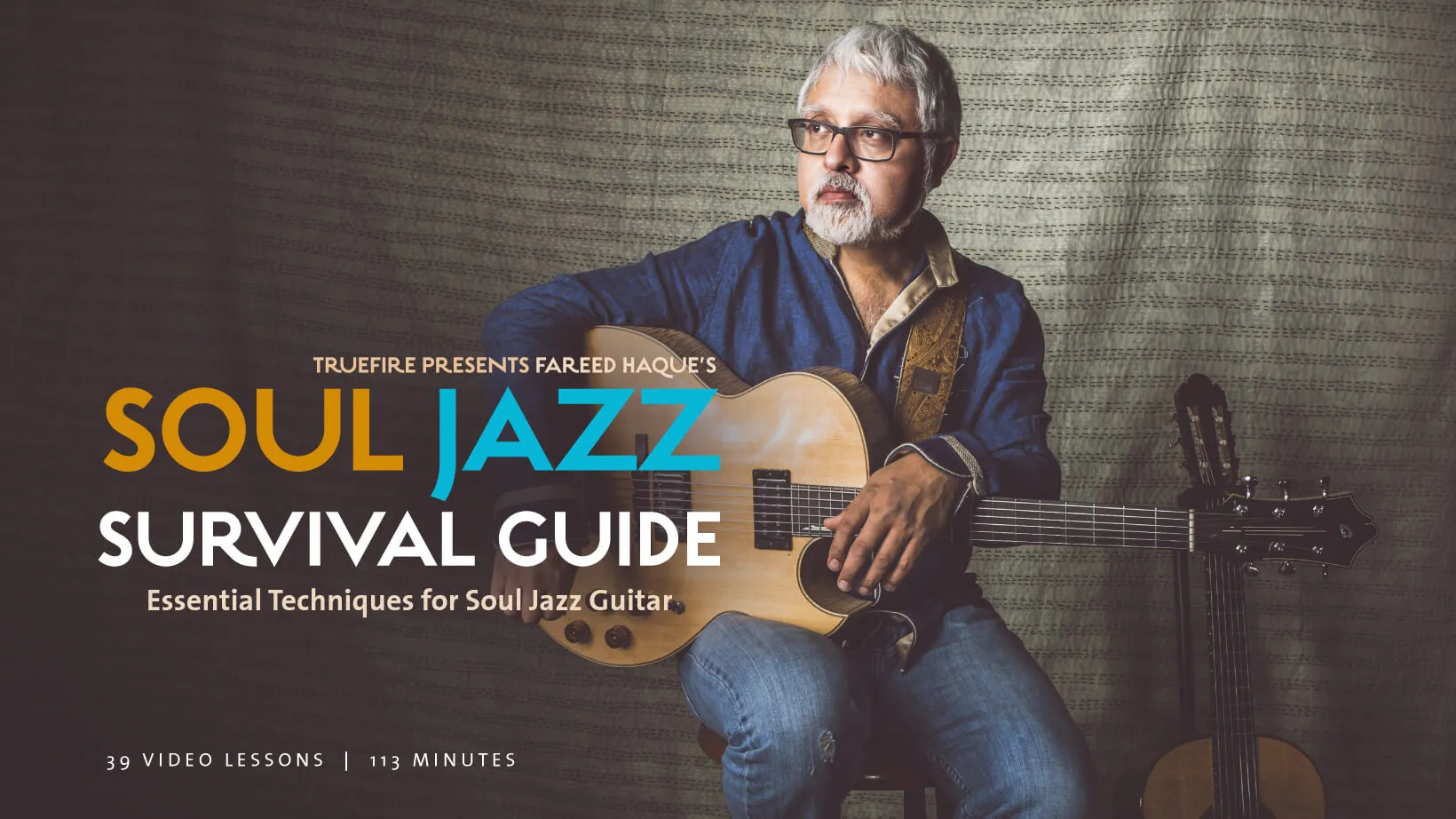
Soul Jazz is rooted to the 60’s and 70’s when musicians combined blues, soul, jazz, gospel, swing, and R&B funk to create "an earthy, bluesy melodic concept” with "repetitive, dance-like rhythms.” Organ trios were very common with Soul Jazz featuring legendary guitarists like Grant Green, Kenny Burrell, George Benson, Pat Martino, and Phil Upchurch.
Soul jazz lives on today in the music of contemporary artists such as Snarky Puppy, Medeski Martin & Wood, Questlove, D Angelo, and Garaj Mahal. Garaj Mahal’s bandleader, and one of TrueFire’s most popular educators, Fareed Haque presents a comprehensive Soul Jazz curriculum here in the Soul Jazz Survival Guide.
”Jazz and Blues and Rock and Funk all come from the same roots. American music is American Music. It’s my mission to embrace this truth in my music, in my playing, and in my teaching. Soul Jazz is as American as folk, pop, and other dance traditions — it is living music! This course is an attempt to continue the dialogue about what living music is all about, and how jazz is an essential part of that dialogue, regardless of what styles of music you choose to play. Plus, Soul Jazz is fun to play, easy to learn, and a great way to build your jazz chops!”
Fareed organized The Soul Jazz Survival Guide into two sections. In the first section, he guides you through 22 key concepts and techniques: Recommended Listening, Embracing the Blues as a Foundation, Major & Minor Pentatonic, Adding The Blue Note, Mixing Major & Minor Blues, Adding Major Blues to Minor Blues, Adding the Major 3rd, Adding the Major 6th, Adding the Major 9th, Adding Minor Blues to Major Blues, Using a Single Blues Scale, Adding Chromatics from 3rd to 5th, Adding Chromatics from 5th to 7th, Adding Chromatics from 7th to 9th, Bringing it Home, Dealing with Chord Changes, Soul Jazz Tricks & Licks, Double Stops, Octaves, Embracing Your Inner Chuck Berry, Swingin’, Laying Back, and Rhythm & Comping Approaches.
If you already play the blues, and/or are already familiar with the pentatonic scale, you’ll breeze through Fareed’s curricular approach for learning Soul Jazz, which is based on the pentatonic scale. In fact, you’ll be able to apply these key principles to play any style of Jazz.
”The 5-note pentatonic scale, NOT the 7-note major or minor scale, is the essential building block of jazz and, frankly, most music from around the world, certainly most American music. Jazz, Funk, Gospel, Bluegrass and other American music styles all come from or are related to the blues. The Blues at the same time. You can solo with Blues scale and hit all of the essential notes in most jazz chord progressions. Once you can do this, then you’ll start to add chromatic notes to connect the 5 notes together… and that starts to sound like… Bebop!”
In the second section, you’ll play through 4 Soul Jazz performance studies and apply all of the key concepts and techniques from the first section. Fareed will demonstrate both rhythm guitar comping approaches and soloing examples.
”I’ll show you a rhythm and lead performance over a two-chord organ trio-style vamp.Next, we’ll play rhythm and solo over a track with slightly more chord changes based on Grant Green’s Flood in Franklin Park. We’ll solo over a slightly outside sounding blues in A, and finally, a lead and rhythm performance study over a laid-back New Orleans-style groove.”
Fareed will explain and demonstrate all of the key concepts and approaches along the way. You’ll get standard notation, tabs, and diagrams for the key examples and performance studies. Plus, Fareed includes all of the rhythm tracks for you to work with on your own. In addition, you’ll be able to loop or slow down any of the performances so that you can work with the materials at your own pace.
Grab your guitar and let's get our Soul Jazz groove on with Fareed Haque!
What you'll learn
Navigate chord changes using multiple blues scale positions
Use guide tones to create clear, light chord voicings
Apply octave technique to minor blues scale licks
Use thumb technique for warm octave tone
Comp through a jazz blues progression with appropriate voicings
Hey all! I'm Fareed Haque, and welcome to the Soul Jazz Survival Guide. On a slightly deeper note, Jazz, blues, rock, and funk all come from the same roots. American music is American music. It's my mission to embrace this truth in my music, in my playing, and in my teaching. Jazz education and jazz educators have for far too long sought to separate themselves and their agenda from the mainstream of contemporary music. They've done this in numerous ways, but the most egregious is to create a theoretical foundation for jazz that is separate from and disparaging to other American "folk", "pop", and dance traditions, and riddled with conservative, elitist views about music and its place in society. This course is an attempt to continue the dialogue about what living music is all about, and how jazz is an essential part of that dialogue, regardless of what styles of music you choose play.
Special thanks go to Bill Harrison and the folks at www.PlayJazzNow.com for providing the live-band rhythm tracks in this course. Alright, grab your guitar, and let’s get started!
The important thing to realize here is that the 5-note pentatonic scale, not the 7-note major or minor scale, is the essential building block of jazz and, frankly, most music from around the world, certainly most American music. Jazz, funk, gospel, bluegrass, and other American music styles all come from or are related to the blues. The blues is unique in that it exists in major and minor tonalities at the same time. The fancy word for this is bi-tonality, meaning 2 tonalities (or more) at once. The pentatonic scale allows us to embrace major and minor key sounds, and it also eliminates the problem 1/2 steps in each key (for example "F" and "B" in key of C) that create all kinds of theoretical complexities and difficulties.
Long story short, you can solo with the blues scale and hit all of the essential notes in most jazz chord progressions. Once you can do this, then we will start to add chromatic notes in to connect the 5 notes together...and that starts to sound like...bebop!
Here are a few tracks you should check out fo' sho':
George Benson - Along Come Mary Kenny Burrell - Chitlins con Carne Grant Green - Jan Jan Boogaloo Joe Jones - Right On Pat Martino - Strings Wes Montgomery - Bumpin' on the Sunset Melvin Sparks - Thank You Lou Donaldson/ Lonnie Smith - Alligator Boogaloo Cannonball Adderley - Mercy, Mercy, Mercy - Entire album! Horace Silver - Song for My Father
Okay, so I pretty much said what I was going to say in the video. So, well, "Like I said!" We can build most of what we need in jazz from the blues scale. So why all the complexity? Start there and keep it fun and keep it groovin'. I think one of the difficult issues to talk about in jazz is that 90% of what jazz is all about actually is not coming from the notes, but coming from the feel. Folks who can't seem to get that feeling focus on the notes, 'cause that's all they know how to do. Instead, focus on the feel and you'll be making jazz in weeks not years.
See the attached chart, Pentatonic Scales Worksheet. Practice these diligently in all positions. Try to vary the way you practice these so that it's not just a boring exercise. Try jamming along to the jam track and staying in each position until you're comfortable and confident in that area of the neck. Add in bends and slides and any other fun stuff that you can think of...
Practice adding the bluenote in as many ways as you can think of: Bend into it, bend around it, play it straight, shake it, use vibrato. See the chart Pentatonic Scales w/Bluenote Worksheet.
Now this is where it starts to get fun. If the C major blues scale gives you all of the sweet notes in C major, the C minor blues scale gives you the funky sounds. So, anywhere you have C major, try adding in C minor pentatonic licks. Similarly (and this can start to get confusing, so try not to think about it, but just look at it on the guitar neck...it'll make more sense that way) the A minor blues scale will give you lots of funky sounds, if you want to add in some sweet sounds, throw in some of the notes from the A major (F# minor) blues scale.
My super talented guitar teacher Fareed Haque. . I was recommended to YOU by REN WRIGHT at Truefire. I purchased almost every product that you have on Truefire. I am so impressed by your patience and indepth teaching method that I must THANK YOU for inspring me to learn from YOU. Currently studying your Soul Jazz Guide. . I would appreciate you letting me know when you relase new Jazz Courses with Truefire. Yours Truly GORDON FRANKS South Africa WhatsApp +2782 5441 551 gordonfranks7@gmail.com
E
ericpwp1
Verified buyer
11/11/25
Buy it, and thank me later.
A great launching point to get you off the pentatonic plateau. By building off what you know, Fareed expands your ear outside the box while keeping you in a familiar space.
A
Addahia
Verified buyer
01/12/25
Amazing
This is an excelente and brilliant course that will for sure give you many ideas and fluency in your own incorporation of jazz to your playing. Easy to follow, short specific lessons stacking over each other and the usual clarity and simplicity of Fareed
5
5peter5000
Verified buyer
12/27/22
Fareed's deep experience shows as in his other courses
M
mfunkyview
Verified buyer
12/19/22
Fantastic course!
Very stimulating and enjoyable course. Friendly and knowledgeable teacher who shares great tips that will make you sound in the style of Grant Green.