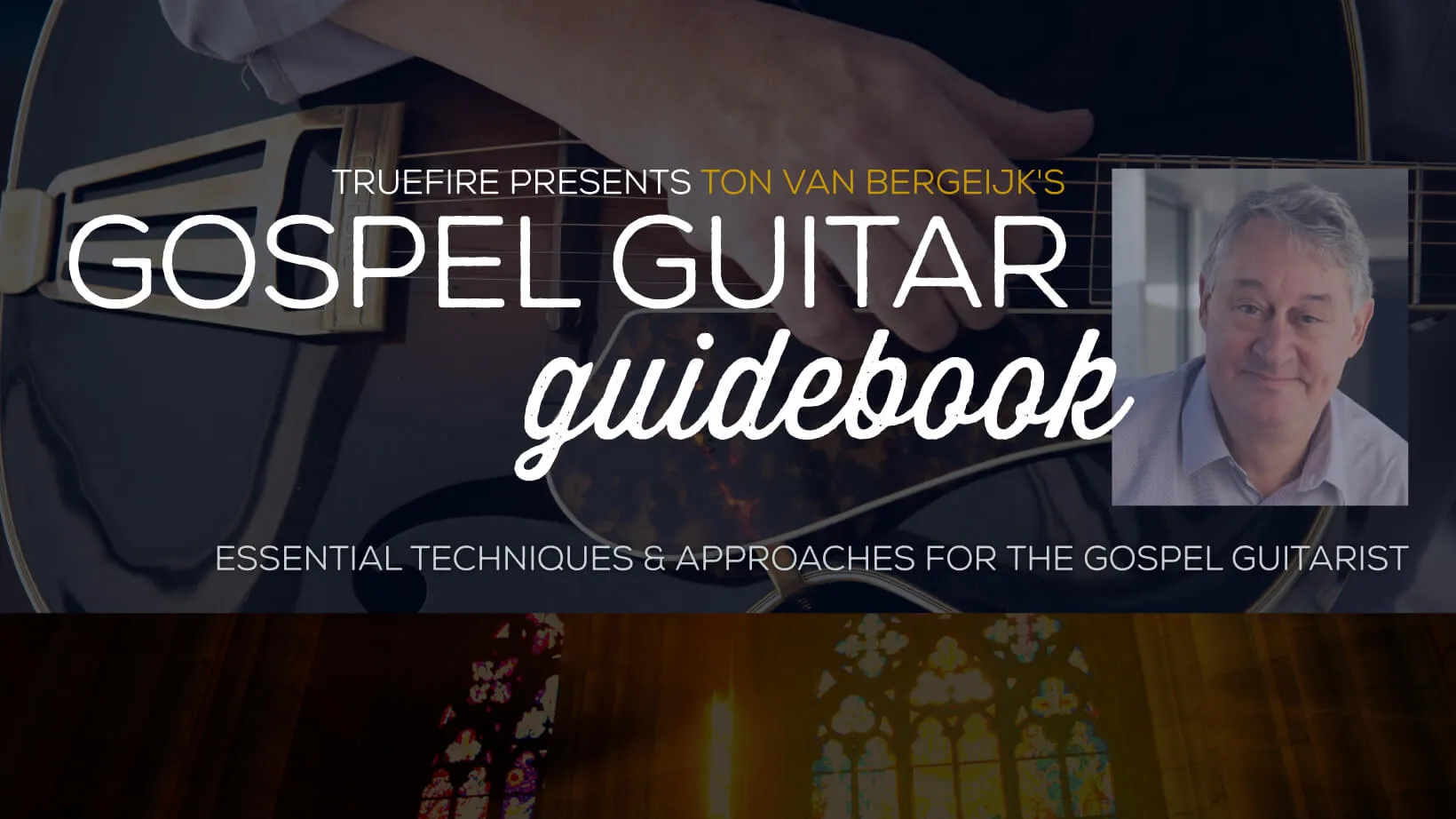

Gospel Guitar Guidebook

Essential Techniques & Approaches for the Gospel Guitarist

Marty FriedmanTommy EmmanuelSteve VaiEric GalesEric Johnson

Get this course and 1,000+ more with All Access

Try 14 days free. Cancel any time.

Purchase Individual Course for $9.99
Gospel Guitar Guidebook

About this course

Gospel music is and always has been, one of the most popular styles of contemporary music. Countless vocalists and musicians performing gospel in the church go on to have mega careers in pop, blues, R&B, soul, country, and even jazz. Accompanying yourself or a vocalist on (solo) acoustic guitar requires special skills for arranging the parts to both support the melody and emphasize the rich sonic textures that gospel music is known for.

Master fingerstyle guitarist, Ton Van Bergeijk has studied gospel music for decades and has developed a unique, and very accessible approach for accompanying the beautiful spirituals, hymns and sacred songs that are synonymous with gospel music. Ton’s Gospel Guitar Guidebook reveals the concepts, techniques and creative approaches for this specialized guitar accompaniment.

”“When I accompany a singer or myself, my first approach is what the old gospel quartets used to do: there’s a lead vocal and a simple rhythmic line in three-part harmony. Gospel vocal quartets like the Fisk Jubilee Singers, The Soul Stirrers, The Swan Silvertones, and the Golden Gate Quartet are the source of inspiration for this course. We'll be using their harmonies and transplant them to the guitar. 

First, we'll look at the technical approach to playing this type of backup. The method that Ton uses to arrange these songs for guitar stems from Eddy Lang and George Van Eps. We’ll then put these concepts to work playing through seven Gospel standards, inspired by Sam Cook & the Soul Stirrers, the Swan Silvertones, Ray Charles and many others.

All these new chord shapes are pretty easy to finger, so you won’t have to concentrate on the guitar part too much when your singing yourself. We're mainly using two-finger picking but everything can easily be applied to strumming with thumb & index or plectrum-style patterns. ”


Ton van Bergeijk will explain and demonstrate all of the key concepts and approaches along the way. You’ll get standard notation and tabs for each of the licks and you'll get some extra background information for each of the tunes. In addition, you’ll be able to loop or slow down any of the videos so that you can work with the lessons at your own pace.

Grab your guitar and let’s get gospel with Ton van Bergeijk!

What you'll learn

  • Apply George Van Eps string interval theory to chord voicings
  • Use diminished chord symmetry to find voicings up and down the neck
  • Apply L4 triad shapes to diminished chord voicings
  • Use M4 chords as alternatives when L4 voicings run off the neck
  • Understand diminished chords as rootless dominant 7 flat 9 voicings
Release date: 03/21/2019 • 1h 28m runtime
Start Course
Sample lessons
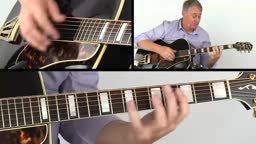
L4 Chords
L4 Chords
Concept 1
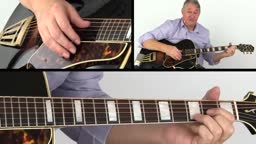
Moses Smote the Waters
Performance
Moses Smote the Waters
Breakdown
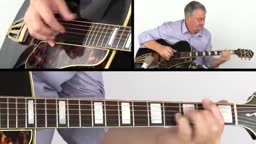
Whiter Than Snow
Whiter Than Snow
Performance

What's included

28 lessons • 20 charts

Gospel Guitar Guidebook
Hi I'm Ton Van Bergeijk. Welcome to the Gospel Guitar Guidebook!

Gospel vocal groups have always had a lot of influence on my guitar playing. Whether you're religious yourself or not, there's no way around the fact that religion is the backbone of all music, be it classical, jazz or pop.

When I have to accompany a singer or myself, my first approach is what the old gospel quartets used to do: there's a lead vocal and a simple rhythmic line in three part harmony. First, we'll look at the technical approach to playing this type of backup. Playing these lines on the lower 4 strings - L4 chords - is the most effective way to achieve this. For some of you, this might be a new way of looking at the guitar. After this, we'll put these concepts to work in seven gospel standards, inspired by Sam Cook & the Soul Stirrers, the Swan Silvertones, Ray Charles and many others.

All these new chord shapes are pretty easy to finger, so you won't have to concentrate on the guitar part too much when you're singing yourself. We're mainly using two finger picking but everything can easily be applied to strumming with thumb & index or plectrum-style patterns. All the performances are tabbed and come with some extra background information. Let's get inspired! I hope you'll enjoy this course!
L4 Chords
The term "L4" comes from Eddie Lang. It just means "lower 4" strings. His system was straightforward: L4=Lower 4, M4=Middle 4, U4=Upper 4. George Van Eps was the one who started doing everything in triads - three notes to the chord sounds neat & clear.
L4 Related Chords
Most of the chords you're gonna need are built like: root - subdominant - dominant 7, or in the key of G: G - C - D7. I've kept these key-related chords close to the inversion-position. In practice, you'd try to create an accompaniment line of the top note of these chords. So, you'll be moving either from one inversion to another, or towards the next chord in your chord-scheme.
L4 Diminished
One way of looking at diminished chords is as a dominant 7 chord with a flatted 9th instead of the root. So in our L4 triads, any rootless dom7 chord can be used as a diminished chord.
M4 Chord Inversions
Sometimes I use triads on the middle 4 strings (M4 chords). They're useful when a harmony line in L4 chords threatens to run off the neck, or as an in between lick or a slight variation. When I'm in dropped D, they also come in handy. Sometimes they require a bit more of a stretch of the left hand.
M4 Related Chords
We'll have a look at the usual suspects in the M4 department: root - subdominant - dominant 7 (i.e., in the key of C: C - F - G7).
Triplets
When playing rhythm while fingerpicking it's nice to have your right hand thumb on the beat. With picking or strumming, that's quite essential. When you have an uneven number of notes on one beat that might be a problem. We're not concerned here with guitar interpretations of Stravinsky. For us, it usually occurs with triplets or 2 sixteenths & an eighth.

+ 21 more lessons

Start Course

Reviews

14 results

zj7tjk

Verified buyer

05/23/26

Finger style Four Part Harmony

I like his style and approach to the guitar
therenewalchiro

Verified buyer

03/27/26

bridge blues and jazz with gospel idea

guitargreg56

Verified buyer

06/12/25

Excellent fast-paced chord comp for old school gospel tunes!

Ton van Bergeijk's 'Gospel Guitar Guidebook' provides an excellent 'Hallelujah' worthy instructional in old school gospel hymn accompaniment. Starting with chord inversions to reflect the different 'registers' for playing with a vocalist or band, the lessons lead naturally to the song performances and breakdown of details for each. The chords are not complex or hard to play, but requires one to learn some fast fingering changes, similar to what a honky tonk piano player might play for these hymns. The tunes are lively enough to be used as chord-melody in themselves, but are designed as accompaniment. TvB adds a dash of humour and lots of inspiration along the way. Great starting point for Jonathan Stout style chord action. Thanks, well done!

loutchos

Verified buyer

06/05/25

Amazing !

all of his masterclass are amazing ! I’ve learned so much !

jstandjam

Verified buyer

11/28/22

Ton Van Bergeijk does an excellent job conveying concepts and ideas in this lesson. As far as I am concerned Ton Van Bergeijk is one the best fingerstyle guitar players alive today. In addition, he is a great teacher! I highly recommend this lesson to achieve well-rounded fingerstyle guitar abilities and styles.

Stop searching. Start improving with All Access.

Try 14 days free. Cancel any time.