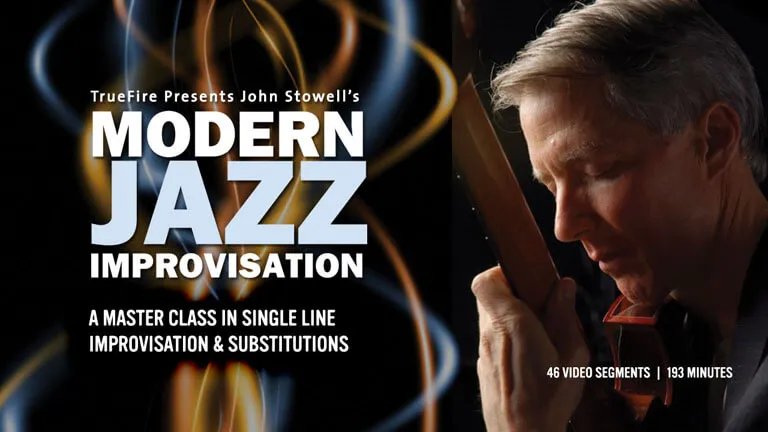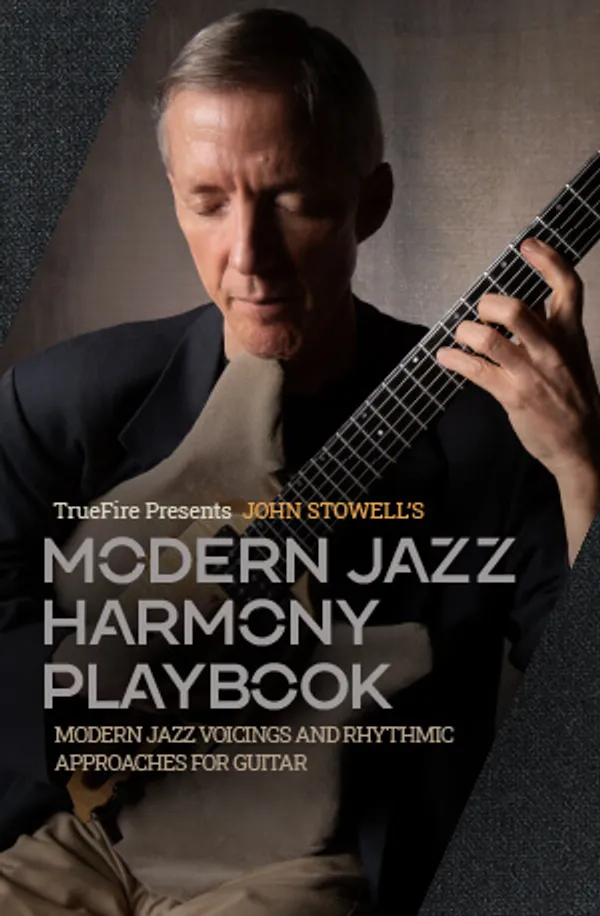
Modern Jazz Improv

A Master Class in Single Line Improvisation & Substitutions

Marty FriedmanTommy EmmanuelSteve VaiEric GalesEric Johnson

Get this course and 1,000+ more with All Access

Try 14 days free. Cancel any time.

Purchase Individual Course for $9.99
Modern Jazz Improv

About this course

Jazz guitar is a wide open place where innovation, interpretation and experimentation run rampant. All of the rules are meant to be broken and the music is played in the moment. One player's ceiling is another player's floor and you can study the form for years and still be nowhere. All this is why we love it so.
Jazz is also a highly subjective art form where beauty clearly is in the "ears" of the beholder. There's much debate amongst players about virtually every quality of Jazz but everyone seems to agree that the best way to learn jazz guitar is to listen and study with a master.

Welcome to this master class in single line improvisation and substitutions from John Stowell. "More guitarists would play like John Stowell if they knew how," says Herb Ellis and now you have the opportunity to do so.

"My goal in this course is to break down complex harmonies into simple components that are easy to memorize and understand. I'm focusing on melodic and harmonic scales and triads and using them as substitutions. Rather than thinking of the modes of the harmonic and melodic minor scales to create extended sounds, I think of different keys of those scales superimposed over a chord quality, for example using a melodic or harmonic minor scale a half step above a dominant chord to generate tensions as opposed to thinking of the 7th mode of those scales."

"John Stowell plays jazz, but he doesn't use any of the clichés; he has an incredible originality. John is a master creator," says Larry Coryell. John has taught internationally for 30 years in every educational setting. His standing-room only clinics on music theory and improvisation are hands-on and highly informative. The jazz guitar lessons in Modern Jazz Improvisation present John's approach for applying advanced theory in an improvisational setting.

"In Modern Jazz Improvisation, I'm moving back and forth between the basic sound of the chord tones and the substitution. As your dexterity and ability to move between two sounds improves, a new composite sound emerges, and you will begin to have an intuitive notion of the sounds that you're generating. The ultimate goal is to have quick access to embellishments and tensions in a way that feels truly spontaneous, both in your own playing, and in your ability to recognize and respond to these sounds when you hear them on the bandstand. Once you have a sense of how these layered sounds function, it's a short step to applying your new extended vocabulary to chord progressions and tunes. Your ears and fingers will get smarter simultaneously as you move through Modern Jazz Improvisation."

Modern Jazz Improvisation: Curriculum

1. Using Ionian & Lydian Arpeggios to Generate Dorian & Aeolian Sounds
2. Using Ionian & Lydian Arpeggios To Generate Phrygian & Locrian Sounds
3. Mixing the Minor Modes
4. Application of Minor Modes in ii-V-I Progressions
5. Melodic Minor Scale
6. Harmonic Minor Scale
7. Major Arpeggios over Dominant Chords
8. V to I Resolutions
9. Melodic Minor Substitutions Over Altered Dominant Chords
10. Melodic Minor Over Altered Dominant 7th Chords
11. Reharmonizations with Implied V7
12. Melodic Minor over Diminished
13. Diminished Moving Down Chromatically
14. Melodic Minor over Whole Tone Scale
15. Melodic Minor Over Half Diminished
16. Relative Melodic Minor Over Major
17. Putting it Together Over a Minor Blues
18. Harmonic Minor Scale Over Dominant Part I
19. Harmonic Minor Scale Over Dominant Part II
20. Harmonic Minor Over Dominant Reharmonizations
21. Melodic Minor Over Substitutions for vi-ii-V-I
22. Harmonic Minor Over Diminished
23. Diminished Chords as Altered Dominant Voicings
24. Harmonic Minor Over Major
25. Melodic & Harmonic Minor: Chord Substitutions
26. Summary of Harmonic Minor: Substitutions & Practice Tips
27. Putting it Together Over a Tune
28. Major Triads Over Major Chords
29. Minor Triads Over Major Chords
30. Augmented & Diminished Triads over Major Chords
31. Major Triads Over Major Chords
32. Minor Triads Over Minor Chords
33. Augmented Triads Over Minor Chords
34. Diminished Triads Over Minor Chords
35. Major Triads Over Dominant Chords I
36. Major Triads Over Dominant Chords II
37. Minor Triads Over Dominant Chords
38. Augmented & Diminished Triads over Dominant Chords
39. Extended Chord Sounds
40. Open String Voicings Chord: Inner Voice Movement
41. Playing Examples: Ballad & Bossa

Modern Jazz Improvisation is not for the faint of heart. Many of the jazz guitar lessons in this course present applications that will take several years to completely absorb and master. However, each interactive video guitar lesson in the course will also yield immediate results as you start to integrate the concepts into your own playing. Dig in!

What you'll learn

  • Create smooth voice leading between upper structure triads
  • Identify and play 7 major triads over major 7 chords
  • Identify and play 9 major triads over dominant 7 chords
  • Identify and play 6 major triads over minor chords
  • Recognize and respond to upper structure triads when accompanying other musicians
Release date: 09/29/2010 • 3h 02m runtime
Start Course
Sample lessons
Ionian & Lydian Arpeggios
Generate Phrygian & Locrian
Melodic Minor Scale
Melodic Minor Scale
Diminished Moving Down
Chromatically
Putting it Together
Putting it Together
over a Minor Blues

What's included

44 lessons • 35 charts

Modern Jazz Improv
I can't emphasize enough the importance of practicing new information in a shared environment with one or more cohorts. Discussing the theory clarifies it in your own mind. Locating information on the neck develops muscle memory as you repeat the patterns and learn to connect them; ear training is happening at the same time. You become familiar with a sound as you hear it played again and again, learning not only how to use it in your own improvisations; you are also training yourself to recognize and respond to new sounds in others' playing.
Ionian & Lydian Arpeggios
Notice as I played my examples here that some of my lines were coming from chord shapes (for example F or Bb major chords, Ionian or Lydian, as D minor Dorian or Aeolian). I will also use open strings when they apply. In this case, all of the open strings work against D minor, so I might use an open A or D string in the bass, or an open high E or B string to add the 9th or the 6th, respectively.
Ionian & Lydian Arpeggios
Phrygian and Locrian sounds employ a bit more dissonance than the Dorian and Aeolian modes, but are very commonly used minor tonalities. The Phrygian is most often associated with the sound of flamenco music, but also appears in modern jazz compositions by musicians like Wayne Shorter and Chick Corea. The Locrian mode is used most often to replace a minor chord in a II-V-I cadence, in a cycle of 4ths alternating with dominant chords (as in the last cadence of "Stella by Starlight"), or in a descending chromatic progression (for example, bV half diminished, IV minor, III, VI, II V, I).
Mixing the Minor Modes
As I mentioned, the amount of time (i.e., number of bars) that you have to work with in a tune will determine how many different minor modes you will combine. It's possible to mix these sounds together if there is another chordal instrument present in the band (a second guitar or piano). A good accompanist will leave enough space to give you some freedom and creative latitude harmonically, playing chords underneath your solo for you to respond to without interrupting your flow.
Application of Minor Modes
As I demonstrate here, playing the II chord with alterations will help you differentiate between Dorian, Aeolian, Phrygian and Locrian sounds in your lines. If I want to come become more conversant with a particular harmony, I'll either seek out and learn a tune that uses that mode/sound, or compose something that uses that tonality. Repetition creates familiarity and comfort.
Melodic Minor Scale
One way to develop a vocabulary with the melodic minor (or any scale) is to learn some melodies that incorporate the sound of the scale or arpeggio. Chuck Wayne's "Solar" and Charlie Parker's "Segment" come to mind as short bebop melodies that draw on the melodic minor. Most modern jazz musicians reference the melodic minor often in their improvisations. Playing the melodic minor a whole tone below a minor (the 2nd mode of the melodic minor, Dorian b2 or Phrygian 6) is a nice sound in between Dorian and Phrygian. I particularly like the combination of major 6th and b2 against a minor chord, and I'll frequently use melodic minor chords a whole tone below a minor chord as well (i.e., Bb melodic minor as Cm7b9).
Harmonic Minor Scale
When using a harmonic minor, I generally avoid playing the b6 and major 7th intervals consecutively if I'm employing a a harmonic minor in the same key (i.e., C harmonic minor over C minor). This sound can also be interpreted as an implied V chord (i.e., G7 altered resolving to C minor). The harmonic minor played a whole tone below a minor (2nd mode of the harmonic minor, Dorian b2b5) is a nice mixture of the blues scale and the Phrygian mode.

+ 37 more lessons

Start Course

Reviews

12 results

sjguitarist

Verified buyer

03/07/25

S bernd

This freezes up every time I try and use it
Brian

11/16/24

WOW!!!

John Stowell,delivers the goods on this course BIG TIME!!! A lifetime of knowledge!!! For pennies. . . . Thank You John for sharing your knowledge and True Fire,for getting John on board. . . WE WANT MORE!!! John Stowell courses!!! We Want More!!! We Want More!!! LOL. . . . GET this course,you will be glad you did!!!

Norlo

02/02/22

John Stowell is a modern jazz improv master!

John Stowell is a master of jazz guitar but also a lovely person and INCREDIBLE teacher. Truefire should make more courses with him!

Carlos L.

12/28/21

Great course and great teacher.

This course is completly great. It gives you a lot of new ideas and approaches to improvisation. John is an amazing teacher, he speaks and show everything really clear, so it wouldn't be a problem if you don't have too much idea of jazz harmony because he explains everything very well. Videos and transcriptions can be a little "old-fashined" in comparison of newest TrueFire courses because it already has 11 years at this moment, but that doens't affect the interesting and amazing it can be. I really recommend it to everyone who would like to expand their musical vocabulary!

laetushold

Verified buyer

06/13/20

Paradigm shifting insights into soloing

John helps you understand how to quickly color a solo with the distinguishing notes of modes using harmonic substitution. He is a true teacher and imparts his knowledge with clarity and authority. His exercises are pedagogic and easily accessible to the intermediate/advanced player. Thanks John.

Stop searching. Start improving with All Access.

Try 14 days free. Cancel any time.