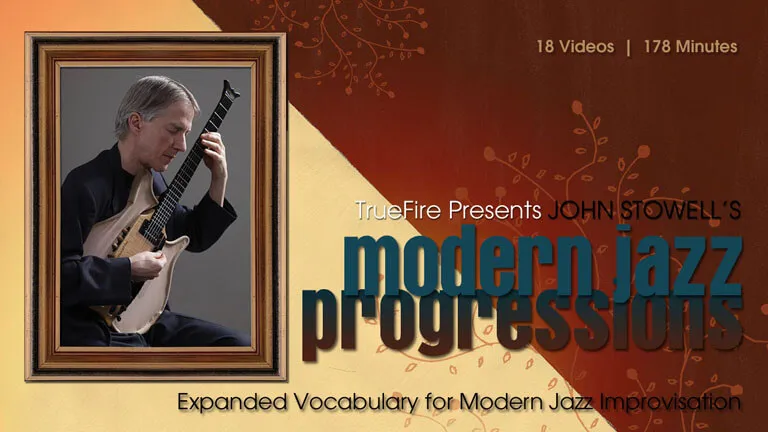

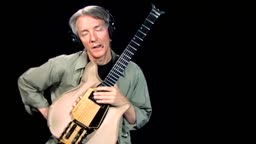



Modern Jazz Progressions

A master class in modern jazz progressions and expanded chord vocabulary

Marty FriedmanTommy EmmanuelSteve VaiEric GalesEric Johnson

Get this course and 1,000+ more with All Access

Try 14 days free. Cancel any time.

Purchase Individual Course for $9.99
Modern Jazz Progressions

About this course

The club is packed to the rafters with jazz freaks and monster players. First set, very first tune, and the sax player's solo has already pulled the audience to the edge of their seats. The next three choruses are yours for the asking but you pass the nod on to the keys 'cause you're just not feeling it lately. You're making the changes but the sparkle's gone AWOL from your improvisations. Yup, we've all been there. But no worries... our resident professor of jazz sparkle, John Stowell has your back with some fresh perspective for crafting fresh lines over commonly encountered chord progressions.

In Modern Jazz Progressions, John reveals how to apply four modes of the melodic and harmonic minor to generate tensions and mega-sparkle over the dominant chords commonly found in jazz chord progressions. Melodic and harmonic minor chords function as altered dominant chords for modern jazz players, and so the applications that John shows you will also spice up your lines when making a minor iii or vi chord dominant.

The four melodic and harmonic minor modes that you'll be working with are the Super Locrian (a half-step above the dominant chord), the Sus Flat 2 (a whole tone below the dominant), the Mixolydian Flat 6 (a fourth above the dominant), and the Lydian Dominant (a fifth above the dominant).

Essentially you'll learn how to develop compelling melodic lines by mixing dominant arpeggios and scales with arpeggios and scales derived from the four modes. Sounds a little like rocket science? Indeed it is, BUT... there is method to the madness and John's intuitive teaching approach in Modern Jazz Progressions will connect the dots for you quickly.

Stowell guides you through six versions of a ii-V-I-vi progression, four versions of a minor blues progression and four versions of a dominant blues progression. Each version of each progression escalates in sophistication so that your ear can acclimate to the new sounds that you'll be creating along the way.

John will demonstrate line construction over rhythm tracks calling out both the embellishments he is using (notes inside the scale to extend the harmony) and tensions (notes outside of the scale -- specifically, notes from one or more of the four melodic and harmonic minor modes). Playalongs are included within each demonstration so that you can apply the moves that John demonstrates immediately in context.

John concludes the course with some sage advice on comping and playing solo. He shows how to achieve a pianistic style of comping that makes use of close intervals, open strings, and broken chords that add depth to your playing while making difficult changes easier to play. If you play solo or chord melody, this section alone is a gold mine.

Modern Jazz Progressions is not a vocabulary building course and while we have transcribed some of the tastier lines (standard notation only - no tab), it is not John's intention to have you learn his lines note-for-note. It's the underlying harmonic and creative approach that John wants students to grasp and then apply in their own lines.

Invest ample practice time into understanding why, where and how to apply the embellishments and tensions covered in Modern Jazz Progressions, and you'll hear that sparkle back in your own improvisations.

What you'll learn

  • Navigate complex jazz progressions with confidence
  • Apply melodic and harmonic minor concepts to progressions
  • Solo over fast-moving changes using systematic approaches
  • Arpeggiate complex chord changes as a foundation for improvisation
  • Recognize and play bebop-style harmonic superimposition
Release date: 12/05/2012 • 2h 58m runtime
Start Course
Sample lessons
Single-Line Substitutions
Overview
ii-V-I-vi Progression
Version 5
Minor Blues Progression
Version 4
Dominant Blues Progression
Version 3

What's included

18 lessons • 15 charts

Modern Jazz Progressions
The goal of "Modern Jazz Progressions" is to expand the single line vocabulary of the intermediate-advanced jazz guitarist. This is accomplished by focusing on and applying specific embellishments and tensions to different chord qualities in the context of a common turnaround and some blues progressions.

On the bandstand, musical choices and decisions are made spontaneously and in the moment. Being able to access sounds quickly and respond to musical information played by your peers are important skills that are developed by focusing on small components of the harmony and applying them in the context of a progression or a tune.

"Modern Jazz Progressions" will help to develop these requisite skills by focusing on many small variations and embellishments of chords in a number of contexts.

The format for the course is interactive, and the tempos are relaxed and easy to play along with.
Single-Line Substitutions
It's important to reference the basic chord tones in your lines as you layer the extensions of the melodic and harmonic minor modes over the dominant chord.

Once you're able to visualize and connect these sounds on the neck, the next step is to apply these extended sounds in the context of a common turnaround such as a II-V-I progression.

Melodic and harmonic minor chords also function well as altered dominant chords, as I demonstrate here.

Play everything slowly in the beginning to be able to connect patterns on the neck and acclimate your ear.
ii-V-I-vi Progression
Notice that I'm trying to generate some interest using very basic arpeggios by playing ideas that span two or three octaves.

I'm also connecting the chord tones together in a variety of ways and occasionally using some chromatic harmony and approach notes.
ii-V-I-vi Progression
The substitutions that I'm using here to create small variations and embellishments over the II, V and I chords are self-explanatory.

Notice that I'm using chords which match the harmonic content of my lines exactly. The element of spontaneity, which is so important on the bandstand, is not in evidence here.

The goal is to develop your ear to recognize a lot of small components of the harmony. With repetition, all of these sounds become a part of your vocabulary and can be played/accessed in the moment.
ii-V-I-vi Progression
It is important to take note of the fact that sounds can co-exist and be mixed together.

As I mention and demonstrate here, the major 6th and 9th intervals can be added to a D minor and combined with a basic minor 7th arpeggio.

Technical skill, muscle memory and ear training all happen at the same time as you connect the patterns.

Hopefully some of my ideas can serve as a starting point and catalyst for your own variations.
ii-V-I-vi Progression
While still retaining the key centers, this cadence is substantially different, with the introduction of the melodic minor, lydian major, tensions/embellishments over the V chord and reharmonization of the VI chord as dominant.

Note the reference to triad substitutions over the I and V chords.

As more tensions and embellishments are added, pay attention to voice leading and the top note of each chord, especially if you're accompanying a soloist.

Some of the sounds in this version may sound dissonant and unfamiliar to you, but they have been a part of the jazz vocabulary since the bebop era.
ii-V-I-vi Progression
The additional tensions added here to the V and VI dominant chords make for a more dissonant cadence.

As you move farther away from the basic harmony, you realize that these sounds can work well interacting with some players and are less successful with musicians who prefer a more consonant approach to their harmony.

As you develop an affinity for these sounds, you will also acquire the ability to quickly take stock of your bandmates' vocabulary and determine the best sounds to use.

+ 11 more lessons

Start Course

Reviews

17 results

Osokin

Verified buyer

07/29/22

Expand Your Harmonic Palette!

This is an older course, so no tab sync, but intermediate jazz guitarists looking to expand their single line vocabulary will certainly benefit from working through this lesson set. John Stowell is an extremely talented guitar player and teacher and shares a wealth of knowledge in these lessons, which focus on different approaches to playing through common progressions. One minor criticism is that the bass notes of the guitar backing John when he is demonstrating lines is a little too loud in the mix at times - but this really shouldn't deter anyone from picking up this excellent course.

Carlos L.

01/04/22

New ideas and new progressions.

I've bought two of his courses already and i'm not disappointed. His way of teaching everything is great and he gives you a lot of new information you can use for practicing new musical ideas while improvising, comping or even composing. He also gives you some few bars to jam with him on the videos while he guides you throught the changes, so this feel of jamming with him is great!

gwcannon

Verified buyer

12/08/21

Excellent teacher. This course is great for for any guitarist who wants to work on using scales more effectively.

jrdocbenson

Verified buyer

06/18/20

50 country licks, 2-5-1, mod jazz progressions...

I am really enjoying all of these programs.

jeanmarctomi

Verified buyer

04/08/20

Incredible course !

For all lovers of jazz guitar, a course (for advanced guitarists) which sheds light on the "strategies" of John STOWELL. Absolutely recommend.

Stop searching. Start improving with All Access.

Try 14 days free. Cancel any time.