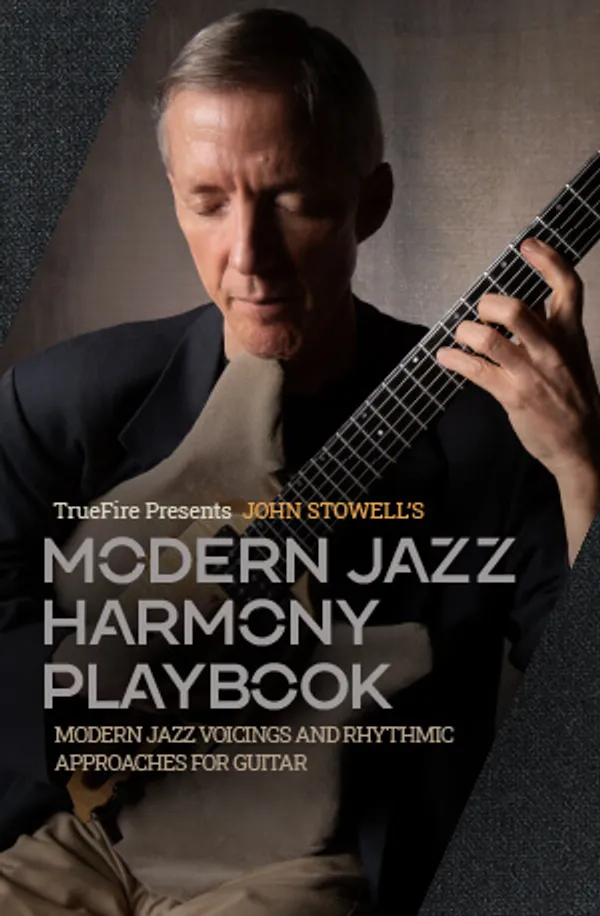
Modern Chord Melody

Contemporary voicings, shapes and single note ideas for jazz guitar

Marty FriedmanTommy EmmanuelSteve VaiEric GalesEric Johnson

Get this course and 1,000+ more with All Access

Try 14 days free. Cancel any time.

Purchase Individual Course for $9.99
Modern Chord Melody

About this course

Jazz chord melody may very well be the most challenging of all guitar styles to truly master. Players must develop right-hand thumb and finger independence, a robust vocabulary of jazz voicings, a strong sense of melody and an arranger’s feel for composition. And these are just the fundamentals. Once you have the "easy" stuff down, it's all about groove, arrangement, performance and improvisation in real time, often as a soloist.

What you'll learn

  • Navigate unusual finger stretches on the fretboard
  • Apply melodic minor a minor 3rd above half-diminished chords
  • Create composite sounds by mixing original chord arpeggios with substitution scales
  • Play melodies and improvisations in rubato style
  • Incorporate open strings musically into melodic phrases
Release date: 11/20/2007 • 2h 59m runtime
Start Course
Sample lessons
Breakdown 1
Breakdown 1
I Wish
Breakdown 2
Breakdown 2
I Wish
Embellished Melody
Embellished Melody
I Wish
Embellished Melody Breakdown
I Wish

What's included

40 lessons • 13 charts

Modern Chord Melody
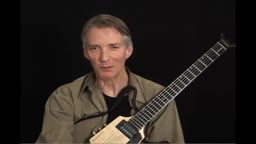
Modern Chord Melody Introductory Welcome to my TrueFire course. Some thoughts that I will articulate as you move through my material bear repeating here: When exposed to a lot of new information, don't be intimidated or assume that the material is beyond your grasp. I prefer to see music as many small subjects, and I rotate my time and energy between them, being led by my progress and intuition. Our development as musicians seldom happens as quickly as we would like, and our playing almost never satisfies us. But we can use our perception of ourselves as lifelong students to motivate and shape us. Document your practicing and playing on tape to evaluate your progress; seek out like-minded musicians to share ideas with, discuss theory and its application in tunes. Play with as many good people as possible, listen to others (both your peers and the great players of the past), expand your repertoire, compose. Create an environment for yourself in which it's fun to learn and improve, and so you shall. The purpose of my course is to help you build your own chord vocabulary and learn to incorporate new shapes and sounds into your own arrangements, accompaniments and solos. In my experience, the best way to familiarize yourself with new chords/inversions is in the context of leraning new material; here we will use five of my original tunes. As you improve your ability to visualize and create new chords by combining familiar shapes with new combinations of intervals, your harmonic palette as a soloist will also grow. I hope that my concept of chords and their applications will serve as a catalyst for you to discover your own voice as you progress through my course. We're embarking on a wonderful journey together. Let's support, encourage and inspire each other and aspire to the highest level of musicianship we can imagine. My Mel Bay book/DVD "Jazz Guitar Mastery" (available from TrueFire) may also be useful to you in your studies. If you'd like to hear recorded versions of my original tunes in this course, they are on "Scenes-Along the Way", a trio CD with bass (Jeff Johnson) and drums (John Bishop) (Origin Records), and "Heres or Theres" a duo CD with vocalist Cheryl Hodge. I Wish - It may be useful to see the melodies of my tunes as originally written first to appreciate my embellished versions of the songs as they evolved in performance over the years. We can (and should) take some creative license as improvising musicians to interpret and change the melody to a tune as we become familiar with it. The beauty of this course is the ease with which the student can sample from all of the video banks. I encourage you to follow your own instincts and look at my material in a variety of chronologies.
Breakdown 1
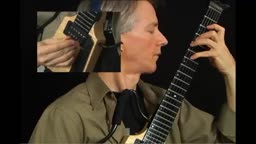
I Wish Breakdown 1 - Here are some details worth noting in the melody as written: a number of chords used here employ open strings, in some cases in combination with close intervals of a fretted note (major or minor 2nd). The right hand is critical here; I use a combination of pick and three fingers to achieve a balance between the notes in my chords, at the same time making sure that the melody is the prominent voice in the chord. I will also use the flesh of my middle finger to play some individual notes. That technique evolved accidentally over time and I found myself enjoying the warmth of the sound. The trick with using pick and fingers together is in learning to achieve the proper balance. As an exercise, try playing familiar 4 note chords and use the pick and remaining three fingers to get everything working. The transposed melody is played on a guitar tuned down a major 3rd, from C to C with the relative pitches retained. This is an embellished version of the melody. Note the rubato sections, accelerandos and deccelarandos, use of vibrato and slight string bends.
Breakdown 2
I Wish Breakdown 2 To analyze my chords and chord melodies, and ultimately create your own interesting chord vocabulary, it's critical to understand the formula for each of the chord qualities (major, dominant, minor, half diminished and diminished). The basic sound and foundation of the harmony is always the 1st, 3rd, 5th and 7th notes of the scale (the arpeggio); the extensions are built upon that basic sound. As we locate and visualize the basic chord shapes and progressively more complex harmonies, we become more skilled in the execution of the mechanics, and more importantly, we begin to internalize the sounds. Ultimately we will see the memorized shapes of familiar chords on the neck, and have the ability to visualize the additional notes that we can add to any chord. This knowledge is essential.
Breakdown 3
I Wish Breakdown 3 - Expanding on my earlier remarks regarding the use of open strings in my melodies, the sustain and chime-like sound of an open string (sometimes combined with fretted notes) works best on slower tunes with some space in the chord progression. Over time you will find your right hand adjusting to create the appropriate balance in the different notes of a chord; with practice you will be able to make the notes played with a pick and those plucked with your fingers sound even and balanced.
Embellished Melody
Embellished Melody For the embellished melody of "I Wish", I'm employing a number of musical devices that will appear in other chord melodies throughout this course. Especially when playing my own compositions as solo pieces, my approach to the melodies tends to gradually change into interpretations that are pretty open rhythmically. I'm playing in time for at least a portion of most of these melodies, but I'm also moving in and out of rubato and playing with a pulse without a fixed meter. It can also be enlightening to play original compositions with a variety of other musicians. A piece can become quite different based on the input and interpretaion of your peers. Looking at my embellished melody, be aware of the following: the use of rubato (as I mentioned earlier), conscious effort to vary the length of the phrases to let the melody "breathe", the use of dynamics (subtle when playing alone but still important), ornamentations such as pull-offs, glissandos, legato and staccato phrasing. All of these devices create variety for the audience and draw them into our performance.
Embellished Melody Breakdown
Embellished Melody Breakdown - Some techniques that I have acquired will help you in your execution of this (or any other) chord melody. I will often isolate the top note of a chord and let that note sustain and create a smooth transition from one fingering to the next. I will also use a note in the bass in the same way, or utilize it as a pedal point when applicable. This melody contains many voicings with open strings and care should be taken with the right hand to achieve a balanced sound. In my case, I employ a combination of pick and three fingers; classical right hand technique with nails can also be used in a jazz context to execute chord melodies. When learning any new chord or chord melody arrangement, make the connection between the name of the chord and the location of the intervals. For example, in "I Wish", the first chord is a Bm#5. The open G string played in the chord is the #5 interval. A broader application here could be the use of the open G in other combinations with various B minor chords.
Extended Performance
Extended Perf. In my performance, I'm employing many of the same devices and techniques that I use during the statement of the melody. Note the use of open strings in my improvisation, both in the chords and single lines. I'm moving between time and rubato playing, and occasionally playing in a pulse-without-meter format that I mentioned earlier. This creates a different kind of open time feel that I enjoy using, and I employ it pretty often when I'm playing solo. I've also tried this approach with some duos and trios; it's a bit unnerving initially attempting to play over a set of changes in a group when no fixed meter is present. Over time (excuse the pun), you get accustomed to moving at a slightly different pace through the harmony than your bandmates. This approach fine-tunes your listening skills and ability to communicate your melodic intentions to others in the group.

+ 33 more lessons

Start Course

Reviews

10 results

Osokin

Verified buyer

12/05/23

Master Modern Chord Melody!

John Stowell presents some challenging material in this series of lessons - but as with all his TrueFire courses, there is a wealth of great ideas and inspiring musical examples.


zewdaroo

Verified buyer

08/08/20

An excellent insight into John's approach to improvisation on solo guitar. Very clearly presented, and beautiful tunes.

Arturoperez

Verified buyer

06/26/20

Un nivel superior

TimHolman

Verified buyer

04/04/20

Loads of Information

This is one of the more advanced courses available so you have to be ready for this but there is years of knowledge here. It will increase your chord vocabulary and understanding of many scales and how to use them. It will, in fact, increase every facet of your musicianship. A steal of a deal and a new friend for a long time to come.

LinguaFranka

Verified buyer

11/14/19

Beautiful Music

Aside from the mountain of knowledge contained in this course there is some really great sounding music. Some of the tunes are so complex but beautiful. Well worth checking out.

Stop searching. Start improving with All Access.

Try 14 days free. Cancel any time.