18-year old Miles Davis told jazz pianist, composer and theorist George Russell that his musical aspiration was to "learn all the changes" and go beyond the traditional harmony of jazz at the time. That remark led Russell to ultimately develop The Lydian Chromatic Concept of Tonal Organization, a liberating theory of harmony based on jazz rather than European music. Subsequently, 33-year old Davis shattered the harmonic structure of bebop putting that theory to work in "modal jazz" recordings like Kind of Blue, one of the top-selling jazz records of all time.
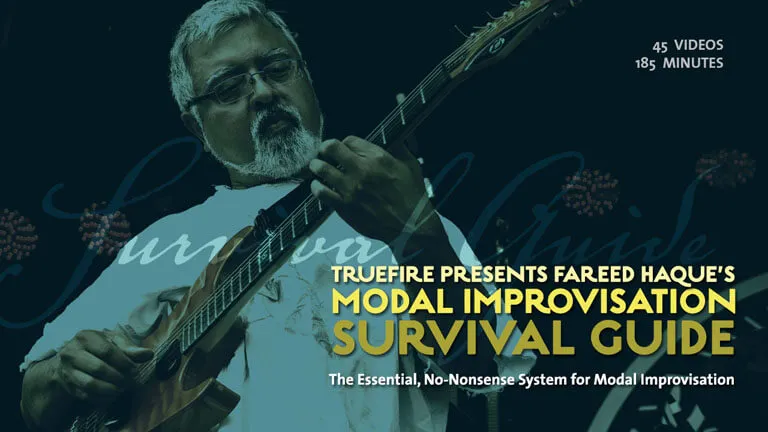
Modal jazz focuses on modes rather than chord progressions as a harmonic framework. Any scale has as many modes as it has notes, thus a major scale has seven modes -- play the scale starting on any of its seven notes and you play that note's mode. Modal jazz provides a wide open landscape to improvise over, which as Art Farmer said, "opens the door to countless means of melodic expression." Ready to step through that door? Fareed Haque's Modal Improv Survival Guide is the key -- turn it and get busy!
Let's get two things straight right off the bat; don't use modes to play bebop (see the Bebop Improv Survival Guide if that's your calling); and secondly, you won't find any Greek references in Fareed's teachings. "When's the last time you saw or heard a toga-wearing ancient Greek jazz musician?"
Throughout the Modal Improv Survival Guide, Fareed demonstrates how to use the notes in each mode to build chords and melodies to create moods. "Early jazz and bebop players used a chromatic, arpeggio-based approach to build melodies, while the more modern players used modes to limit their note choices and set a mood for their improvisations."
Good news; you will grasp the concept of modal playing very quickly, especially under Fareed's tutelage. There's no complicated chord changes to solo over; often times you're improvising over simple one and two-chord vamps. Plus, if you already know the major scale, you already know all the modes. The challenge with modes is making your improvisations dynamic and interesting. Fareed's got you covered there as well.
In the first section, Fareed introduces you to the modes of the major scale and then shows you how to easily build chords and scales from those modes. You then get a little ear training experience as Fareed performs several examples to help you tune into the modal sound.
Next up, Fareed generously passes on his widely respected Fretboard Mastery System, an intuitive approach for developing your ability to move from key to key, mode to mode, effortlessly and seamlessly (this is BIG!).
In the next series of lessons, Fareed takes you through a truckload of one and two-octave modal workouts and playalongs, across a variety of keys. This is where and how you'll start developing your modal improvisation chops, developing your own fingerings, sound and fretboard awareness along the way. The perpetual motion workouts in this section further hone your skills.
In the last section, you bring it all together and improvise over a full modal arrangement, working out the modes and lines for each section of the arrangement, and then playing along with Fareed trading measures. This last series of lessons completes your modal training and qualifies you to take on any modal setting.
True to Fareed's inimitable educational approach, you will not be spending a lot of time studying theory or working through tedious exercises -- you'll play your way through the Modal Improv Survival Guide and have a blast doing it. Stay cool.
P.S. Can't get Cherokee out of your head? Check out Fareed Haque's Bebop Jazz Survival Guide!
What you'll learn
Master modes across the entire fretboard using Fareed's Fretboard Mastery System
Navigate horizontally across the fretboard using one-octave patterns
Execute seamless key changes between modal centers
Connect modal theory to real-world jazz improvisation
Build chords from different modes of the major scale
Welcome to the Modal Jazz Survival Guide! In the course of my career, the number one GTR GEEK question has been "Hey man, What modes do you use?" In this course, we are going to dive into what modes "are" as well as "are not". We will also study when they should and should not be utilized. Along the way we, are also going to use our study of modes as a way to learn the fingerboard and master major scales, improvise through keys and develop effortless key changing skills. Hopefully you will leave this course understanding how and when to use Modal concepts, have a mastery of the fingerboard, develop some cool riffs and grooves and have some fun trading licks with me. First, lets talk abit about the histry of modal playing.
What are modes? Any note in a scale can be treated as a root note. Each note thus becomes the root note of its own 'Mode' of the parent scale. Each scale has as many modes as it has notes. A 5 note scale has 5 modes, a 7 note scale has 7 modes. A C Scale from D to D is teh 2nd mode of C major, a c major scale from E to E is the third mode of C major. D is the root note of the 2nd mode, and E is the root note of the 3rd mode of C major. We use the notes in each mode to build chords and melodies that reflect the sound of each mode.
When you think of mode also think of MOOD. Each mode has a certain sound or feeling, and we like to use each Mode to create a certain Mood....this is a big part of what happened to jazz in the 60s. Modes were originally used as a way of describing the types of scales used in different folk musics from around the world. Flamenco music from Spain often uses the 3rd mode of major, while Carnatic music from India often uses the 5th mode of major. Chinese music often uses different modes of the pentatonic scale. Composers such as Debussy, Ravel, Bartok, Stravinsky and others used a modal approach to write music that sounded more folky, earthy and not so classical. Similarly jazz musicians in the late 50s and 60s became more and more interested in folk music - blues, African and Indian music. As they wanted to get away from a jazzy style based on songs from popular - and often corny - musicals, they searched for roots music, and found modes. Whereas early jazz and bebop players used a chromatic, arpeggio based approach to build melodies, modern modal players used modes and often LIMITED their note choice to create moods; they might use only 5 or 7 notes in a scale - ans stick to just those notes - rather than embellishing with all 12 notes of the chromatic scale, as did more traditional jazz players.
Important note: Since modes evolved in jazz from a desire to get away from the Be Bop sound, DONT USE MODES TO PLAY BEBOP! It does not work. Using modes to play Bebop is like using a screwdriver to hammer in a nail. You can sort of do it, and the nail and screwdriver both get messed up in the process. If you wanna play Bebop go to the Bebop Survival Guide RIGHT NOW. Hurry! One last thng: You may notice that in this entire course there is not one Greek mode name, no toga wearing jazz musicians, no Phrygian, Myxolydian, Lydian #6, Macrobiotic b2. Why?? 'Cuz as far as I know NO ANCIENT GREEKS EVER PLAYED JAZZ! Listen, we got enough to work on without having to memorize silly ancient Greek terms that have nothing whatsoever to do with jazz. The 1st mode of major is best called...hmmmm " The 1st mode of major". You down with that?? Works for me, and i hope we can purge jazz theory of all this extra clumsy and cumbersome terminology RIGHT NOW and forever more. Sorry Berklee, Greek mode names are great for ancient Greek music, suck for Jazz.
Practice jamming on each mode of the major scale so you can get an idea of how each mode sounds and feel, and to get an idea of the MOOD each mode creates. Find some way to get a bass drone happening on each root note, so you can just run up and down the scale and hear how each note changes from mode to mode. Each note changes its relationship to the new root note and that changes its sound. So for ex a D in 1st mode is the 9th...sweet! but a D in 3rd mode is the 7th - tough! and a D in 6th mode is an 11th - cool! so the same note changes function and mood as you change the modal root.
One of the nice things about the modal approach is the way it can help us build unique chords and chord voicings. Typically jazz chords are built by stacking thirds, and we can do this to build very typical sounding jazz chords. However, unlike an arpeggio based Bebop approach we can also easily stack notes in a mode using any other interval we like...so we can create chords by stacking 4ths or stacking 5ths. Also we can simply find an interval formula that we like - say a 4th and a 2nd ( C, F and G ) and move that thru a mode: C,F,G becomes D,G,A becomes E,A,B.
Keep in mind that we will stack intervals DIATONICALLY, that is we will always stay in the scale to build our chords. So a 4th in the key of C can be C to F, D to G, E to A, AND F to B. Even tho this is an augmented 4th it still is part of the C scale so its one of the diatonic 4ths in C.
In this section we will build a fun, funky track using the chords to the Herbie Hancock classic Maiden Voyage. Once we've built the track I'll play over the Maiden Voyage Changes in a BeBop style and then in a few different modal styles so you can check out how the different approaches sound.
Here is a simple chart to Herbie Hancock's Maiden Voyage.
So after finding a nice guitar groove and some cool voicings, we lock it into a nice drum loop and voila! Jam Track! Notice how the two guitar parts both have interlocking melodies, and basslines. And all the parts lock nicely with the drums. Always try to find parts that 'hook up' with each other.
Coming back to the guitar after a decade of being away. . . . i knew the basics and had a good grasp of the theory, but this course took me to another level! I watch through these lessons pretty much every week. Amazing stuff!
S
Steve
07/29/20
Modal Revelation
I have a degree in Music and with all the teachers and classes I have taken, this course is The best explanation AND example of what modes are I have ever heard. Great Job!
5
5peter5000
Verified buyer
07/16/20
Modal Improv Survival Guide
Fareed's courses never disappoint. This is my 3rd course from him, and it's no exception
J
Jeffochka
Verified buyer
10/31/18
In The Mood For Modal Improv
I concur with the other reviews already posted here. I love the teacher’s easygoing style. You get a lot of content and absolutely no fluff; the teacher stays on subject and keeps the lessons bite-size so you are able to learn as much as possible in a short amount of time while adding layers of knowledge with each new lesson. Great teacher and great material! This teacher is superb and the course totally blew me away. The teacher makes theory so accessible while keeping it practical and fun. Great job! Fareed is simply brilliant! He puts the comp in competent! His approach to modal improv is worth learning and implementing.
M
mattstutts2
10/03/18
Really good
If you play modal tunes or want to up your game in those warm-up vamps and aren't sure how to approach pieces with very few or elongated chords, you should give this a shot. There's a lot of very specific examples here using well known modal tunes and Fareed does a good job breaking down various options that run through his mind as he approaches the changes (or lack thereof). Enjoyable.