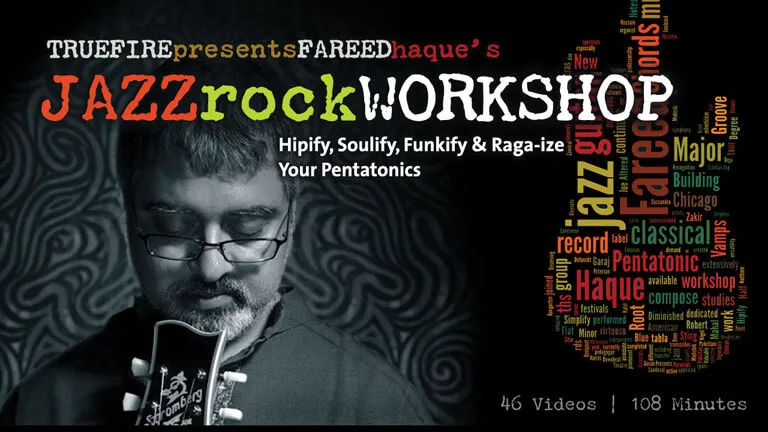
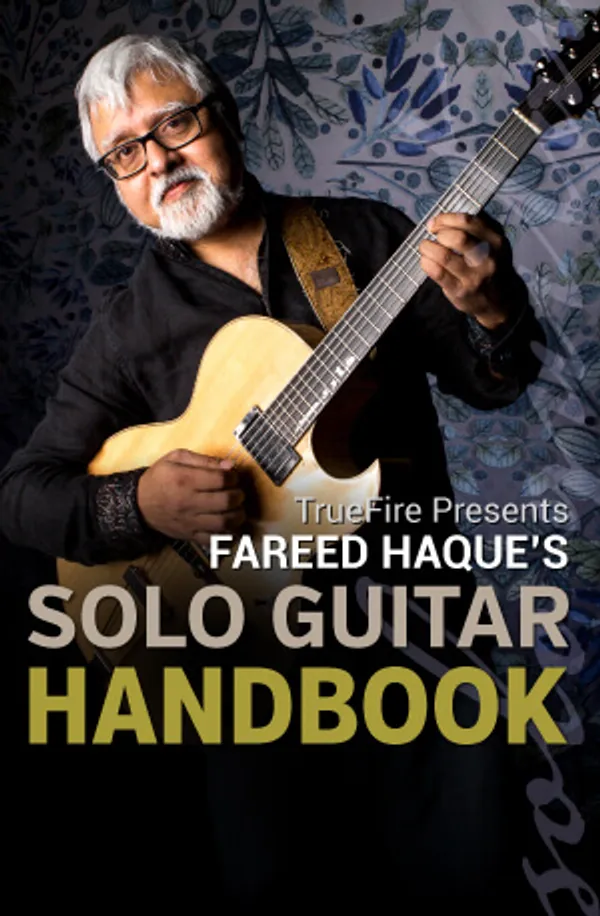
Jazz Rock Workshop

Hipify, soulify, funkify and raga-ize your pentatonics

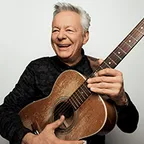
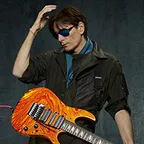
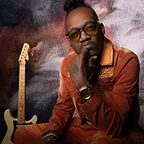
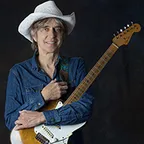
Marty FriedmanTommy EmmanuelSteve VaiEric GalesEric Johnson

Get this course and 1,000+ more with All Access

Try 14 days free. Cancel any time.

Purchase Individual Course for $9.99
Jazz Rock Workshop

About this course

Flavor your rhythm section with heaping portions of Funk, Rock, R&B, a pinch of Hip-Hop, and a touch of Worldbeat until feet, head and torso start moving involuntarily. Season to taste with modern harmony and pungent improvisation. Bake to the beat.

You've just cooked up Jazz Rock aka Acid Jazz aka Jazz Funk aka Jam Funk aka Groove Jazz aka Jazz Fusion. Call it what you like but for the purpose of this educational experience with Fareed Haque, we're going with Jazz Rock Workshop aka How To Hipify, Soulify, Funkify and Raga-ize Your Pentatonics.

For those of you ready to cook up your own Jazz Rock brew, we've got good news and bad news. First the good news; a lot of Jazz Rock is played in one key, over a one-chord vamp, improvising mostly with a simple Pentatonic scale.

Now the bad news; a lot of Jazz Rock is played in one key, over a one-chord vamp, improvising mostly with a simple Pentatonic scale. Creating fresh and interesting improvisations, measure after measure, night after night, within such a basic structure is a daunting and extremely challenging task.

So how do the likes of John McLaughlin, Mike Stern, John Scofield, Larry Coryell, Scott Henderson, Charlie Hunter, Pat Methany and our resident Guru of World Guitar, Fareed Haque twist and turn that simple landscape into so many new and uncharted sonic territories?

More good news; Fareed Haque's Jazz Rock Workshop will teach you how to transform that tired old pentatonic scale of yours into a veritable kaleidoscope of colors, textures and moods that you can apply with unlimited improvisational possibilities.

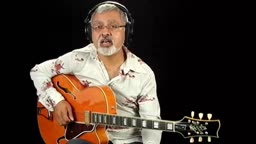
Guitar virtuoso and master educator Fareed Haque has worked with Sting, Dizzy Gillespie, Dave Holland, Joe Henderson, Joe Zawinul, Ramsey Lewis, Nigel Kennedy, Bob James, David Sanborn, many symphony orchestras and dozens of other well-known artists. He's performed all of the major guitar concertos and has had numerous modern works dedicated to him. Fareed currently holds an associate professorship in jazz and classical guitar studies at Northern Illinois University, tours extensively with his jam super-group, Garaj Mahal and has released nine recordings as a leader in various configurations.

Fareed's approach is zen-like in it simplicity. Haque first shows you how to add just a single note to your pentatonic to bring out a whole new character to your lines when played over a prevailing vamp. Add just a minor 3rd to the pentatonic, or just a major 3rd , or a major 7th, a flat 9th or the 9th or the 13th - adding just one of these tones to your 5-note pentatonic scale will dramatically impact the harmony and vibe of your improvisation. Fareed then demonstrates how to combine them, adding two or three or more in your lines for exponential firepower.

Once you've got a grip on the add-a-note-to-your-pentatonic recipe, Haque continues with a series of lessons showing you how to play your reincarnated pentatonic scales off of different degrees of the prevailing key; root, 5th and 9th in particular. Maximum spice.

Fareed also shows you how to build up grooves to improvise over and explore distinct tonalities and interesting rhythms. He'll even throw a little Hindustani and Puriya Dhanashree your way just to keep you on your toes.

Now here's the icing on this cake; no heavy theory, no fancy moves, no rocket science required to achieve your Jazz Rock prowess. You'll play your way through the course, you'll have fun, you'll be inspired, and your ears won't believe that the lines you're playing are coming from simple pentatonic scales let alone your own fingertips.

Your Jazz Rock Workshop Agenda:
1. Introduction
2. Overview & Approach
3. Building the Vamp
4. Minor Pentatonic
5. Adding the Blue Note
6. Adding the Major 3rd
7. Adding the Major 7th
8. Adding the Flat 9
9. Adding the 9th and 13th
10. The Kitchen Sink
11. Raga-ize Your Pentatonics
12. Hindustani Vamp
13. Puriya Dhanashree
14. Building a New Groove
15. Root, 5th & 9th Pentatonics
16. The Root Pentatonic
17. 5th Degree Pentatonic
18. 9th Degree Pentatonic
19. Other Chord Types
20. Major Family Chords
21. Half Diminished Chords
22. Dominant Chords
23. Altered Dominant Chords
24. Altered Chords
25. How to Simplify Complex Progressions
26. Conclusion
Indeed, Fareed Haque's Jazz Rock Workshop will hipify, soulify, funkify and raga-ize your pentatonics. Dig in!

What you'll learn

  • Create complementary guitar parts that don't clash
  • Understand how to move pentatonic patterns across the fretboard
  • Understand how to listen to drums and find rhythmic spaces
  • Build a three-layer rhythm guitar arrangement
  • Develop parts with attitude and rhythmic precision
Release date: 03/13/2011 • 1h 52m runtime
Start Course
Sample lessons
Overview & Approach
Overview & Approach
Hipify your pentatonics!
Adding the Major 3rd
Overview
Adding the Major 3rd
Playing Example
The Kitchen Sink
The Kitchen Sink
Overview

What's included

42 lessons • 29 charts • 20 Jam Tracks

Jazz Rock Workshop
Playing night after night on the one-chord vamp can get boring. But if we accept the challenge to creating new and interesting twists and turns on the one-chord vamp, I think you'll find that it is a worthwhile task that can lead to many new and uncharted territories.

Remember that for centuries, music was linear, melodic and modal in nature. Music from anywhere in the world was based on ONE key and ONE scale. One-chord vamp music is the oldest and most powerful music of all time. In fact, each culture, nation or even tribe had a different scale and key. So don't feel that jamming on one chord is 'simple' or 'basic' or even less 'serious' than jazz or classical music. Believe it or not, all that music is relatively new and unproven…jazz has been around for 120 years at best and classical music for only about 400 years. Whereas Indian music, for example, is one of the most advanced modal types of music and has been around at least for 5,000 years (amazing, but true)!
Overview & Approach
One thing that I cannot emphasize enough is the power of rhythm. A simple scale played with rhythmic inventiveness and style can be interesting and charming. The great blues players often use the same material night after night, raising the roof (while others can't), I like to say that music is very much like language. All of us can speak, fluently, functionally. Yet only a few of us are poets. It's very similar with music. It's not just talent, but artistry that makes the music meaningful.

Rhythm is not just the metronome. Actors or comedians tell you that timing is the difference between getting that laugh or that gasp from the audience, and getting yawns.

Subtle timing is everything! So remember there is brute rhythm, the ticks on a metronome, and there is subtle rhythm, the flow of the breath. Both are important, but subtle rhythm is the one that is going to connect you to your audience. So take a deep breath, exhale, and at the right moment, wham! Strum that chord…it has power. Believe in it. One of the reasons that the pentatonic scale is so powerful is that it has its roots in the blues, and ultimately in the music of Africa, and much of the music of Asia.

All of the concepts we will introduce here are meant to build on a foundation of the blues. Blues, as a genre, is so important. It's always a good idea to study more blues (whether it's new tunes, licks, riffs etc) and then take those blues ideas and apply the concepts to all styles of music. Blues is like the heart of western pop music – so let's bring it on!

I remember playing at the High Sierra Music Festival and getting invited to sit in with The Radiators (www.theradiators.org) - the legendary New Orleans rock and blues band. I had just got off stage with my own group (the Flat Earth Ensemble), wearing an all white Indian Kurta, which is a formal long Indian concert dress.

When the Radiators got a look at me, they appeared to be a bit flustered, probably wondering "Who is this weirdo, and what's he gonna do on our stage?" I mentioned briefly that I was from Chicago (home of the blues right?) and that seemed to reassure them. But just a bit.

However, after we hit the stage, my one number turned out to be eleven songs. We played until 4 am. It's like the old saying, "You can take the Pakistani kid out of Chicago, but you can't take the Chicago out of the Pakistani kid." The blues is a deep and wonderful art, and understanding it, or beginning to, was and is, a profound lesson for me. I like to think that the basic difference between blues (and many other African and afro inspired musical forms) and western music is merely one of intention. Most western music is obsessed with the need to tell a story, hence the operas, long concertos and symphonies of the great classical composers. Most of the Tin Pan Alley standard songs that jazz is built on, tell a story too. They are often from musicals so they were an essential part of telling the story. I call this "prosaic" music like the prose of our western literature.

I would argue that on a deeper level, what we love about the blues is that it does not have to tell a story. It is not "prosaic" rather "poetic." In fact, one of the most striking and surprising things about the blues is that nothing really happens! We start out at home (I), head to sub-dominant (IV), go back home (I) then head off to V, only to head back to I, where we start the thing all over again. It's hypnotic almost.

In fact, the blues progression is basically the same for almost every blues song. Imagine a blues band plays its set of ten blues songs at a blues festival, 5 bands a day for, say 4 days. That's like 200 blues tunes in one blues festival, the same song like 200 times. And yet, 200 songs later, the audience is still screaming for more. So why doesn't it get boring? The reason for this is repetition. The blues feels good and the repetition gets you into a groove. I feel that this difference represents the difference in concepts of time between western music and African music (and much of the tribal world). Westerners (or western music) typically want[s] to go somewhere or do something. As a result, we are always in a hurry because we have to "get there"! But the blues just feels good. It sits there. It doesn't have to go anywhere or tell a long story because…it's already there…and it feels fine.

In the blues one of the best things you can do is simply play something that feels good. Then play it again, again and again (maybe in a slightly different way). Like poetry that uses repetition (saying a few things again and again, but with beauty and grace or charm) so it is with the blues.

This is especially true for "bluesy jazz." To groove and play something that feels good, and then repeat it, modifying it with some variations, will eventually get your audience "into the groove." It was the great alto sax player Arnie Lawrence [1938-2005] that first clued me in to the blues. I was young (maybe 16 or 17) and Arnie and I were playing together in Chile, with some great musicians from down there. He'd sing or play the blues, and then I'd play. Now I wasn't proud of my playing back then…it was seriously corny. I did not understand repetition and variation.

Arnie used to kid me, on and off stage, he'd say (in a huge pre-war radio announcer voice), "Ladies and Gentlemen, now our young guitarist is going to play for you, one of his favorite songs, called 'The Blues'". Humiliating, but I eventually started to get it (and many thanks to Arnie for so much music, fun, and a seemingly endless supply of great jokes.) Here's a video of Arnie online: http://www.youtube.com/watch?v=TQLkcZgEKJk&feature=related Even the great Joe Zawinul (check out http://www.youtube.com/watch?v=Th3fi-4k8uY) had his take on this. His instructions to me at our first rehearsal was, "play this part, and don't ever change it. But be sure to never ever play it the same way twice."

That took a week (or a lifetime) to make sense of. But Joe was making sense. He wanted me to play the part and never change it, but always keep making variations on it. Like in nature where no two leaves or snowflakes are ever the same, so too do all of the variations create poetry.

Building the Vamp
Funk is certainly not new. It's as old as music itself. African music is funky. So is Indian folk music, Javanese gamelan music, Duke Ellington, Monk, Grant Funkin' Green and more!

Funk (for me) is primarily about a groove and secondarily a hypnotic trance dance state. You find it in gospel, in Quwali (Sufi spiritual music), in flamenco from Spain, and Arabic dance music, Native American and South American music (some call it "charismatic" music). It is not part of one culture, rather all human cultures. We all historically share the experience of music that lifts us out of ourselves and into a tranced out, blissed out state. Another thing that almost all folky funk music has in common is counterpoint. Simple things layered and coordinated one on top of the other give rise to a complexity common to artists like James Brown, Batacumbele, and Bach.

Understanding counterpoint, is to know what guitar part, keyboard part or bass part will make the music jump and jive and which rhythms will add to the music and which will detract. So take this "building-a-groove" thing seriously. Solos in and of themselves are not what make millions of dollars in music, but the groove and the counterpoint that underlies those grooves IS and DOES.

On a technical note, the guitar is a Stromberg Montreaux and it is strung with 0013 D'Addario chrome flat wound strings.
Minor Pentatonic Scale
It's critical to know all of the positions. There are bends and licks that will not work in some positions, and only work in others. So yes, you gotta know them all. You will find that by just by switching positions new ideas and possibilities will appear.
Minor Pentatonic
In this playing example, I use the basic minor pentatonic over a one chord vamp. Note the use of strong rhythm gives even this basic sound some life and vibe and groove.
Adding the Blue Note
If you get a chance check out some of the early African music recordings from the Smithsonian folkways field recordings, there are some cool recordings of African 'Banjo' from 1890s or so.

It is amazing stuff that the legendary Paul Berliner turned us onto in Ethnomusicology 101. The "Blue" note has definitely been around for a long time before it came to America.

Check out The African Roots of the Blues 1, 2, 3
Adding the Blue Note
For those of you paying attention, the last lick I play here, is a modified Indian Tihai. A Tihai is a lick played 3 times that ends on 1.

Officially it should always have the same space or gap between licks (in this case 1 eighth note). As in many modern Tihais, I actually end on the 'a' of 4. But Zakir said it was OK, so it's OK.

+ 35 more lessons

Start Course

Reviews

11 results

George H.

06/18/26

There are no wrong notes

And Fareed explains why, in this brilliantly reavealing course. He has torn up the non - discloser agreement that most guitar tutors seem to have signed. Fareed lifts the vail and shows us where to play those elusive notes on our guitar neck that we love to hear in Jazz Fusion. Do you want make sounds similar to Mahavishnu Orchestra, Return to Forever. Weather Report and Mike Stern. Fareed Haque shows you how in his clear no nonsense, step by step manner by taking the pentatonic scale and adding one note at a time. It's fun!

arpeggio5

Verified buyer

01/14/25

explained very clear with guide tones

BrianVon

Verified buyer

01/02/25

Pretty cool. . .

SwissDok

Verified buyer

07/23/23

If you like the soul jazz course go on herr

Logical continuation of the soul jazz course. Extremly good teacher and great jazz guitarist!

Sindibad

12/22/20

Fareed Haque's Jazz Rock Workshop

This lesson helps you think outside the box and can help you find your own way.

Stop searching. Start improving with All Access.

Try 14 days free. Cancel any time.